
Deed of Assignment in Nigeria: The Complete Guide for Property Buyers and Sellers
If you've ever bought land or property in Nigeria, someone has probably mentioned the deed of assignment at some point during the process. Maybe a lawyer brought it up, or the seller told you it was the document you'd receive once payment was complete. Either way, there's a good chance the conversation moved on before anyone fully explained what it actually is, why it matters, and what happens if it's missing or poorly done.
This guide is here to fill that gap.
Whether you're buying land in Lagos, selling a property in Abuja, or simply trying to understand what you already own, understanding the deed of assignment is not optional — it's fundamental. It is the document that transfers ownership of property from one person to another, and in Nigeria's real estate environment, where land disputes are common and title documents are sometimes murky, getting it right is the difference between owning something and just thinking you do.
What Is a Deed of Assignment?
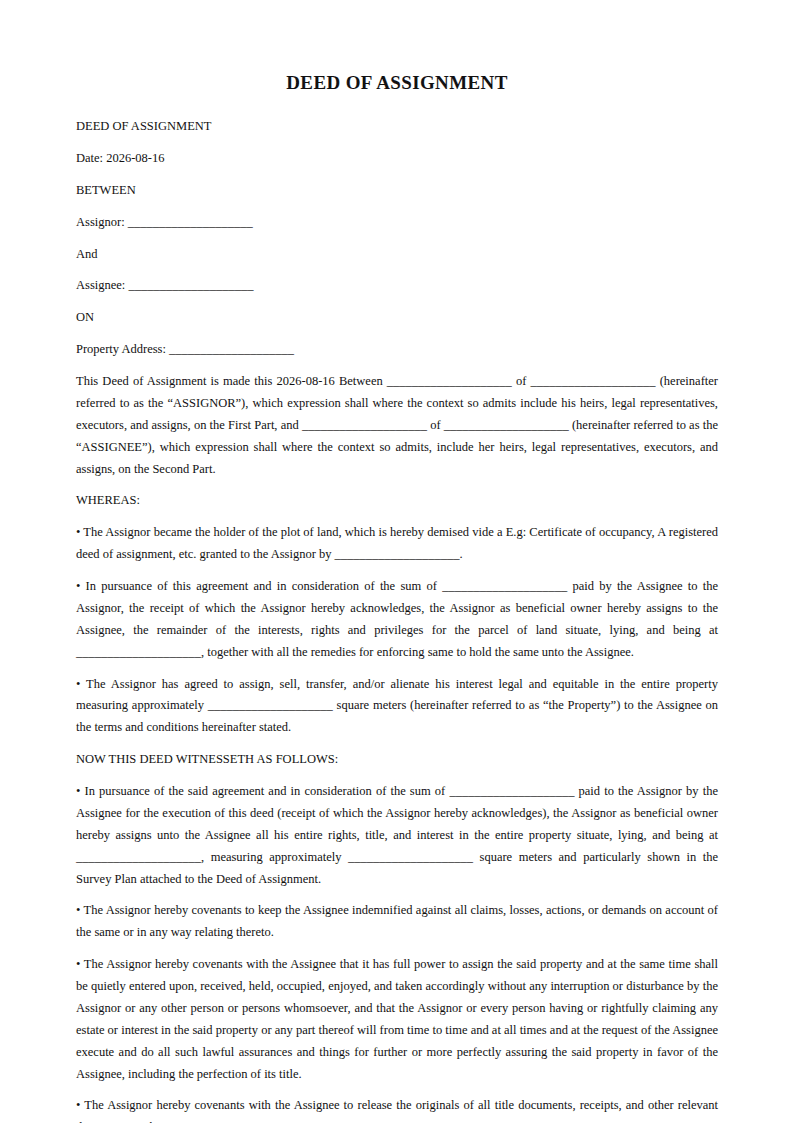
A deed of assignment is a legal document that transfers the rights, interests, and title to a property from one party (the assignor) to another party (the assignee). In plain terms, it is the document that says: "I, the seller, am handing over my ownership rights in this property to you, the buyer."
What makes a deed of assignment different from a regular sales agreement or receipt is that it does more than record a transaction — it actually conveys the legal interest. A receipt proves you paid money. A sales agreement records your intention to transfer. A deed of assignment, when properly executed, is the instrument of transfer itself.
In Nigeria, the deed of assignment is most commonly used in the context of land and real property transactions, though it also applies to other types of rights — intellectual property, lease interests, and contractual rights, for example. For the purposes of this article, however, we'll focus primarily on its use in property transactions, which is where most Nigerians encounter it.
Why the Deed of Assignment Is So Important in Nigeria
Nigeria's property ownership landscape is complicated by the Land Use Act of 1978, which vests all land in each state in the hands of the state governor. Under this framework, individuals don't technically own land outright — they hold a right of occupancy, either statutory (granted by the government) or customary (based on traditional ownership). When you "buy land" in Nigeria, what you're actually acquiring is the seller's right of occupancy or leasehold interest in that land.
This makes the deed of assignment the critical mechanism through which that right passes from one person to another. Without it, the buyer has no document evidencing the transfer, and no legal basis to claim ownership if the matter ever comes before a court or government authority.
The importance of this becomes sharper when you consider the frequency of property disputes in Nigeria. Sellers who sell the same land to multiple buyers, family members who contest the sale of inherited property, and government acquisitions that leave buyers without adequate documentation — these are not hypothetical problems. They happen regularly, and the people who survive them with their investment intact are typically the ones who had proper documentation, including a valid deed of assignment.
The Deed of Assignment Versus Other Property Documents
People sometimes confuse the deed of assignment with other property documents that circulate in Nigerian real estate transactions. It's worth spending a moment distinguishing between them.
A contract of sale (or agreement for sale) is what parties sign when they've agreed on a price but haven't yet completed the transaction. It records the terms of the deal — price, timeline, conditions — but it doesn't transfer ownership. Think of it as the handshake before the handover.
A deed of assignment comes after the contract of sale and completion of payment. It is the actual instrument of transfer. Once executed, the assignee (buyer) holds the seller's former interest in the property.
A Certificate of Occupancy (C of O) is a government-issued document that grants a statutory right of occupancy over land. It is not a deed of assignment — it is a title document issued by the state. When you see a deed of assignment in a chain of title documents, you're looking at evidence of who transferred the right of occupancy to whom, and when.
Governor's Consent is another document that comes up in Lagos and some other states. Under the Land Use Act, any transfer of a statutory right of occupancy requires the governor's consent to be valid. This means that after executing a deed of assignment, the parties are supposed to obtain governor's consent on that deed to perfect the title. Without governor's consent, the deed of assignment may be valid between the parties but is not fully legally effective against third parties or the government.
Understanding how these documents relate to each other is important because no single document alone tells the complete story of who owns a property in Nigeria. The title investigation process — which a good lawyer will carry out before any transaction — looks at all of them together.
What Must a Valid Deed of Assignment Contain?
There is no single statutory form that a deed of assignment must follow in Nigeria, but there are elements that courts and lawyers have consistently recognised as essential for a deed to be valid and enforceable.
The parties must be clearly identified. The full legal names of the assignor and assignee should appear at the top of the document, along with their addresses. Where a company is involved, the registered company name and its place of registration should be stated.
Recitals tell the story of how the assignor came to hold the interest being transferred. They typically trace the ownership history — who owned it before, how the assignor acquired it, and any encumbrances or conditions that exist. Well-drafted recitals are important because they demonstrate that the assignor actually has something to assign.
A clear description of the property is non-negotiable. This goes beyond a vague address. It should include the survey plan number, the size of the land, its location, boundaries (sometimes described by compass bearings and distances), and reference to any plan attached to the deed. If the property description is vague or inaccurate, disputes are almost inevitable.
The consideration — the amount of money paid — must be stated. Even in transactions where other forms of value are exchanged, courts expect the consideration to be reflected in the deed.
The operative words of transfer are the heart of the document. This is the clause that actually transfers the interest — "the assignor hereby assigns to the assignee all that piece and parcel of land..." These words, and the way they are framed, determine whether a valid transfer has occurred.
The covenants are promises made by the assignor about the property — that they have good title, that the land is free from encumbrances (or specifying what encumbrances exist), and that they will do nothing to disturb the assignee's quiet enjoyment. These aren't just legal boilerplate; they give the buyer grounds for action if the assignor misrepresented the state of the property.
Execution requires the deed to be signed, dated, and — in Nigeria — typically witnessed. The formality of execution varies depending on the type of parties involved. Where a company is the assignor or assignee, the company seal and signature of authorised officers may be required. Deeds by individuals require signature and witnessing at minimum.
An attached survey plan is standard practice in Nigerian property transactions. The plan, prepared by a registered surveyor, provides the visual and technical description of the land that the deed's written description references.
The Process: How a Deed of Assignment Is Prepared and Executed
The process starts well before anyone picks up a pen. Before a deed of assignment is prepared, the buyer (or their lawyer) should carry out due diligence — investigating the title to confirm that the seller actually owns what they're selling, that there are no competing claims, and that there are no government notices or acquisitions affecting the property.
Once the parties are satisfied and have agreed on terms, the contract of sale is signed and payment (or an initial deposit) is made. At this stage, a lawyer — typically the buyer's lawyer — will draft the deed of assignment.
The draft is then reviewed by both parties (or their lawyers) and any revisions are negotiated and agreed. This back-and-forth can take days or weeks depending on the complexity of the transaction and how well-organised both sides are.
Once the final version is agreed, the deed is executed. Both parties sign in the presence of witnesses, and the document is dated. In most Nigerian property transactions, the original deed is handed to the buyer, while the seller keeps a copy.
After execution, the deed should be stamped at the Stamp Duties Office. Stamp duty is a tax on the document, and an unstamped deed is not admissible in court as evidence without first being stamped — potentially with penalties. The duty payable depends on the purchase price and the state in which the property is located.
The final step, where applicable, is registration — recording the deed at the Land Registry. Registration gives the transaction public notice, meaning third parties are deemed to be aware of it. In Lagos and most other states, a deed of assignment affecting a statutory right of occupancy should also be presented for governor's consent, which effectively perfects the title.
The Role of Governor's Consent
Governor's consent is one of the most frequently misunderstood concepts in Nigerian property law, and it's directly connected to the deed of assignment.
Section 22 of the Land Use Act provides that a holder of a statutory right of occupancy cannot alienate (transfer) that right without the prior consent of the governor of the state. In practice, what this means is that a deed of assignment of a statutory right of occupancy — the kind of right that underlies most registered properties in Nigerian cities — requires governor's consent to be fully legally effective.
A deed of assignment without governor's consent is not void between the parties themselves, but it does not confer a fully protected legal interest on the buyer in relation to third parties. If the state government decides to make a claim, or if a third party asserts a competing interest, the buyer without governor's consent is in a weaker position.
Obtaining governor's consent is a separate process that happens after the deed has been executed and stamped. It involves submitting the deed and related documents to the relevant state ministry (usually the Ministry of Lands), paying the applicable fees, and waiting for the state's approval. In Lagos, this process is managed through the Lagos State Lands Bureau, and it can take months depending on the volume of applications and the completeness of the file.
Many property buyers in Nigeria skip this step — often because of the cost, the bureaucratic complexity, or simple lack of awareness. That's an understandable decision in the short term, but it creates a title deficiency that can become a serious problem later, particularly if the buyer wants to sell the property or use it as collateral for a loan.
Common Problems With Deeds of Assignment in Nigeria
The property market in Nigeria generates a remarkable number of deed-related problems, most of which stem from the same root causes: transactions done without proper legal guidance, sellers who don't have what they're selling, and documents that were poorly drafted or not drafted at all.
One of the most common issues is a missing root of title. A buyer receives a deed of assignment from the seller but has no idea how the seller came to own the property in the first place. If the seller's own acquisition was flawed, that flaw travels down the chain — including to the new buyer. This is why tracing the history of ownership matters so much before any transaction is completed.
Another frequent problem is property description errors. When the survey plan number referenced in the deed doesn't match the actual coordinates on ground, or when boundaries are described inaccurately, disputes with neighbours or government authorities can arise. Surveyors and lawyers need to cross-check these details carefully.
Forged deeds are a real concern in parts of the Nigerian property market. Fraudsters have been known to produce false deeds of assignment, fake survey plans, and even counterfeit government approvals. The way to protect against this is to conduct searches at the Land Registry before completing any transaction — if a property has a genuine registered title, it will show up there, and anything inconsistent with the registered record should be a serious warning sign.
Family land disputes also interact badly with deeds of assignment. In some communities, land is owned collectively by a family, and a sale by one family member may not bind the rest. A buyer who purchased in good faith from a single family member can find themselves facing claims from other members who say their consent was never obtained. Due diligence should always include inquiries into whether the land has a family or community ownership dimension.
Deed of Assignment for Leasehold Properties
Not all property in Nigeria involves a freehold or outright statutory right of occupancy. Some properties are held on leasehold terms — particularly commercial properties in developed urban areas — where the owner holds a long-term lease from the government or another party.
In these situations, a deed of assignment is used to transfer the leasehold interest from one party to another. The mechanics are similar to a freehold assignment, but there are additional considerations: the assignee steps into the shoes of the original tenant, which means they take on the obligations of the lease as well as its benefits. If the original leaseholder had rent obligations, maintenance requirements, or use restrictions under their lease, those same obligations now apply to the new assignee.
This is why it's important to review the original lease agreement carefully before executing a deed of assignment of a leasehold interest. What you're buying isn't just the property — you're buying the entire bundle of rights and responsibilities that came with it.
Who Pays for the Deed of Assignment?
In most Nigerian property transactions, the buyer bears the cost of preparing the deed of assignment. This follows a general convention in the market, though it's not a statutory requirement — the parties can agree otherwise.
The costs associated with a deed of assignment typically include the lawyer's professional fees for drafting and reviewing the document, stamp duty on the deed (a percentage of the purchase price), and Land Registry fees for registration. If governor's consent is being sought, that attracts separate fees payable to the state government.
The total cost varies depending on the state, the value of the property, and the professional fees involved. In Lagos, for example, stamp duty on property transactions is charged at 1.5% of the purchase price (or assessed value, whichever is higher), and governor's consent fees are calculated on a scale. Buyers should budget for these costs upfront rather than treating them as afterthoughts.
Can You Use a Template for a Deed of Assignment?
Yes — and for straightforward property transactions, a properly drafted template can provide an excellent foundation. The caveat is that the template must genuinely reflect Nigerian law and practice, not something adapted from a foreign jurisdiction or downloaded from a site that has no connection to Nigerian real estate.
A good deed of assignment template for Nigeria will already include the standard clauses — recitals, operative words, covenants, schedule for the property description — and will be structured in the form that Nigerian lawyers and courts recognise. What you're then doing is filling in the specific details of your transaction: the parties, the consideration, the property description, and the execution particulars.
For particularly complex transactions — high-value land, commercial properties, disputed titles, or situations where the chain of ownership is unclear — involving a qualified property lawyer adds significant value. A lawyer who conducts searches, investigates the title, and tailors the deed to your specific circumstances does more than draft a document. They identify problems before they become your problems.
LegalDoc's deed of assignment template has been drafted and reviewed by Nigerian lawyers, which means the foundational structure and legal language already meet the standard required. You answer a few questions about your transaction, and the document is generated and ready to download.
Frequently Asked Questions About Deed of Assignment in Nigeria
What is the difference between a deed of assignment and a contract of sale?
A contract of sale (also called an agreement for sale) records the agreement between buyer and seller — the price, the terms, the conditions. It doesn't transfer ownership. A deed of assignment is the document that actually transfers the seller's legal interest to the buyer. Both documents play a role in a property transaction, but they serve different purposes and are executed at different stages.
Is a deed of assignment the same as a Certificate of Occupancy?
No. A Certificate of Occupancy (C of O) is a government-issued title document that grants a right of occupancy over land. A deed of assignment is a private legal document that transfers one person's interest in land to another. In a typical transaction, the C of O belongs to the seller initially, and after the deed of assignment is executed and governor's consent obtained, the state may issue a new C of O in the buyer's name, or the original C of O is endorsed to reflect the transfer.
Do I need a lawyer to prepare a deed of assignment?
It is strongly advisable. While a well-designed template can take you a long way, a lawyer adds value by conducting title searches, investigating the history of the property, and identifying any legal issues before you complete the transaction. For high-value or complex transactions, the cost of professional legal advice is minimal compared to the risk of getting it wrong.
What happens if I buy property without a deed of assignment?
You may still be in possession of the property, but your legal title is questionable. Without a deed of assignment, you have no documentary proof that the seller transferred their interest to you. If the seller later sells to someone else, or if family members contest the sale, or if the government raises a query, you have very little to stand on. A payment receipt is not a substitute for a deed of assignment.
What is governor's consent and do I need it?
Governor's consent is approval from the state governor (exercised through the Ministry of Lands) for the transfer of a statutory right of occupancy. Under the Land Use Act, it is legally required for any such transfer. Without it, the deed of assignment is valid between the parties but not fully enforceable against third parties or the government. If your property is held under a statutory right of occupancy, you should obtain governor's consent after executing your deed of assignment.
How long does it take to get governor's consent in Lagos?
The timeline varies significantly depending on the completeness of your documentation and the current processing load at the Lagos State Lands Bureau. In practice, it can range from a few months to over a year. Having a lawyer who is familiar with the process and can follow up on your file tends to reduce delays.
Can a deed of assignment be cancelled or reversed?
Once a deed of assignment has been properly executed, stamped, and registered, reversing it is not straightforward. It would typically require a mutual agreement between the parties and the execution of a new deed transferring the property back, or a court order setting aside the original deed. Grounds for setting aside a deed include fraud, misrepresentation, duress, and lack of capacity.
What is stamp duty on a deed of assignment and who pays it?
Stamp duty is a tax on the deed of assignment document. It's typically calculated as a percentage of the purchase price, and the rate varies by state. In Lagos, the rate is generally 1.5% for property transactions above a certain threshold. Convention holds that the buyer pays stamp duty, though the parties are free to agree otherwise. An unstamped deed is inadmissible in court without first being stamped — potentially with a penalty.
Can a company be a party to a deed of assignment?
Yes. Companies regularly buy and sell property in Nigeria and are competent parties to a deed of assignment. Where a company is a party, the deed should identify the company by its full registered name and state of incorporation, and execution should follow the requirements of the Companies and Allied Matters Act (CAMA) — typically the signature of authorised directors and, for some companies, affixing the company seal.
What if the property has no survey plan?
A deed of assignment without an attached survey plan creates a significant risk. The property description in the deed becomes vague, and boundary disputes are far more likely. Before completing any property transaction, commission a survey from a registered surveyor and ensure the plan is referenced in and attached to the deed. If you're buying and the seller has no survey plan, insist on one being prepared before the transaction is concluded.
Can a deed of assignment be used for property other than land?
Yes. While it is most commonly associated with land and real property in Nigeria, a deed of assignment can transfer any assignable right — including intellectual property rights, lease interests, benefits under contracts, and insurance interests. The structure of the document differs depending on what is being assigned, but the legal principle — that a formal instrument is used to transfer the interest — remains the same.
What documents should I collect after executing a deed of assignment?
At a minimum, the buyer should retain the original executed deed of assignment (or a certified true copy if the original is lodged with a registry), the stamped copy of the deed showing payment of duty, the registered copy if the deed has been registered at the Land Registry, the governor's consent endorsement where applicable, the survey plan referenced in the deed, and copies of the seller's title documents showing how they acquired the property. Keeping these documents organised and secure is as important as having them in the first place.
What is a "perfection of title" and how does it relate to the deed of assignment?
Perfection of title refers to the process of completing all the steps required to make a property transfer fully legally effective. In Lagos, for example, perfection involves three steps: stamping the deed, registering it at the Land Registry, and obtaining governor's consent. Some people use the term loosely to refer to the entire post-execution process. Until all three steps are completed, the title is said to be "unperfected" — valid between the parties but not fully protected against third-party claims.
Getting Your Deed of Assignment Right
Buying property in Nigeria is one of the most significant financial decisions most people will ever make. The deed of assignment is the document at the heart of that transaction — the thing that records, in legal language, that the property is now yours.
It deserves to be done properly. That means using a document that reflects Nigerian law, that clearly identifies the parties and the property, that contains the right operative language, and that is then stamped, registered, and — where required — accompanied by governor's consent.
LegalDoc makes it straightforward to generate a professionally drafted deed of assignment that meets Nigerian legal standards. Answer a few questions about your transaction, preview the document, and download it — ready for execution. For significant transactions, you can always complement the template with professional legal advice to handle the title search and post-execution steps.
The goal is simple: to make sure that when you hand over your money and receive your keys, the document in your hand actually means what you think it means.