
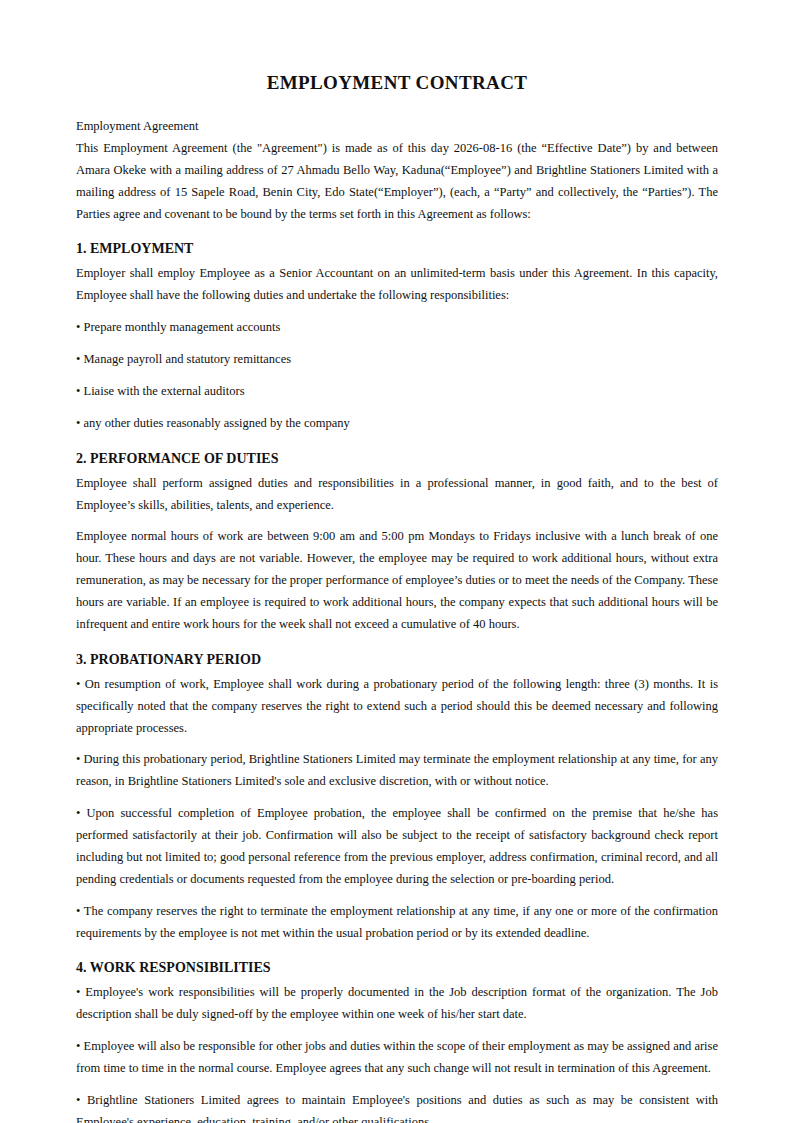
EMPLOYMENT CONTRACT
An employment contract, also known as an employment agreement, is a legally enforceable contract that outlines the terms of the work relationship, including benefits, length, and salary. For those looking to draft one, our Employee Contract Template can be helpful. It describes the obligations and rights of each party while the employee is on the job. These obligations and rights are a precursor to what is found in a standard employee handbook
An employee contract is a legally binding document that sets forth the terms of employment. It may be a written, verbal, or implied agreement, although written contracts are recommended for clarity and legal enforceability. These contracts typically cover:
- Job title and responsibilities
- Compensation and benefits
- Work hours
- Duration of employment
- Termination conditions
- Confidentiality and non-compete clauses
Benefits of Employee Contracts
Having a clear and detailed employee contract offers numerous advantages:
- Clarity: It eliminates ambiguity regarding job roles and responsibilities.
- Legal Protection: Provides a framework for resolving disputes.
- Employee Retention: Clearly defined terms can improve job satisfaction.
- Employer Security: Protects sensitive business information through confidentiality agreements.
Key Elements of an Employee Contract
- Job Title and Description: Clearly define the role and expectations.
- Compensation: Include salary, bonuses, and other benefits.
- Working Hours: Specify daily or weekly working hours and overtime policies.
- Leave Policies: Outline vacation, sick leave, and other time-off entitlements.
- Termination Clause: Define notice periods and conditions for termination.
- Confidentiality and Non-Compete: Protect sensitive business information.
- Dispute Resolution: Detail procedures for handling workplace disputes.
Common Frequently Asked Questions About Employee Contracts
1. Are employee contracts mandatory?
No, but having a written contract is highly recommended to avoid misunderstandings and provide legal protection.
2. Can an employee contract be changed?
Yes, but changes require mutual agreement. Amendments should be documented in writing.
3. What happens if either party breaches the contract?
Breach of contract can lead to legal consequences, including compensation claims. It is advisable to consult legal counsel in such cases.
4. Is a probationary period part of the contract?
Yes, many contracts include a probationary period to assess the employee's performance before confirming their position.
5. Can an employer terminate a contract without notice?
Termination without notice is possible in cases of gross misconduct or other serious violations, as defined in the contract.
6. Do employee contracts need to comply with local laws?
Yes, all employee contracts must adhere to the labor laws and regulations of the jurisdiction in which the employment occurs.
THE GRUNDNORM AS IT RELATES LABOUR MATTERS IN NIGERIA
In Nigeria, the grundnorm (the foundational legal norm from which all other laws derive validity) concerning labour matters is the Constitution of the Federal Republic of Nigeria, 1999 (as amended).
Here’s how it applies to labour matters:
1. The Constitution (Grundnorm)
-
The 1999 Constitution is the supreme law of Nigeria (Section 1(1)).
-
All labour laws, employment statutes, and regulations must conform to the Constitution.
-
Key provisions relevant to labour include:
-
Chapter II (Fundamental Objectives and Directive Principles of State Policy) – although generally non-justiciable, Section 17(3) sets out the duty of the state to ensure just and humane conditions of work.
-
Chapter IV (Fundamental Rights) – protects rights such as freedom of association (Section 40), which underpins the right of workers to join trade unions.
-
The Constitution also grants the National Assembly exclusive legislative competence over labour, trade unions, industrial relations, and conditions of service under Item 34, Part I, Second Schedule (Exclusive Legislative List).
-
2. Other Key Labour Laws (Deriving Validity from the Constitution)
All other labour-related statutes operate under the umbrella of the Constitution, for example:
-
Labour Act, Cap L1 LFN 2004 – governs contracts of employment, protection of wages, employment of women and young persons, etc.
-
Trade Unions Act, Cap T14 LFN 2004 – regulates formation and functioning of trade unions.
-
Trade Disputes Act, Cap T8 LFN 2004 – deals with settlement of industrial disputes.
-
Factories Act, Cap F1 LFN 2004 – ensures occupational health and safety.
-
National Industrial Court of Nigeria (NICN) Act, 2006 – establishes NICN as the specialized court for labour and industrial matters.
3. Judicial Recognition
The courts, especially the National Industrial Court of Nigeria (NICN), recognize the Constitution as the grundnorm. All labour rights and obligations are interpreted in line with constitutional provisions, especially the protection of fundamental rights and compliance with international labour standards ratified by Nigeria (e.g., ILO Conventions).