
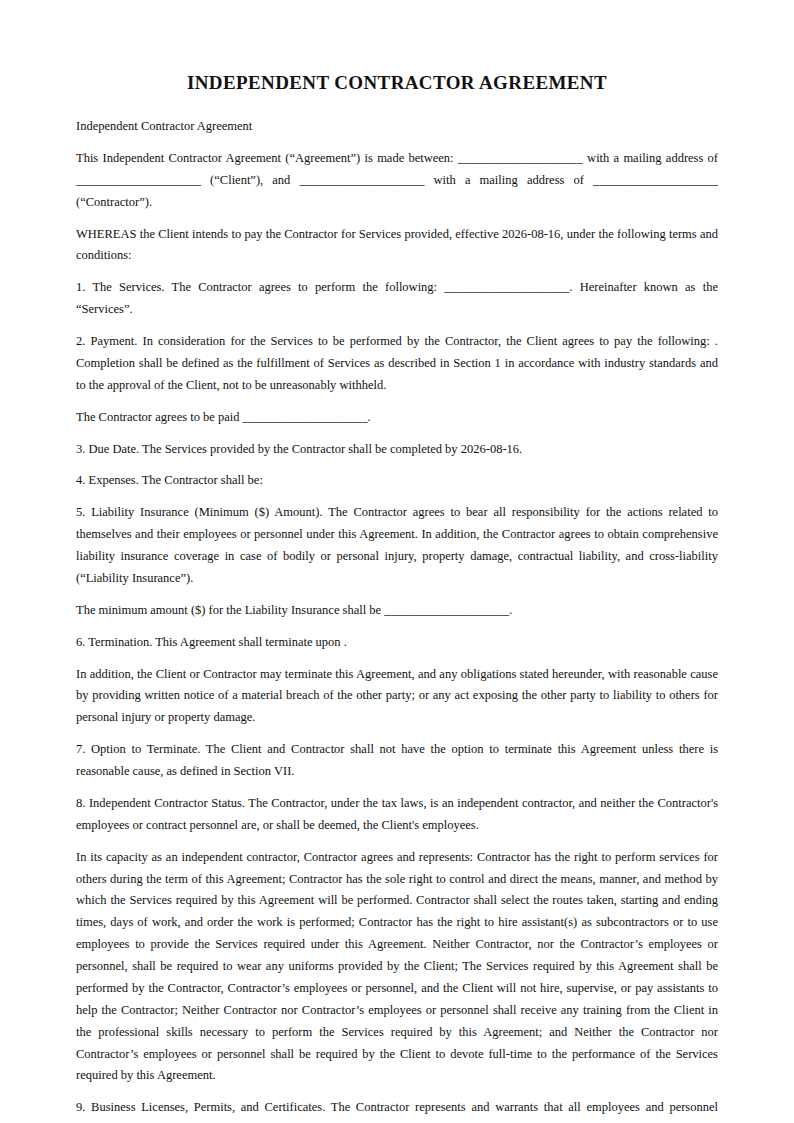
Independent Contractor Agreement in Nigeria
An independent contractor agreement engages somebody to deliver work without making them an employee. It sets out the scope, the fee, the deadline, who owns the output and who carries the tax.
The document does more than record the deal. It is the main evidence that the person is genuinely a contractor, and that question decides whether you owe them employment rights and whether you have been deducting the wrong tax for a year.
Contractor or Employee: Why the Label Does Not Decide
Calling somebody a consultant does not make them one. The National Industrial Court looks at what actually happens, and it has jurisdiction over employment disputes under section 254C of the Constitution.
The factors that count against you are familiar. You control how and when the work is done rather than just what is delivered. They work only for you. They use your equipment at your premises on your hours. They have a job title, appear on the organisational chart and take instructions from a line manager. There is no end date and no defined deliverable.
A genuine contractor is in business on their own account. They decide how to do the work, they can take other clients, they can send a substitute, they invoice, and they carry the risk of doing the job badly.
If the reality is employment, the consequences are real: notice, terminal benefits, pension and tax liabilities you did not budget for, and a claim at a court that tends to look past labels.
The Clauses That Do the Work
Scope and deliverables. Specific, with dates. "Marketing support as required" is the wording of an employment contract wearing a disguise. A schedule listing outputs and milestones is what a contractor agreement looks like.
Fee and payment terms. Fixed fee, day rate or milestone based. When invoices are due, how long you take to pay, and what happens if you are late.
Term and termination. An end date or a completion event, plus how either side can end it early and what is payable for work already done.
Status and tax. An express statement that the contractor is not an employee, is responsible for their own tax and pension, and will indemnify you if that turns out to be wrong.
Intellectual property. Dealt with below, and the clause most often missing.
Confidentiality. Surviving the engagement.
No exclusivity. That the contractor may work for others, unless you have a genuine reason to restrict it.
Substitution and subcontracting. Whether they may send somebody else. A right of substitution is strong evidence of contractor status.
Who Owns the Work
Here is the trap. Under the Copyright Act 2022, copyright in a commissioned work does not automatically belong to the person who paid for it. The author is the first owner unless there is a written assignment.
So a designer who made your logo owns it. A developer who wrote your platform owns the code. A photographer owns the photographs of your own products. Paying the invoice does not transfer copyright, and neither does a verbal understanding.
The agreement needs an express written assignment of all intellectual property in the deliverables to you, effective on creation or on payment, with the contractor warranting the work is original and does not infringe anybody else's rights. Add a clause requiring them to sign anything further needed to register or perfect your title.
If the contractor wants to keep their own pre-existing tools and libraries, and most developers will, that is reasonable. Deal with it by carving out their background material and taking a licence to use it, rather than leaving the whole question open.
Tax, Withholding and VAT
A contractor is responsible for their own income tax. Where you are paying for professional or consultancy services, you are generally required to deduct withholding tax at source and remit it to the relevant tax authority, giving the contractor a credit note for it. The applicable rate depends on the nature of the service and whether the contractor is an individual or a company, so confirm the current rate rather than assuming.
Value added tax is separate. A contractor registered for VAT should charge it on their invoice at the prevailing rate, and the agreement should say whether the quoted fee is inclusive or exclusive of VAT. Ambiguity there produces an argument on the first invoice.
State in the agreement who bears what, and that the fee is subject to any deduction required by law. A contractor who was quoted a gross figure and paid a net one will otherwise treat it as a shortfall.
Practical Points Before You Sign
Get the contractor's details properly: full legal name or registered company name, address, tax identification number and bank details, in writing, from them.
Agree a revision limit. Open ended amendments are the commonest cause of contractor disputes on creative work. Two rounds included, further rounds charged.
Keep instructions focused on outcomes rather than method. Supervising how a contractor works is the behaviour that turns them into an employee in a tribunal's eyes.
Frequently Asked Questions About Contractor Agreements in Nigeria
What is the difference between a contractor and an employee in Nigeria? Control and independence, not the job title. The National Industrial Court asks who decides how the work is done, whether the person can work for others, who provides the tools, and whether they are genuinely in business on their own account.
Who owns work created by a contractor? The contractor, unless the agreement assigns it to you in writing. Under the Copyright Act 2022 the author is the first owner of copyright, and paying for the work does not transfer it. This is the clause to check before anything else.
Do I deduct tax from a contractor's fee? For professional and consultancy services you are generally required to deduct withholding tax at source and remit it, issuing the contractor a credit note. The rate turns on the service and the type of payee, so verify the current figure before you pay.
Do contractors get notice or severance? Not if they are genuinely contractors. They get whatever the agreement provides on early termination. If a court finds the relationship was really employment, notice and terminal benefits follow, which is why the substance matters more than the label.
Can a contractor work for my competitor? Unless the agreement restricts it, yes, and a broad restriction weakens your argument that they are a contractor at all. Protect yourself with confidentiality and a narrow non-solicitation clause rather than an exclusivity demand.
Getting Your Contractor Agreement Right
Read next: who counts as an independent contractor and what misclassification actually costs. Hiring properly instead? Use the employment contract.
The agreements that hold up define the deliverables, assign the intellectual property in writing, deal with tax openly, and describe a relationship that genuinely is what it says it is.
Answer a few questions and you will have an independent contractor agreement written for Nigerian use, ready to download in Word and PDF.