
Tenancy Agreement in Nigeria: What Every Landlord and Tenant Needs to Know
Renting property in Nigeria is one of those experiences that can either go smoothly or turn into a full-blown headache — and more often than not, the difference comes down to one thing: whether there was a proper tenancy agreement in place.
If you've ever had a disagreement with a landlord over who is responsible for fixing a leaking roof, or watched a tenant disappear three months into a one-year lease, you already understand why this document matters. A tenancy agreement isn't just paperwork. It's the foundation of the entire landlord-tenant relationship, and when things go sideways — and sometimes they do — it's the thing that determines who has a case and who doesn't.
This guide covers everything you need to know about tenancy agreements in Nigeria: what they are, what they must contain, how the law treats them, and what both landlords and tenants should watch out for before signing anything.
What Is a Tenancy Agreement?
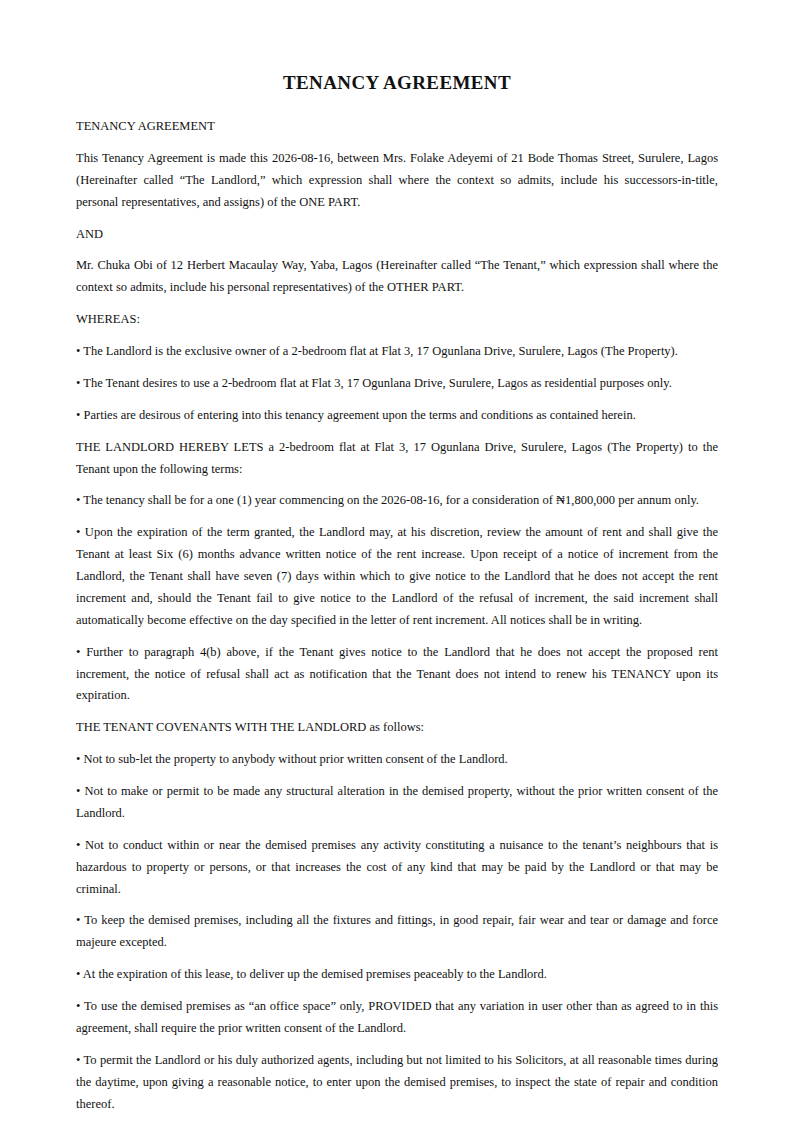
A tenancy agreement is a legally binding contract between a landlord (the person or entity that owns the property) and a tenant (the person renting it). It sets out the terms under which the tenant occupies the property — things like how much rent is to be paid, when it's due, how long the tenancy lasts, and what both parties are expected to do during that period.
In Nigeria, tenancy agreements can be written or verbal. Verbal agreements are technically valid under common law, but trying to enforce one in court is where things get complicated. With a verbal agreement, it becomes your word against theirs — and courts are generally not sympathetic to situations that could have been easily avoided with a written document.
Written tenancy agreements are the standard for a reason. They create a clear record of what was agreed, protect both sides, and give either party a solid foundation to stand on if the relationship breaks down.
Why a Tenancy Agreement Matters More Than People Think
A lot of Nigerians still treat tenancy agreements as a formality — something you sign quickly so you can collect the keys. That mindset tends to change the moment there's a dispute.
Here's the reality: without a clear agreement, common disagreements become full legal battles. Who pays for repairs? Can the landlord enter the property without notice? Is the tenant allowed to sublet a room? What happens if the landlord sells the property mid-tenancy? These questions all have answers — but only if those answers were written down at the beginning.
Beyond disputes, a tenancy agreement also protects you in ways you might not immediately think about. For tenants, it stops a landlord from arbitrarily increasing rent or evicting you without proper notice. For landlords, it gives you legal grounds to recover your property and pursue unpaid rent through the courts.
There's also a practical side to it for tenants who are running businesses, applying for loans, or dealing with government agencies. Many institutions in Nigeria now request a tenancy agreement as proof of address. A properly drafted document with the right details carries weight in these situations in a way that a verbal arrangement simply doesn't.
The Legal Framework: What Nigerian Law Says
Tenancy law in Nigeria isn't governed by a single federal statute. Instead, each state has its own legislation, and some of them differ quite significantly from others. The most commonly referenced is the Tenancy Law of Lagos State 2011, which introduced some of the most structured regulations around landlord-tenant relationships in the country.
Under Lagos tenancy law, for instance, landlords are required to give advance notice before increasing rent, and there are strict rules around eviction — including specific notice periods depending on the type of tenancy. Other states, particularly in the North and South-South zones, operate under older legislation or rely more heavily on common law principles.
What this means practically is that a tenancy agreement that works perfectly in Lagos might need adjustments before it's used in Rivers State or Kano. It's always wise to specify in the agreement which state's laws will govern it — something that Nigerian lawyers refer to as the "governing law clause."
Key Elements Every Tenancy Agreement in Nigeria Should Contain
There's no universal template that fits every situation, but certain elements should appear in every agreement regardless of whether you're renting a room, a flat, or an entire commercial building.
Names and details of both parties — The full legal names and contact details of the landlord and tenant should be clearly stated. If the landlord is a company, the registered company name and its representative should be identified. Vague references like "the property owner" create room for later disputes about who exactly signed what.
Full description of the property — The address alone isn't always enough. A comprehensive description includes the property type, the specific unit being rented (e.g., "the ground floor two-bedroom flat"), and any ancillary spaces like parking spots or storage that form part of the rental.
Duration of the tenancy — Whether it's a monthly tenancy, annual, or a fixed term of two years, this needs to be stated clearly, along with the start date. If there's an option to renew at the end of the term, the agreement should spell out how that process works.
Rent amount and payment terms — How much is the rent? When is it due? What is the accepted method of payment? Many Nigerian landlords still collect rent annually or bi-annually, which differs from monthly arrangements that are more common globally. Whatever the arrangement, it should be documented explicitly.
Security deposit terms — The security deposit (sometimes called a caution fee in Nigerian parlance) should be clearly defined — how much it is, what it covers, and under what circumstances it will be refunded. Disputes over security deposits are among the most common grievances between landlords and tenants, and a clear clause goes a long way toward preventing them.
Permitted use of the property — Is the property for residential use only? Can the tenant operate a business from the premises? Are sub-tenants allowed? These questions matter. A landlord who lets a property for residential purposes and later discovers it's being used as a mini-mart has a legitimate grievance — but only if the agreement addressed this.
Maintenance and repair responsibilities — Typically, landlords in Nigeria are responsible for structural repairs (roof, walls, plumbing systems) while tenants handle minor day-to-day maintenance. But this split can vary, and it should be written into the agreement rather than assumed.
Rules and restrictions — This might cover anything from noise levels and pet policies to waste disposal practices and whether the tenant is allowed to make alterations to the property. These clauses tend to seem small until they don't.
Notice periods for termination — Under the Lagos Tenancy Law, different notice periods apply depending on the type of tenancy: a weekly tenant is entitled to one week's notice, a monthly tenant gets one month, and a yearly tenant gets six months. These requirements may vary by state, but the principle of adequate notice applies broadly across Nigeria. The agreement should clearly state what notice is required from either party.
Dispute resolution — It's becoming increasingly common to include a clause specifying how disputes will be handled — whether through mediation, arbitration, or the courts. This isn't just legal housekeeping; it can save both parties significant time and money if things go wrong.
Signature and witnessing — The document must be signed by both the landlord and the tenant. Witnesses strengthen the agreement's enforceability, and in some cases — particularly where the tenancy exceeds three years — the law requires the involvement of a notary or registrar.
Types of Tenancy Arrangements in Nigeria
Not every tenancy is the same, and the type you have affects your rights and obligations as well as the notice period either party must give.
A fixed-term tenancy runs for a specific period that's agreed upfront. If you sign a one-year lease starting in January, the tenancy runs until December of that year. Neither party can normally terminate it before the end of the term without incurring consequences — unless the agreement provides for early termination.
A periodic tenancy rolls over automatically at the end of each period — monthly, quarterly, or annually — until one party gives notice. Most Nigerian tenancy arrangements, particularly at the residential level, fall into this category. You pay your rent annually, it's renewed annually, and the relationship continues until someone decides to end it.
A tenancy at will is a more informal arrangement where the tenant occupies with the landlord's permission but no fixed term has been agreed. This offers the least protection for the tenant because the landlord can technically end it at any time, subject to reasonable notice.
Common Mistakes Landlords Make in Their Agreements
Many landlords in Nigeria draft their own agreements or use templates downloaded from the internet — templates that may not be compliant with Nigerian law or tailored to their specific situation. A few mistakes come up again and again.
Vague language is the biggest one. Phrases like "the tenant shall maintain the property in good condition" mean very little without specifics. What counts as good condition? Who decides? A well-drafted agreement defines these terms clearly.
Another common mistake is failing to include a clause around rent review. If you want to review the rent after the first year, that right needs to be explicitly stated and the review process defined. Under Lagos law, a landlord cannot simply increase rent mid-tenancy without proper notice.
Some landlords also skip witness signatures, assuming that both parties signing is enough. While the agreement may still be enforceable, witnessed signatures add a layer of legal weight — and make it much harder for either party to later claim they didn't sign the document or didn't understand what they were signing.
Common Mistakes Tenants Make
Tenants are sometimes in such a hurry to secure a property that they sign whatever is placed in front of them without reading it carefully. This is understandable in a competitive rental market, but it's also how people end up locked into agreements that don't work in their favour.
The most important thing any tenant can do before signing is read the entire document — including the clauses that seem obvious or harmless. Pay particular attention to the termination clause, the security deposit refund conditions, and any restrictions on how you use the property.
If anything is unclear, ask. If the landlord won't give you time to read the document or refuses to explain any clause, that itself is a red flag worth taking seriously.
Tenants should also insist on getting a copy of the signed agreement. It sounds basic, but there are plenty of situations where a tenant signs and the landlord keeps all copies. If you don't have your own copy, you have no document to refer back to — and no proof of what was agreed.
Eviction in Nigeria: What the Law Actually Says
One of the most sensitive areas in any tenancy relationship is eviction, and it's an area where Nigerian law is actually more protective of tenants than many people realise.
A landlord cannot simply ask a tenant to leave and expect them to comply immediately. The law requires that proper notice be given — and the notice period depends on the type of tenancy. As mentioned earlier, yearly tenants in Lagos are entitled to six months' notice. After notice is given, if the tenant doesn't vacate, the landlord must go through the court process to obtain a possession order. Self-help evictions — changing the locks, removing the tenant's belongings, cutting off utilities — are illegal and can expose the landlord to liability.
This doesn't mean tenants can overstay indefinitely. A tenant who refuses to leave after a valid court order faces forced eviction by court officials. But the process requires following the law, not bypassing it.
Understanding this is important for both parties. Landlords who know the proper process avoid situations where an illegal eviction becomes a costly legal problem. Tenants who know their rights don't have to panic every time a landlord makes threats.
Does a Tenancy Agreement Need to Be Stamped?
In Nigeria, stamp duty is a tax levied on certain legal documents — and tenancy agreements are among them. The Stamp Duties Act requires that tenancy agreements be stamped, particularly those with a term exceeding one year or those with rent above a specified threshold.
An unstamped agreement isn't automatically invalid, but it cannot be used as evidence in court without first being stamped and the applicable duty being paid, along with potential penalties. For this reason, it's generally advisable to have your agreement stamped at the appropriate stamp duty office. Many lawyers handle this as part of the process when they draft tenancy agreements.
Do You Need a Lawyer to Draft a Tenancy Agreement?
This is one of the most common questions people ask, and the honest answer is: it depends.
For a straightforward residential tenancy — a one-bedroom flat, a one-year term, no unusual arrangements — a well-crafted template that's been properly adapted to your situation can work perfectly well. Platforms like LegalDoc offer tenancy agreement templates that have been drafted and vetted by Nigerian lawyers, meaning the foundational legal requirements are already in place. You fill in the specific details, preview the document, and download it.
For more complex arrangements — commercial leases, long-term tenancies, properties with multiple occupants, or situations involving significant sums of money — involving a qualified lawyer adds a meaningful layer of protection. A lawyer who knows Nigerian tenancy law can anticipate issues that a template might not address and draft clauses specific to your circumstances.
The key is not to use an agreement that clearly wasn't designed for Nigeria — one that references laws in another jurisdiction, uses terminology that doesn't reflect Nigerian practice, or misses clauses that are standard locally.
Frequently Asked Questions About Tenancy Agreements in Nigeria
Is a verbal tenancy agreement legally valid in Nigeria?
Yes, it is legally valid in principle — Nigerian courts recognise verbal contracts. The problem is enforcement. Without written evidence, proving what was agreed becomes very difficult, and courts are limited in what they can do when the terms are disputed. A written agreement is strongly advisable for any tenancy arrangement.
Can a landlord increase rent during an ongoing tenancy?
In most cases, no — not during a fixed term unless the agreement specifically allows it. For periodic tenancies, a landlord can review rent at the end of each period, but must give adequate notice before the review takes effect. In Lagos, this means giving proper notice before the tenancy renewal date. Landlords cannot increase rent arbitrarily in the middle of a tenancy period.
What happens if the tenant doesn't pay rent?
The landlord's first step should be to serve the tenant with a formal notice to pay or vacate — often called a "Notice to Quit." If the tenant doesn't comply, the landlord can file a claim in the relevant court (usually a Magistrate Court or the Tenancy Tribunal) to obtain a possession order. At that point, the court handles the eviction.
Can a landlord enter the property without the tenant's permission?
No. Even though the landlord owns the property, the tenant has the right to quiet enjoyment during the tenancy. A landlord who enters without permission — or without giving reasonable notice — is technically trespassing. Most tenancy agreements include a clause requiring the landlord to give notice (usually 24 to 48 hours) before entering for inspections or repairs.
What is a "notice to quit" and when is it used?
A notice to quit is a formal document served by a landlord informing the tenant that the tenancy will be terminated at a specific date. It's the first formal step in the eviction process and must be served before any court action. The notice period required depends on the type of tenancy and the state in question.
Can a tenant sublet part of the property to someone else?
Only if the tenancy agreement allows it. Most standard agreements in Nigeria prohibit subletting without the landlord's written consent. Subletting without permission can be grounds for termination of the tenancy.
What should a tenant do if the landlord refuses to return the security deposit?
The tenant should first write a formal demand letter requesting the deposit's return and providing a deadline. If the landlord doesn't respond or refuses, the tenant can file a claim in the Magistrate Court for recovery of the deposit. Having a written tenancy agreement that clearly states the deposit conditions makes this process significantly easier.
Is a tenancy agreement the same as a lease agreement?
The terms are often used interchangeably, but there is a technical distinction. A lease agreement typically refers to longer-term arrangements (usually above three years) and often involves more formal registration requirements. A tenancy agreement more commonly refers to shorter-term occupancy arrangements. For practical purposes in Nigeria's residential rental market, both terms are frequently used to mean the same thing.
Do I need to register my tenancy agreement?
For agreements with a term of less than three years, registration isn't typically required, though stamping is advisable. For agreements with a term of three years or more, registration with the Land Registry may be necessary under the Land Use Act. A lawyer can advise on whether your specific agreement needs to be registered.
Can a company be a tenant?
Yes. A registered company can enter into a tenancy agreement. In that case, the agreement should identify the company by its full registered name and specify which officer or director is signing on its behalf.
What happens to the tenancy if the landlord sells the property?
In most cases, the tenancy survives the sale. The new owner takes the property subject to the existing tenancy, meaning the tenant's rights under the agreement remain intact. The new owner becomes the landlord for the remainder of the tenancy term. However, this depends on whether the tenancy was properly documented — another reason why a written agreement is so important.
Can a tenant be evicted because the landlord wants to renovate?
In some circumstances, yes — but the landlord must follow the proper legal process, give adequate notice, and in some states, demonstrate genuine intention to carry out the renovation. Simply claiming you want to renovate as a pretext to remove a tenant is not legally sufficient.
Getting Your Tenancy Agreement Right
Whether you're a landlord preparing to rent out your property for the first time or a tenant about to sign for a new home, the tenancy agreement is the document that will shape the entire experience. It's worth getting it right.
A good agreement doesn't just protect you legally — it creates clarity from the start. When both parties understand exactly what they've agreed to, the chances of disputes arising are dramatically lower. And even if something does come up, having a clear written record of what was agreed makes resolution far simpler.
You don't need to spend a fortune to have a professionally drafted tenancy agreement. With LegalDoc, you can create a tenancy agreement in minutes — one that has been drafted and reviewed by qualified Nigerian lawyers, covers all the essential clauses, and is tailored to your specific situation. Fill in a few details, preview the document, and download it instantly.
It's a small step that can save you from very large problems down the line.