
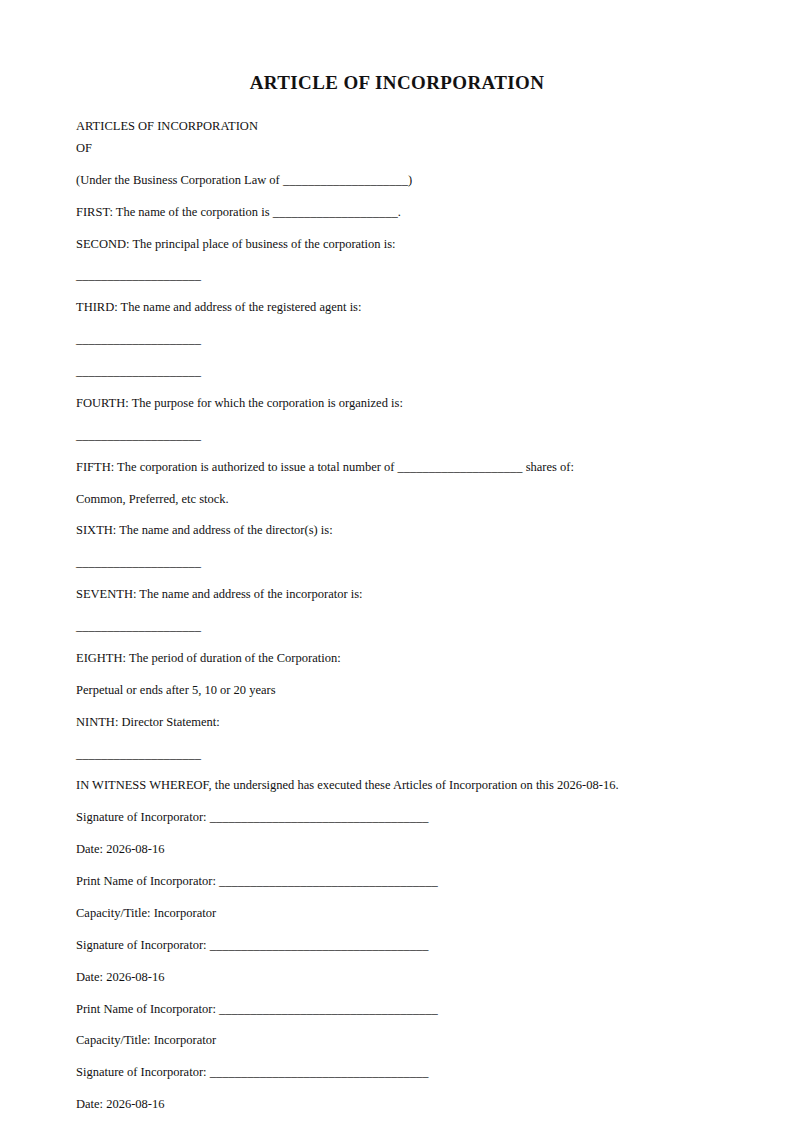
Articles of Incorporation: Creating a US Corporation
This is a United States document. Articles of incorporation are filed with a state to create a corporation. Delaware and New York call the same document a certificate of incorporation.
Nigeria does not use this form. A Nigerian company is incorporated at the Corporate Affairs Commission under the Companies and Allied Matters Act 2020, by filing an application together with a memorandum and articles of association, and you can begin that with business registration. If you are weighing up structures, our guide on a business name against a limited company is the place to start.
If you are incorporating in a US state, read on.
Corporation or LLC
Both give limited liability. They differ in structure, formality and how investors treat them.
A corporation has shares, shareholders, a board of directors and officers, with statutory formalities: annual meetings, minutes, bylaws. That structure is precisely what institutional investors expect, which is why venture backed companies are almost always corporations.
An LLC is lighter, with members instead of shareholders and considerable freedom to arrange things by agreement. It suits owner operated businesses and property holding.
If you intend to raise venture capital, issue stock options to employees, or eventually go public, incorporate. If you are running a business for yourselves, an LLC is usually simpler and cheaper to maintain.
The Name and the Registered Agent
The corporate name needs a designator: Incorporated, Corporation, Company, Limited or an abbreviation the state accepts. It must be distinguishable from existing entities in the state, so search the state database first, and be aware that a name being available as a state registration says nothing about whether it infringes somebody's trademark.
The corporation needs a registered agent with a physical street address in the state, available in business hours to accept service of legal documents. No post office boxes. Letting the agent lapse risks a default judgment in a case you never heard about, and administrative dissolution by the state.
Authorised Shares, Which Is the Clause People Get Wrong
The articles must state how many shares the corporation is authorised to issue, and of what classes. This is where new founders most often create a problem for themselves.
Authorised shares are the ceiling. Issued shares are what has actually been given out. You authorise more than you issue, so there is room for future investors, an employee option pool, and later founders, without having to amend the articles each time. A common starting point for a startup is ten million authorised shares, with a fraction of that issued to the founders.
Par value is a nominal figure, commonly a fraction of a cent, and shares cannot be issued below it. In Delaware the combination of authorised shares and par value feeds into the franchise tax calculation, so authorising an enormous number of shares with a high par value produces a tax bill for no benefit.
If you plan more than one class, for example common and preferred, the articles need to set out the rights attaching to each, or authorise the board to fix them by resolution, which is the flexible approach investors prefer.
It is worth noting for comparison that CAMA 2020 abolished the concept of authorised share capital in Nigeria and replaced it with a minimum issued share capital, so a Nigerian company issues what it registers. The two systems do not map onto each other, and a founder moving between them should not assume they do.
Incorporator, Directors and Bylaws
The incorporator signs and files the articles. They need not be a shareholder, director or officer, and their role ends once the corporation exists and the initial board is in place.
Some states require the initial directors to be named in the articles; others leave it to the organisational meeting. Where you have the choice, leaving names out keeps them off the public filing.
The bylaws are separate and are not filed. They govern the internal workings: how meetings are called, what constitutes a quorum, how directors are elected and removed, what the officers do, and how shares are transferred. A corporation with articles and no bylaws is missing the document that runs it day to day, and our corporate bylaws page covers that.
C Corporation, S Corporation and What Follows Filing
A newly formed corporation is taxed as a C corporation by default, meaning the company pays tax on its profits and shareholders pay again on dividends.
An eligible corporation can elect S corporation treatment with the Internal Revenue Service, so profits pass through to shareholders instead. The eligibility conditions are restrictive: a limited number of shareholders, individuals who are US persons, and only one class of stock. That last condition is why an S corporation cannot take venture capital, which is invested as preferred stock.
After filing, hold the organisational meeting, adopt bylaws, appoint officers, issue share certificates, get an employer identification number, open a bank account, and diarise the annual report and franchise tax. Founders' shares should be subject to vesting from the start, because investors will insist on it and retrofitting it is awkward.
Frequently Asked Questions About Articles of Incorporation
What is the Nigerian equivalent? Incorporation at the Corporate Affairs Commission under CAMA 2020, filing an application with a memorandum and articles of association. Nigeria does not use articles of incorporation, and CAMA 2020 replaced authorised share capital with a minimum issued share capital.
How many shares should I authorise? More than you issue, so there is room for investors and an option pool without amending the articles. Ten million authorised with a small fraction issued is a common startup structure, and par value should be kept nominal to avoid inflating Delaware franchise tax.
Should I incorporate in Delaware? If you are raising venture capital, probably, because investors know the law and the Court of Chancery. If you are not, incorporating in your home state avoids paying fees and maintaining agents in two states.
Are bylaws filed with the articles? No. The articles are the public filing that creates the corporation. Bylaws are internal, adopted at the organisational meeting, and kept with the corporate records.
What is the difference between a C corporation and an S corporation? It is a tax election, not a different entity. C is the default with tax at company and shareholder level. S passes profits through but limits shareholder numbers and permits only one class of stock, which rules out venture investment.
Getting Your Articles of Incorporation Right
The decisions that matter are the share authorisation, the par value, the registered agent and whether to name directors on a public filing.
Answer a few questions and you will have your articles of incorporation prepared, ready to download in Word and PDF. Incorporating in Nigeria instead? Start with business registration.