
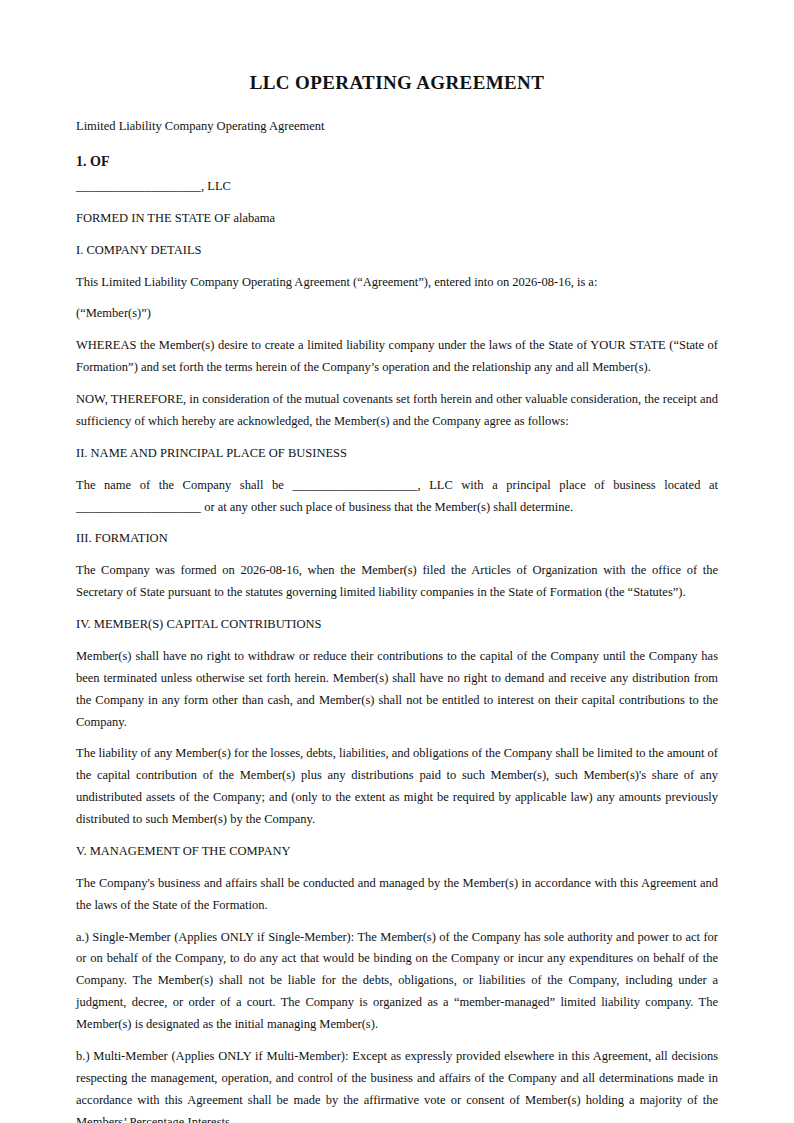
LLC Operating Agreement: What It Is and Who Needs One
This is a United States document. A limited liability company, or LLC, is an entity created under the law of a US state, and an operating agreement is the internal contract between its members governing how it is owned and run.
Nigeria has no LLC. A Nigerian business with the same purpose registers a private company limited by shares at the Corporate Affairs Commission under the Companies and Allied Matters Act 2020, and the documents that do this job are the articles of association plus a shareholders agreement. If you are registering in Nigeria, that is the page you want, and if you are starting a business with co-founders, look at the founders agreement as well.
If you genuinely have a US LLC, whether because you formed one in Delaware or Wyoming, or because you run a US subsidiary, read on.
The Agreement Is Not the Formation Document
Two documents get confused constantly. The articles of organization are filed with the state to bring the LLC into existence. The operating agreement is internal, is not filed anywhere, and governs the relationship between the members.
Most states do not require you to have one. A handful, including California, Delaware, Maine, Missouri and New York, do. But the requirement is beside the point, because without one your LLC is governed entirely by your state's default rules, and those defaults are frequently not what the members would have chosen.
The classic example is profit sharing. Some state statutes default to splitting profits equally among members regardless of what each contributed. A member who put in ninety per cent of the capital and assumed they would get ninety per cent of the profit can discover otherwise.
Members, Capital and Percentages
Start with who the members are and what each one contributed: cash, property, intellectual property or services. Record a value for non cash contributions, because that value drives everybody's percentage.
Then state each member's ownership percentage, and say whether it can change and how. Deal with whether members can be required to contribute more later, called a capital call, and what happens to a member who will not or cannot meet one. Dilution, a loan from the contributing member, or a forced buyout are the usual answers, and picking one now is far easier than picking one during a cash crisis.
Distinguish allocations from distributions, because they are taxed differently in effect. An allocation is a member's share of profit for tax purposes. A distribution is cash actually paid out. A member can be allocated income they never received, and owe tax on it, which is why the agreement should address whether tax distributions are made.
Member Managed or Manager Managed
A member managed LLC is run by its members, each generally able to bind the company. It suits a small business where everybody is involved.
A manager managed LLC is run by one or more managers, who may or may not be members, while the other members are passive. It suits an LLC with investors who put in money but do not want to run anything.
Whichever you choose, define the decisions that need member approval rather than management discretion: admitting a new member, borrowing above a threshold, selling substantial assets, amending the agreement, dissolving, and entering a business outside the stated purpose. Set the voting threshold, by percentage interest or by head, and say what constitutes a quorum.
Transfers, Exits and Deadlock
An LLC is not a public company and members generally do not want a stranger buying in. So restrict transfers: a right of first refusal in favour of the LLC and then the other members, and a requirement of consent before a transferee becomes a full member rather than merely an economic assignee.
Then set out the buy sell terms. What triggers a buyout: death, disability, bankruptcy, divorce, withdrawal, or expulsion for cause. How the price is determined, whether by formula, by an appraiser, or by a valuation the members agree annually. And how it is paid, because a lump sum can wreck a small company's cash flow where instalments would not.
For a two member LLC with an even split, include a deadlock mechanism. Without one, two members who cannot agree can leave the company unable to act at all, with no internal route out.
Tax Elections, and the EIN
By default a single member LLC is disregarded for federal tax purposes and a multi member LLC is taxed as a partnership, with profits passing through to the members' own returns. The LLC can instead elect to be taxed as a corporation, and can further elect S corporation treatment, which changes how income and distributions are characterised.
These elections are made with the Internal Revenue Service on its own forms and are not part of the operating agreement, but the agreement should be consistent with whichever you choose, and should say who is responsible for filings and for providing members their tax information each year.
The LLC will also need an employer identification number from the IRS, which banks require to open an account.
Why a Single Member LLC Still Wants One
It feels pointless to contract with yourself, and it is not.
The value of an LLC is limited liability, and that protection depends on the company being treated as genuinely separate from its owner. Where an owner ignores the separation, mixing personal and company money and keeping no records, a court can disregard the entity and reach the owner personally. An operating agreement, properly followed, is part of the evidence of separateness.
More practically, banks, payment processors and landlords ask for one, and so does anybody buying the business later.
Frequently Asked Questions About LLC Operating Agreements
Is there an LLC in Nigeria? No. Nigeria has private and public companies limited by shares, registered at the Corporate Affairs Commission under CAMA 2020, and CAMA 2020 also introduced limited liability partnerships. The Nigerian equivalent of an operating agreement is the articles of association together with a shareholders agreement.
Is an operating agreement legally required? Only in a few states, including California, Delaware, Maine, Missouri and New York. Everywhere else it is optional, but without one your state's default rules govern, and those defaults often allocate profits and control differently from what the members intended.
Do I file it with the state? No. The articles of organization are filed to create the LLC. The operating agreement is an internal document kept with the company's records.
Do I need one if I am the only member? It is still worth having. It supports the separateness that limited liability depends on, and banks, processors and future buyers routinely ask to see it.
Does it decide how the LLC is taxed? No. Tax treatment follows the default rules or an election made with the Internal Revenue Service. The agreement should be drafted consistently with whichever treatment applies, and should cover who handles filings and member tax reporting.
Getting Your Operating Agreement Right
The clauses that matter are the capital and percentage provisions, the management and voting structure, the transfer restrictions and the buy sell terms.
Answer a few questions and you will have a US LLC operating agreement, ready to download in Word and PDF. If your company is Nigerian, use the shareholders agreement instead.