
Founders Agreement in Nigeria: Deciding the Hard Things Early
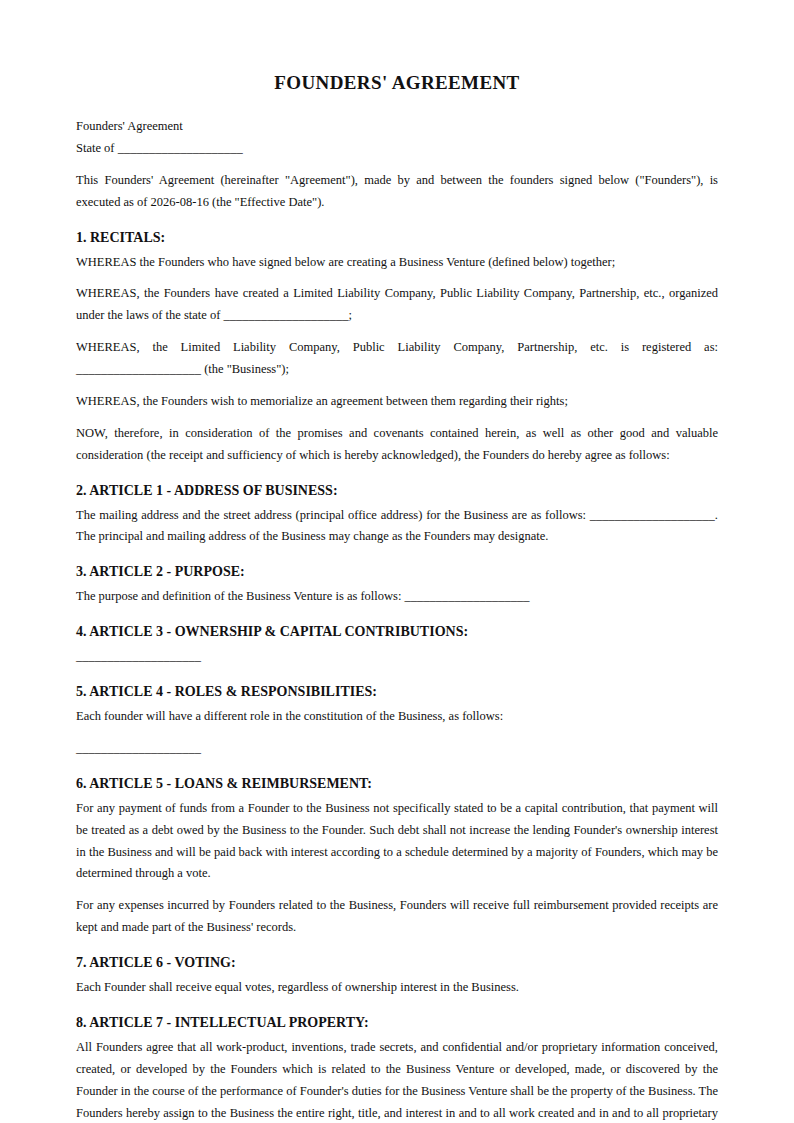
A founders agreement is what two or more people starting a business sign before the business is worth arguing over. It records who owns what, who does what, and what happens when somebody leaves.
Almost nobody wants to sign one at the start, because the relationship feels obvious and the paperwork feels like distrust. Then eighteen months in, one founder has stopped showing up and still holds thirty per cent, and the conversation becomes a great deal harder than it would have been on day one.
Why the Company's Own Documents Are Not Enough
When you register a company at the Corporate Affairs Commission under the Companies and Allied Matters Act 2020, you get a memorandum and articles of association. Those govern the company. They say almost nothing about the founders' relationship with each other.
They do not say that equity vests over time. They do not say a departing founder must sell back unvested shares. They do not say who can veto a decision, or what happens if two founders deadlock. A founders agreement covers the ground the articles leave blank, and where it needs company law force behind it, it is backed up by a shareholders agreement and, where necessary, amended articles.
The Equity Split
Start with the honest conversation. Equal splits are common and often right, but equal is not automatically fair. Weigh who had the idea, who is working full time and who is not, who put in money, who brings the customer relationships, and who is taking the salary cut.
Whatever you land on, write down the reasoning as well as the numbers. A year later, when somebody's contribution has changed, the reasoning is what lets you have a sensible discussion instead of a fight about memory.
Be explicit about what the percentages are of. A percentage of the issued shares today is a different thing from a percentage after an investment round, and founders who did not understand that are how dilution disputes start.
Vesting, the Clause That Matters Most
Vesting means a founder earns their shares over time rather than owning them all on day one. The standard shape is four years with a one year cliff: nothing vests for twelve months, then a quarter vests, then the rest monthly.
The reason to have it is simple. A founder who leaves after three months should not keep a third of the company, and without vesting they do. That dead equity on the register is also the first thing a serious investor will refuse to accept, so putting it in now saves an awkward renegotiation later.
Deal with the leaver categories too. A founder who resigns is treated differently from one who is dismissed for misconduct, and differently again from one who dies or becomes seriously ill. Good leaver and bad leaver provisions are the practical mechanism, and they need to say who buys the shares, at what price, and how it is valued.
Roles, Decisions and Deadlock
Say who is responsible for what: who runs product, who runs sales, who is managing director, who signs on the bank account. Vague roles at the start become duplicated work and resentment.
Then say which decisions need everybody's agreement rather than a simple majority. Issuing new shares, taking on debt, selling the business, changing anybody's equity, hiring at a senior level, spending above a threshold. Under CAMA 2020 many of these need particular company approvals anyway, but the agreement is where founders decide what they need from each other.
And plan for deadlock between two equal founders, because a fifty fifty company with no deadlock clause can simply stop functioning. Options include a casting vote, a chairman, an independent third party, or a buyout mechanism that neither side wants to trigger.
Intellectual Property Belongs to the Company
This is the clause that quietly saves the business. Everything the founders create for the venture, the code, the designs, the brand, the customer lists, the documents, has to be owned by the company rather than by the individual who made it.
Under the Copyright Act 2022 copyright in a work generally vests first in its author, and an assignment or exclusive licence must be in writing. So an express written assignment from each founder to the company is required, not assumed. Trademarks should be registered in the company's name, and domains and social accounts should be held by the company, not in somebody's personal account.
A founder leaving while owning the code is the single worst position a young Nigerian company can be in, and it is entirely preventable with one clause.
Money, Confidentiality and Leaving
Record what each founder is putting in and on what basis: equity for cash, a loan to the company, or unpaid work. If it is a loan, say whether it carries interest and when it is repayable, because founders' loans become contentious the moment there is money in the account.
Add confidentiality that survives departure, and a reasonable restriction on a departing founder competing or taking the team and customers. Keep it proportionate: Nigerian courts treat restraints of trade as void unless they are reasonable and protect a genuine business interest, so a narrow non-solicitation clause will do more for you than a sweeping ban.
Frequently Asked Questions About Founders Agreements in Nigeria
Is a founders agreement legally binding in Nigeria? Yes. It is an ordinary contract between the founders and is enforceable like any other. Where it affects share rights or company governance, it should be supported by a shareholders agreement and, if necessary, changes to the articles filed at the Corporate Affairs Commission.
Do we need one if we have already registered the company? Yes, and you need it more. Registration gives you articles that govern the company, not the relationship between the founders. Vesting, leaver terms and deadlock provisions are not in your articles unless somebody put them there.
What if we split equity equally and one founder stops working? Without vesting, they keep their shares. That is precisely the situation vesting exists to prevent, and it is also the first thing an investor will want fixed before funding you.
Should the founders agreement be stamped? It is prudent to stamp it under the Stamp Duties Act so that it can be tendered in evidence without objection, and share transfers themselves attract stamp duty separately.
Can a single founder company have one? CAMA 2020 allows a company with one member, and a sole founder does not need an agreement with themselves. What a sole founder does need is a written assignment of intellectual property to the company, and a plan for the day a co-founder joins.
Getting Your Founders Agreement Right
Read next: five reasons you need a founders agreement and how a shareholders agreement differs from your articles. The shareholders agreement is what gives these terms company law force.
The agreements that matter cover four things properly: the split, the vesting, the leaver terms and the intellectual property. Everything else can be tidied up later.
Answer a few questions and you will have a founders agreement written for Nigerian companies under CAMA 2020, ready to download in Word and PDF.