
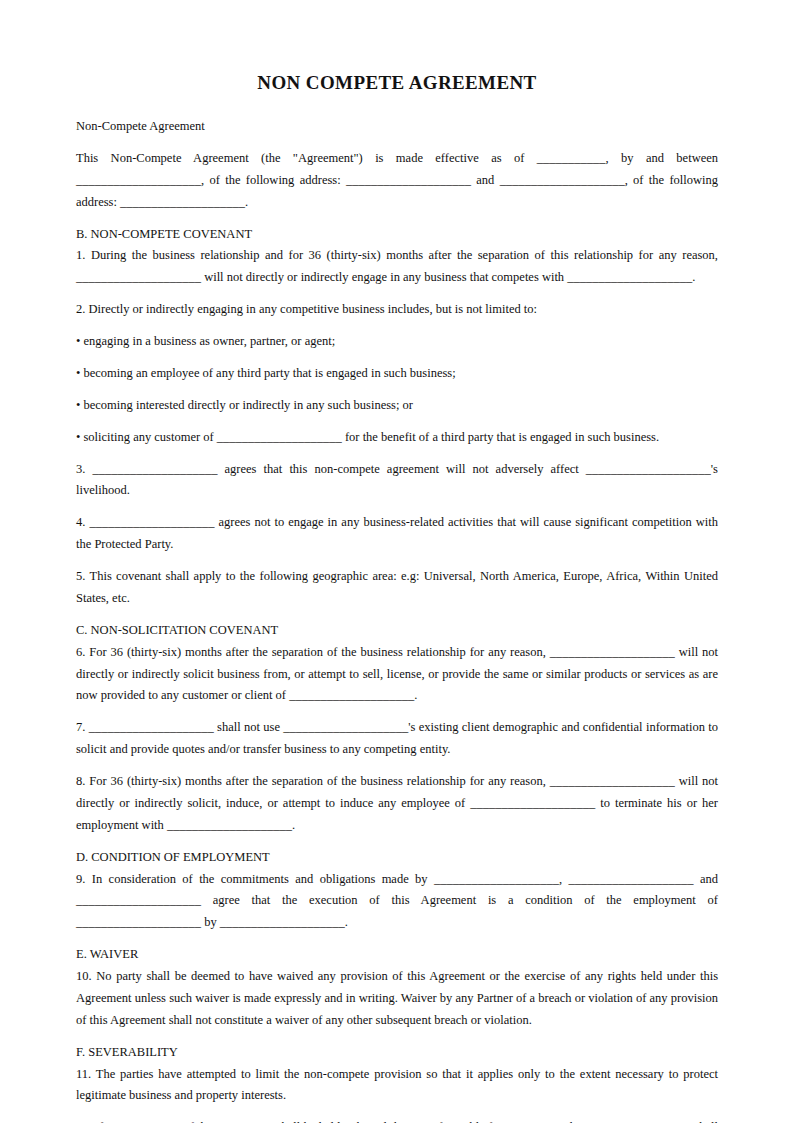
Non-Compete Agreement in Nigeria: Narrow Enough to Enforce
A non-compete restricts somebody from competing with you after the relationship ends. It is used with employees, with departing co-founders, with contractors, and with sellers of a business.
The thing to understand before drafting one is that Nigerian courts start from a position of hostility to it. A restraint of trade is void unless it can be justified, and the burden of justifying it is on the party trying to enforce it. Most of the non-competes circulating in Nigerian employment contracts would not survive a serious challenge.
The Doctrine That Decides the Case
Nigerian law follows the common law doctrine of restraint of trade. A clause restricting a person's ability to earn a living is prima facie void, and becomes enforceable only where the party imposing it shows two things: that it protects a legitimate proprietary interest, and that it goes no further than reasonably necessary to protect that interest.
Legitimate interests include trade secrets and confidential information, customer connections, and the goodwill of a business that has been sold. What is not a legitimate interest is simply not wanting competition, or not wanting to lose a trained employee. A clause whose real purpose is to stop somebody working is the kind that gets struck down.
The National Industrial Court, which handles employment matters, applies this with particular scepticism in employment cases, where the bargaining power between the parties is unequal.
Four Dials, All of Which Must Be Reasonable
Duration. Six to twelve months for an ordinary employee is defensible. Two years needs a strong justification. Five years will not be enforced against an employee, although a longer period can be reasonable against the seller of a business.
Geography. Tie it to where the business actually operates. A Lagos business restraining somebody across all of Nigeria and West Africa is asking a court to say no.
Activity. Restrict the specific work the person did and the specific competing business, not an entire industry. Barring a payments company's accountant from "working in financial services" is overreach.
Who it binds. A senior person with real customer relationships and access to strategy can be restrained more than a junior one. The same clause applied to every employee regardless of role is evidence that nobody assessed necessity.
There is a trade off between the dials. A broad activity restriction can be reasonable if the period is short and the area is small. All four set wide at once is the pattern that fails.
The Clauses That Work Better
In practice you will get more protection from three narrower obligations than from a non-compete.
Confidentiality. Enforceable without the restraint of trade problem, provided the information is genuinely confidential and identified rather than described as everything the person saw.
Non-solicitation of customers. A restriction on approaching customers the person actually dealt with, for a limited period. Courts treat this far more favourably than a blanket ban on competing, because it protects a real connection without stopping the person working.
Non-solicitation of staff. A restriction on poaching colleagues. Reasonable, and usually the clause employers most want in practice.
Include a non-compete if you have a genuine interest that needs it. But build the protection on these three, because these are the ones that will still be standing after a hearing.
Selling a Business Is a Different Case
When somebody sells their business, the buyer is paying for goodwill, and goodwill that the seller can immediately compete away is worth nothing. Courts recognise this, and restraints on a seller are assessed far more generously than restraints on an employee.
Two to five years, covering the territory the business served and the activities it carried on, is commonly reasonable in a sale. The restraint should be in the sale agreement, expressed as part of the consideration, and drafted to bind the seller personally as well as any company they control.
Drafting So a Court Can Save It
Write the restrictions as separate, severable obligations rather than one long sentence. If a court finds the twelve month customer restriction reasonable but the nationwide competition ban excessive, severability lets it strike the bad part and keep the good one. One combined clause goes entirely.
State the interest you are protecting, in the agreement. A recital explaining that the employee has access to named categories of confidential information and holds the relationship with key customers gives a court the justification it is looking for.
Consider paying for the restraint. A payment during the restricted period, or garden leave on full pay, strengthens the argument that the bargain was fair.
Frequently Asked Questions About Non-Competes in Nigeria
Are non-compete clauses enforceable in Nigeria? They can be, but they are void unless the employer shows the clause protects a legitimate proprietary interest and goes no further than necessary. Broad, long, nationwide restraints on ordinary employees are routinely unenforceable.
How long can a non-compete last? Against an employee, six to twelve months is usually defensible and longer periods need real justification. Against the seller of a business, two to five years is often reasonable because the buyer has paid for goodwill.
Can I stop a former employee working for a competitor at all? Only in narrow circumstances, and only where you can point to trade secrets or customer connections that need protecting. A general wish to avoid competition is not a protectable interest.
What is the difference between a non-compete and a non-solicitation clause? A non-compete stops the person competing at all. A non-solicitation stops them approaching your customers or staff. Non-solicitation is narrower, and Nigerian courts are considerably more willing to enforce it.
Does it help to pay the employee during the restricted period? Yes. Payment, or garden leave on full salary, supports the argument that the restraint was a fair bargain rather than a one sided imposition, and it makes enforcement more likely to succeed.
Getting Your Non-Compete Right
Read next: the elements of a Nigerian non-compete and how to draft these clauses alongside an NDA. In practice the non-disclosure agreement often does more of the real work.
The non-competes that work are short, local, specific about the activity, and paired with confidentiality and non-solicitation clauses that carry most of the weight.
Answer a few questions and you will have a non-compete drafted for Nigerian use, scoped to be enforceable rather than merely intimidating, ready to download in Word and PDF.