

Not sure a cooperative is the right structure?
If what you are building is a business or a non-profit, a company, business name or NGO registered at the CAC may fit better.
Compare the optionsStaff savings schemes, market traders' associations, farmers pooling money for inputs, estate residents buying in bulk. A lot of Nigerian money moves through groups like these, and many of them are run informally, on trust, with the funds sitting in one member's personal account.
That works until it does not. A treasurer travels, a dispute starts, somebody wants their contributions back, and there is no legal structure to settle any of it.
A registered cooperative society fixes that. The surprise for most people is where you go to register one, because it is not the Corporate Affairs Commission.
The short answer
A cooperative society in Nigeria is registered with the Director of Cooperatives in the state where it operates, under the Nigerian Cooperative Societies Act and that state's cooperative law, not with the CAC. You need at least ten members with a common bond, an inaugural meeting, adopted bye-laws, and in most states a period of operating under the cooperative office's observation before registration. Once registered, the society is a legal person that can own property, borrow and enforce its own rules.
What a cooperative actually is
A cooperative is a business owned and run by the people it serves. The members put in the capital, the members use its services, and the members control it, with each member having one vote regardless of how much they have contributed.
That last point is what makes it different from a company. In a company, the shareholder with the most shares has the most say. In a cooperative, the member who saves a hundred thousand naira a month and the member who saves five thousand each have one vote.
The common types in Nigeria:
- Thrift and credit societies, the familiar staff cooperative where members save from their salaries and borrow against those savings.
- Multipurpose societies, which combine savings and loans with buying, selling or other services for members.
- Producer and farmers' cooperatives, where members pool resources for inputs, equipment, processing or marketing.
- Consumer cooperatives, which buy goods in bulk for members at better prices.
- Housing cooperatives, which help members acquire land or homes together.
Cooperative, company or NGO?
Before you register anything, it is worth being sure a cooperative is the right shape for what the group wants to do. The three structures are often confused, and they work very differently.
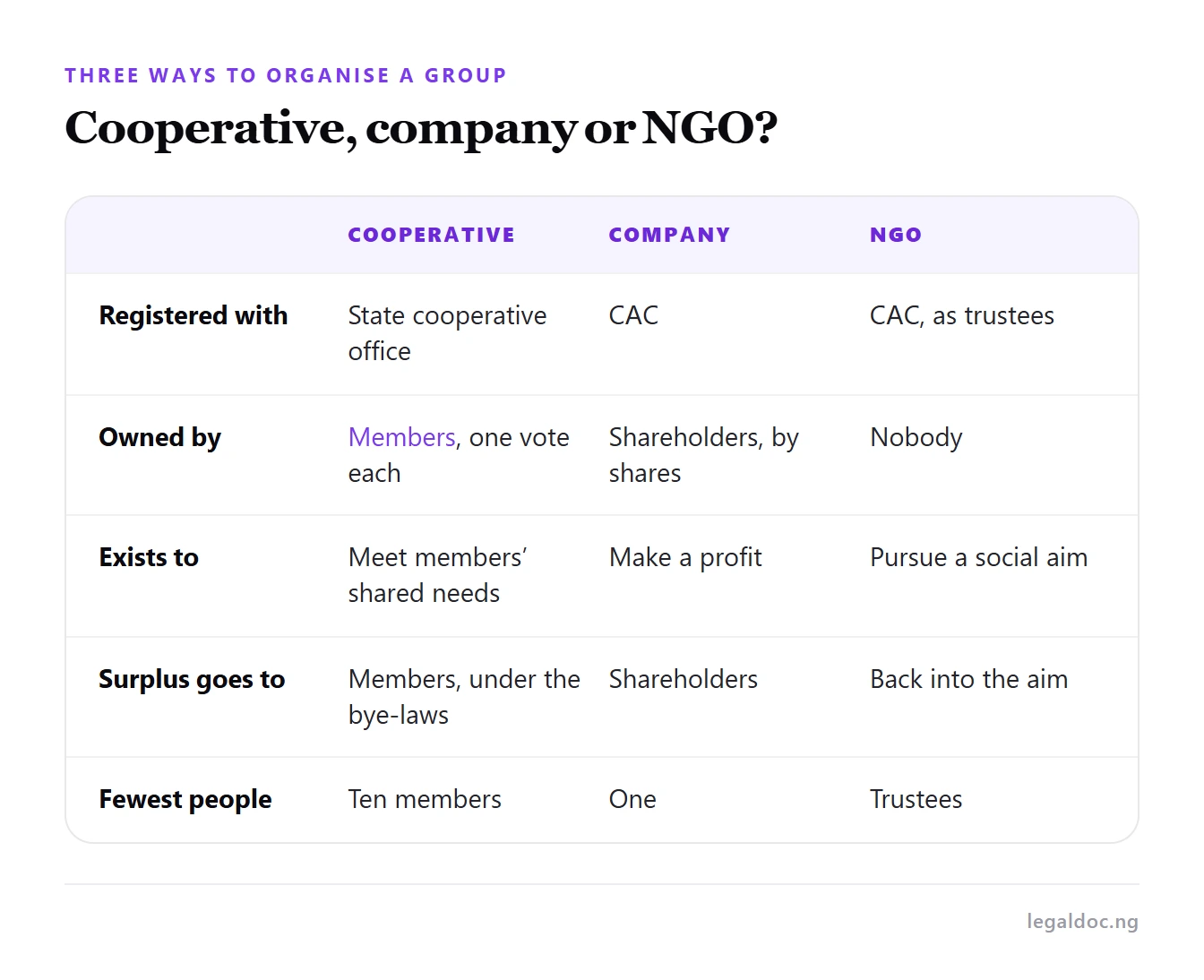
The same group of people could form any of the three. They would end up with very different organisations.
If the group's purpose is to serve its own members, with surplus going back to them, a cooperative fits. If a few people want to build a business and own it in proportion to what they put in, that is a company. If the aim is charitable or social and nobody should take money out, that is an NGO registered as incorporated trustees, which we cover in the benefits of setting up an NGO.
And one word of warning: the CAC will generally not let a company use the word "cooperative" in its name. That word is kept for registered cooperative societies.
Who registers a cooperative
Cooperatives are governed by the Nigerian Cooperative Societies Act and by the cooperative law of each state. Registration is handled by the Director of Cooperatives, sometimes called the Registrar, in the state ministry responsible for cooperatives.
In practice that means the process, the fees and the timelines differ a little from state to state. Lagos does not run exactly the way Kano or Enugu does. The overall shape is the same everywhere, but it pays to visit or call your state's cooperative office early and ask for its current requirements, rather than relying on what a friend did in another state.
A society whose operations genuinely span more than one state may need to deal with the federal cooperative authorities instead. Most societies are local and register with their own state.
Cooperative, company or NGO? Ask which one fits what you are building
Describe your group and its aims, and LegalDoc+ explains the structure that suits it and why.
Ask LegalDoc+Who can form one
A primary cooperative society needs at least ten members. They must be adults, and they need a genuine common bond: working for the same employer, practising the same trade, farming in the same area, or living in the same community.
The common bond matters more than people expect. It is what makes a cooperative work, because members who share an interest are more likely to keep paying in, repay their loans and turn up to meetings. A cooperative office will ask about it, and a group of strangers with nothing in common will struggle to get registered.
How registration works
The sequence below is the usual one. The details, particularly the length of the observation period, vary by state.
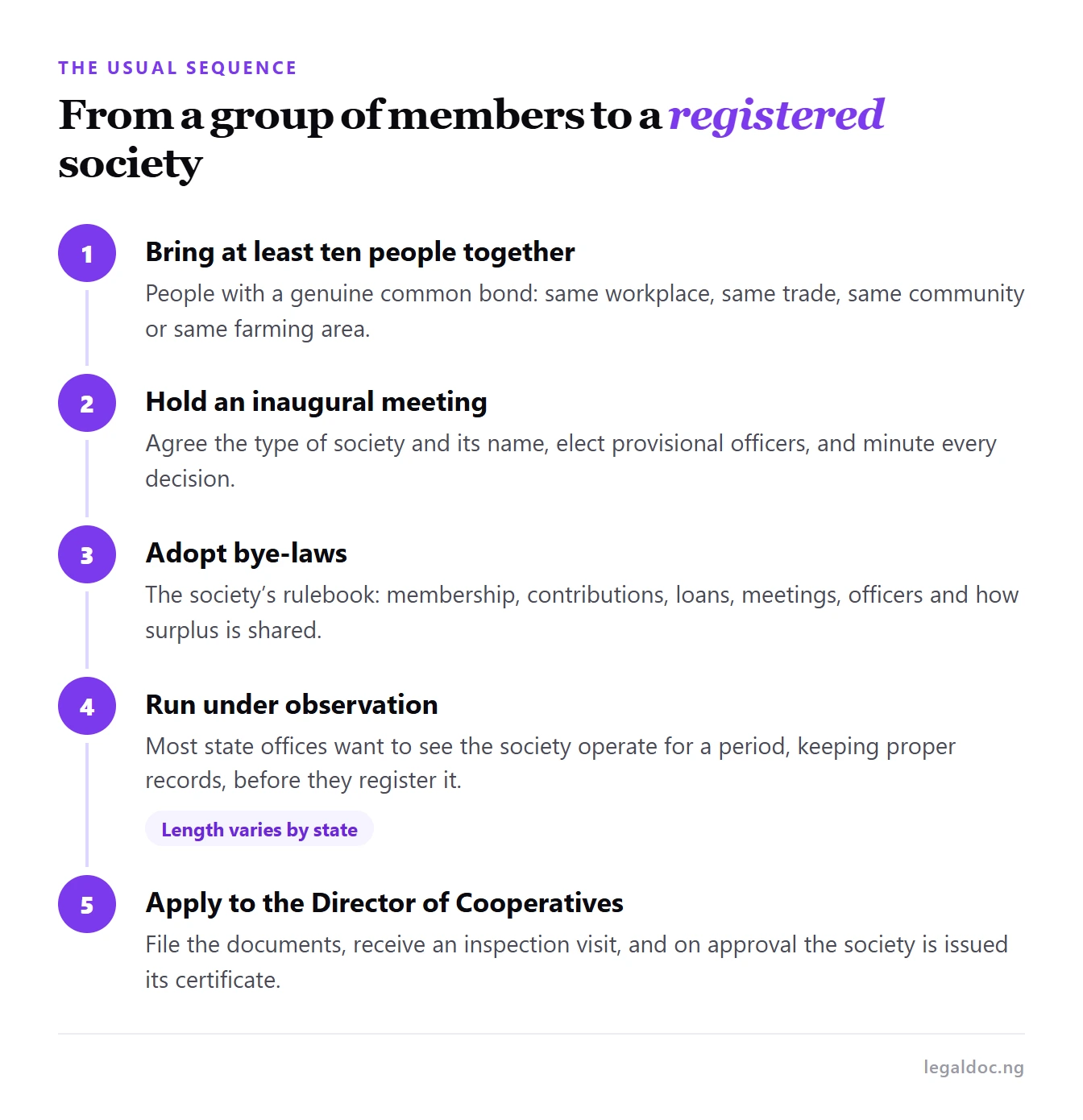
The observation period is the step most groups do not expect.
The observation period deserves a word of its own. Many state offices will not register a society on paper alone. They want to see it actually run for a while, with members saving, records kept and meetings held, before they issue a certificate. Treat that period as practice, because the habits you build in it are the ones the society will keep.
The bye-laws are the society
If there is one document worth getting right, it is the bye-laws. They are the society's rulebook, and almost every dispute in a cooperative is ultimately a question about what the bye-laws say.
They should deal clearly with:
- Who can become a member, and how a member leaves or is expelled.
- What members must contribute, how often, and what happens if they stop.
- How loans are given: how much a member can borrow against their savings, the interest, the repayment period and what happens on default.
- Who the officers are, how they are elected, and how long they serve.
- Who can sign on the society's bank account. Always at least two.
- How surplus is shared at the end of the year, and how much goes into reserves first.
- How a departing member gets their savings back, and how quickly.
Many state cooperative offices provide model bye-laws. They are a good starting point, but read them properly and adapt them to how your group actually works, rather than signing whatever is handed over.
What you will need
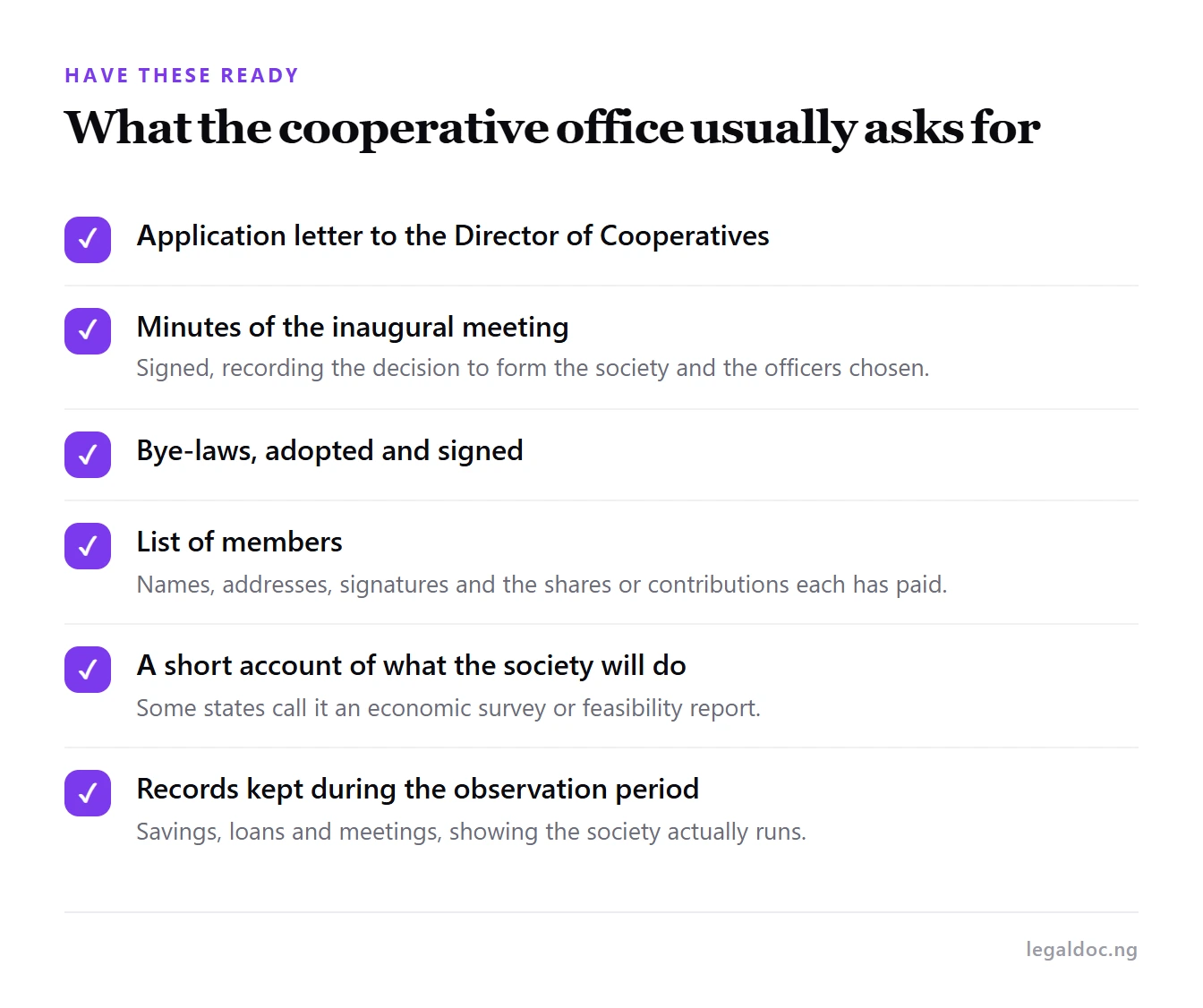
Requirements vary between states, so confirm the list with your own cooperative office.
After registration
A registered society is a legal person. It can open bank accounts in its own name, own land and buildings, enter contracts, lend to its members and take legal action to recover what members owe it. Members' liability is limited, which is why registered cooperatives carry "Limited" at the end of their names.
Registration also brings obligations. The society keeps proper books, holds an annual general meeting, has its accounts audited, usually by or through the cooperative department, and stays in good standing with the state office. A society that stops doing these things can be deregistered.
And it opens doors. Lenders, government agricultural schemes and development programmes often prefer to deal with registered cooperatives rather than individuals, because a registered society is accountable in a way an informal group is not.
Frequently Asked Questions About Registering a Cooperative in Nigeria
Do I register a cooperative society with the CAC? No. Cooperatives are registered with the Director of Cooperatives in the state where they operate, under the Nigerian Cooperative Societies Act and the state's cooperative law. The CAC registers companies, business names and incorporated trustees.
How many members do I need to form a cooperative? At least ten for a primary society. The members must be adults with a genuine common bond, such as the same employer, trade or community.
How long does it take to register a cooperative society? It depends on the state. Many offices require the society to operate under observation for a period before registration, so expect the process to take months rather than weeks.
Can a cooperative make a profit? It can make a surplus, and members can share it in line with the bye-laws once reserves have been set aside. But its purpose is to serve its members, not to generate returns for investors.
What is the difference between a cooperative and an ajo or esusu group? An informal savings group has no legal existence of its own, so its money is held by an individual and its rules cannot easily be enforced. A registered cooperative is a legal person with bye-laws, accounts in its own name and a regulator.
Where this leaves you
If your group is already pooling money informally, registration is worth the effort. It protects the members, it protects whoever is holding the money, and it gives the group a way to settle disputes other than falling out.
Start by calling your state's cooperative office, get your ten members and your common bond in order, and spend real time on the bye-laws. And if, having read this, a company or an NGO sounds like a better fit, compare the options before you commit.