

Spare your family this application
A will names your executors and says who inherits, which makes everything in this article simpler for the people you leave behind.
Write my willSomebody you love has died, and in the middle of the grief there is paperwork nobody warned you about. The bank has frozen the accounts. The pension administrator wants a document you have never heard of. The tenants in the family house have stopped paying because they do not know who to pay. And everybody keeps saying the same three words: letters of administration.
If the person who died left no will, letters of administration are what give somebody the legal authority to deal with what they owned. Without them, in most cases, nobody can.
This guide walks through what they are, who applies, what the registry will ask for, and what happens after the grant. It focuses on the process. If your question is who inherits, read what happens when you die without a will in Nigeria alongside it.
The short answer
Letters of administration are a grant from the Probate Registry of the State High Court that authorises named people, usually close family, to collect, manage and distribute the estate of somebody who died without a valid will. The family agrees who will apply, gathers the death certificate, a list of assets and debts and other documents, files at the registry, pays fees based on the estate's value, and provides sureties and a bond. Anybody with an objection can lodge a caveat. The process commonly takes several months.
Probate or letters of administration?
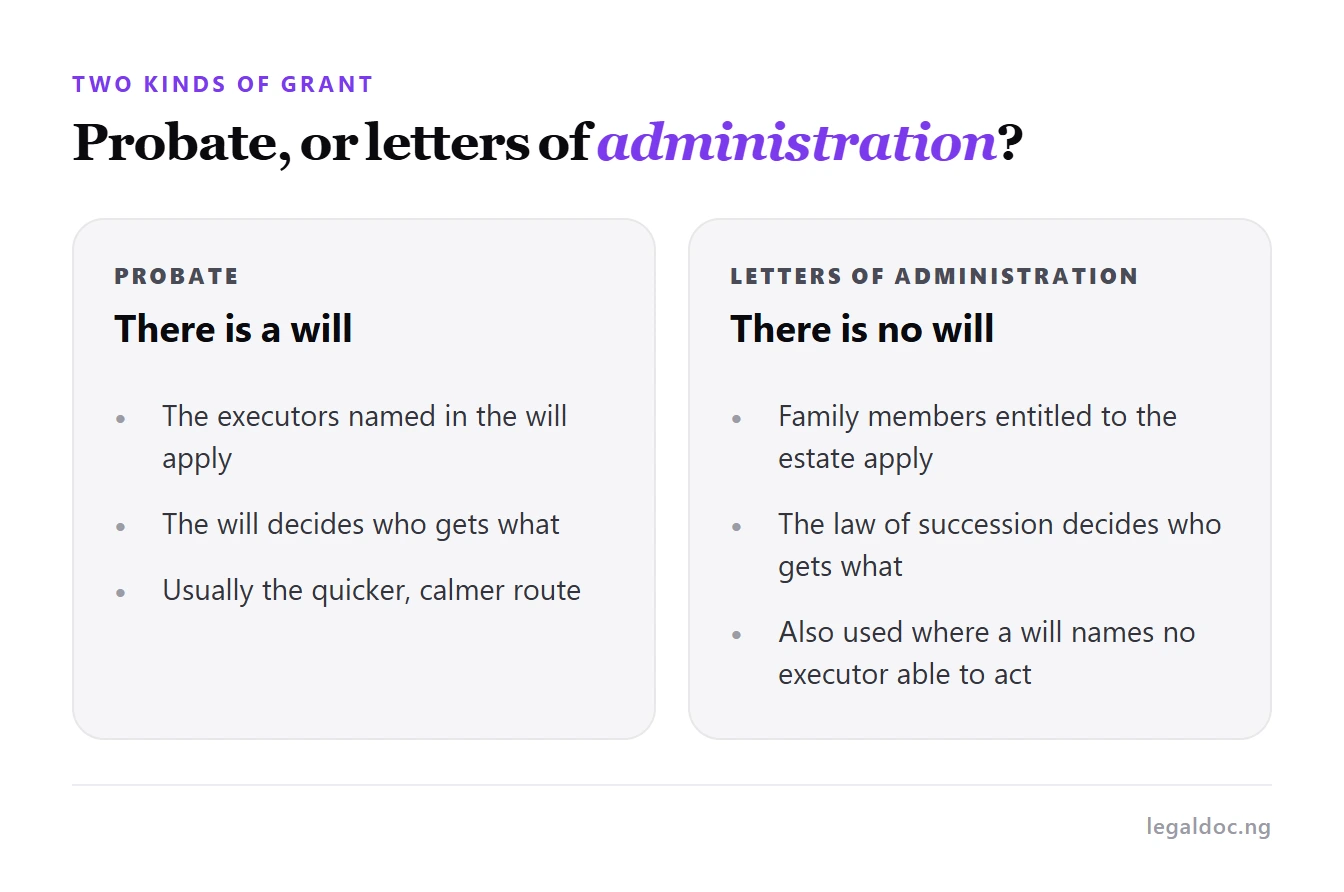
Same registry, same purpose. The difference is whether there was a will naming executors.
Where there is a will that names executors, they apply for probate. Where there is no will, or the will names no executor who is able and willing to act, the family applies for letters of administration. In the second case the will, if there is one, is attached to the grant and still decides who gets what.
Either way, the grant is what banks, pension administrators, company registrars and land registries rely on. It is the estate's proof of who is in charge.
Why you cannot skip it
When a bank learns that an account holder has died, it freezes the account. Some banks will release a small balance to the family on an indemnity, but anything substantial will need a grant. Pension fund administrators generally ask for letters of administration or probate before paying out a deceased contributor's retirement savings. Shares cannot be transferred, land cannot be sold or transferred, and debts owed to the deceased cannot be properly collected.
Families sometimes try to manage without it for years, collecting rent informally and avoiding the bank. It usually ends in a dispute, because nobody has clear authority and everybody has an opinion.
Who applies
Administrators are normally drawn from the people entitled to share in the estate: a surviving spouse, adult children, and failing them, parents or brothers and sisters. The court will not usually grant administration to more than four people, and where a beneficiary is still a child, it usually wants at least two administrators so that no one person controls a minor's inheritance alone.
In practice, the registry expects the main beneficiaries to agree on who will apply, and that agreement is often recorded in a signed family consent. A surviving spouse together with one or two adult children is a common arrangement. Where the family cannot agree, the application tends to stall or turn into a contested case, which is slower and more expensive for everybody.
Two things the law will not accept, whatever a family meeting decides. The Supreme Court held in Ukeje v Ukeje that a customary rule excluding daughters from inheriting their father's estate is unconstitutional discrimination. And the Constitution prohibits discrimination against a child because of the circumstances of their birth. Children born outside marriage are children of the deceased.
What the registry will ask for
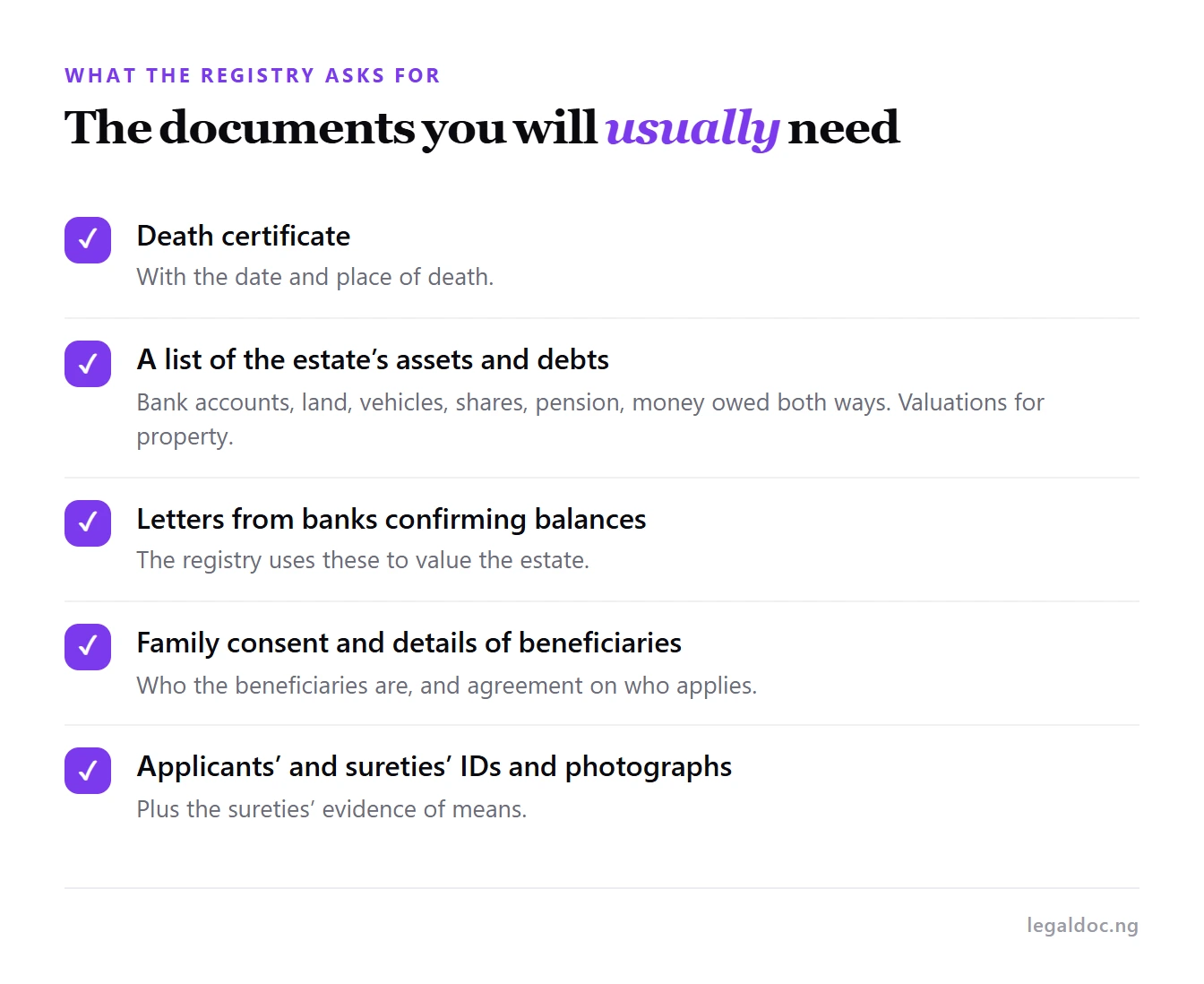
Requirements vary by state. Ask your registry for its current list before you start gathering.
The list of assets and debts deserves care. It is the backbone of the application, the registry's fees are generally calculated on the value of the estate it shows, and administrators who leave things off can face questions later. Include bank accounts, land and buildings, vehicles, shares, pension savings, money owed to the deceased, and what the deceased owed.
Dealing with a loved one’s estate? Ask what comes next
LegalDoc+ explains the grant you need, who should apply and what the registry will expect.
Ask LegalDoc+The process, step by step
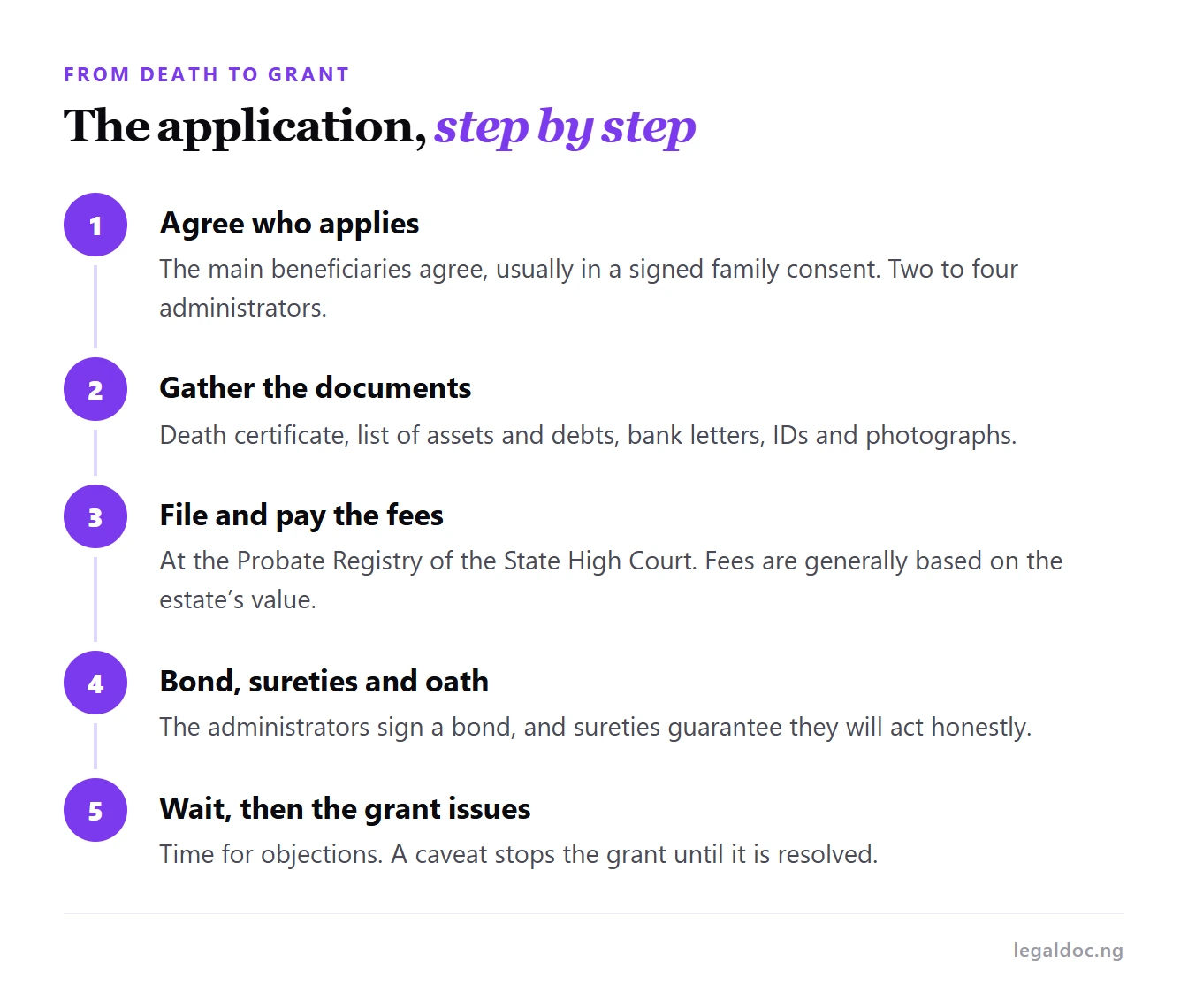
The waiting period exists so that anybody with a claim can come forward before the grant issues.
Sureties and the bond
Administrators are handling property that belongs to other people, so the court wants security that they will do it honestly. They sign an administration bond, and the registry will usually require sureties: people of sufficient means who guarantee that the administrators will administer the estate properly. The registry checks that the sureties are who they say they are and can stand behind the guarantee.
Caveats
Anybody who has an interest in the estate, a relative who was left out, a creditor, somebody who believes there is a will, can lodge a caveat at the registry. A caveat stops the grant being issued without notice to them. If the objection is not resolved, the dispute goes before the court.
A caveat is a legitimate tool, but it is also sometimes used to delay. The best protection is a transparent application, with the whole family informed and the beneficiaries listed accurately from the start.
How long it takes
Commonly several months for an uncontested application with complete documents. Missing documents, unverified sureties, valuation queries or a caveat can add months more. Fees and timelines vary from state to state, so check with the registry where the deceased lived or owned property.
If the deceased owned property in another state, or abroad, a grant from one state may need to be resealed in the other. We explain that process for Lagos in how to reseal a grant in Lagos State.
After the grant
The grant is the beginning of the administrators' work, not the end. Their job is to gather in the estate, pay what it owes, and pass what is left to the people entitled to it.
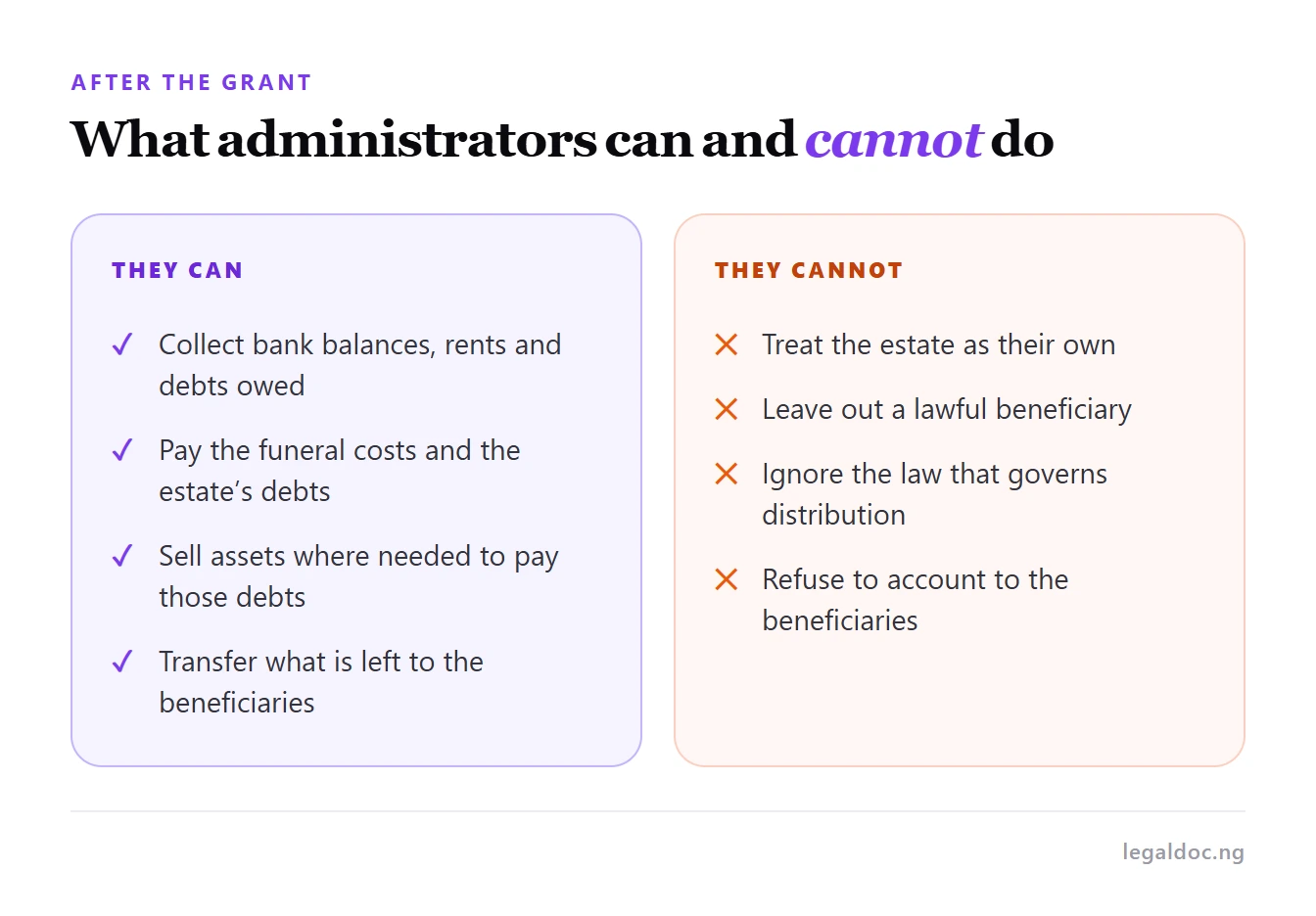
Administrators hold the estate for the beneficiaries, not for themselves.
Administrators are in the position of trustees. They must act for all the beneficiaries, keep proper accounts, and distribute according to the law that governs the estate, which depends on how the deceased married and lived, as we explain in the intestacy article linked above. A beneficiary who believes the estate is being mismanaged can ask the court to order accounts or to remove the administrators.
A note on Muslim estates
Where the deceased was Muslim, the estate is usually distributed according to Islamic law, and in some states the process runs through different courts. But banks, pension administrators and registries still need formal authority before they release assets, so the family will still need a grant or its equivalent.
The simplest way to spare your family this
Almost everything in this article becomes easier with a will. A will names executors, so there is no argument about who applies. It says who inherits, so there is no argument about that either. Probate on a clear will is generally faster and calmer than administration of an estate where everybody has a different view of what the deceased would have wanted.
Writing one takes far less time than most people imagine. Our will template walks you through it, and how to write a will in Nigeria explains what makes a will valid.
Frequently Asked Questions About Letters of Administration in Nigeria
What are letters of administration? A grant from the Probate Registry of the State High Court that gives named people, usually close family, legal authority to collect, manage and distribute the estate of somebody who died without a valid will.
Who can apply for letters of administration in Nigeria? Usually people entitled to share in the estate: the surviving spouse, adult children, and failing them, parents or siblings. Registries generally expect the main beneficiaries to agree, and will not usually grant administration to more than four people.
How long does it take to get letters of administration? Commonly several months for an uncontested application with complete documents. Missing paperwork, surety checks or a caveat can make it much longer.
How much does it cost? Registry fees are generally calculated on the value of the estate, so they differ from case to case and state to state. Ask the registry for its current schedule, and budget for valuation and legal fees as well.
Can a bank release money without letters of administration? Some banks release small balances to the family on an indemnity, but for anything substantial they will need a grant of probate or letters of administration.
Can daughters inherit if there is no will? Yes. The Supreme Court held in Ukeje v Ukeje that excluding daughters from their father's estate under customary law is unconstitutional discrimination.
Where this leaves you
Letters of administration are slow, but they are not mysterious. Agree as a family who will apply, list the estate honestly, gather the documents and sureties, and keep everybody informed. Then, once it is done, think about writing your own will, so that the people you leave behind never have to go through it.