
Employee Warning Letter in Nigeria: The Paper That Makes a Dismissal Safe
A warning letter records that an employee was told about a problem, told what needed to change, and told what happens if it does not. It is the ordinary tool of workplace discipline and it is also, quietly, the document that decides whether a later dismissal survives a challenge.
Nigerian employers lose cases at the National Industrial Court far more often on procedure than on facts. The employee did the thing. The employer simply cannot show they followed a fair process before acting on it.
Why the Paper Trail Decides the Case
The National Industrial Court has exclusive jurisdiction over employment disputes under section 254C of the Constitution, and it applies international best practice as well as Nigerian statute. In practice that means it expects to see that an employee was told what they did wrong, given a chance to respond, and given an opportunity to improve before losing their job.
A dismissal with no warnings on file, for conduct that was not gross misconduct, is the easiest kind of case for an employee to win. The warning letter is what turns "we dismissed him because he kept coming late" into a documented process.
The Stages of a Warning
Verbal warning. A conversation, but still recorded. Note the date, what was discussed and what was agreed, and put a file note in writing.
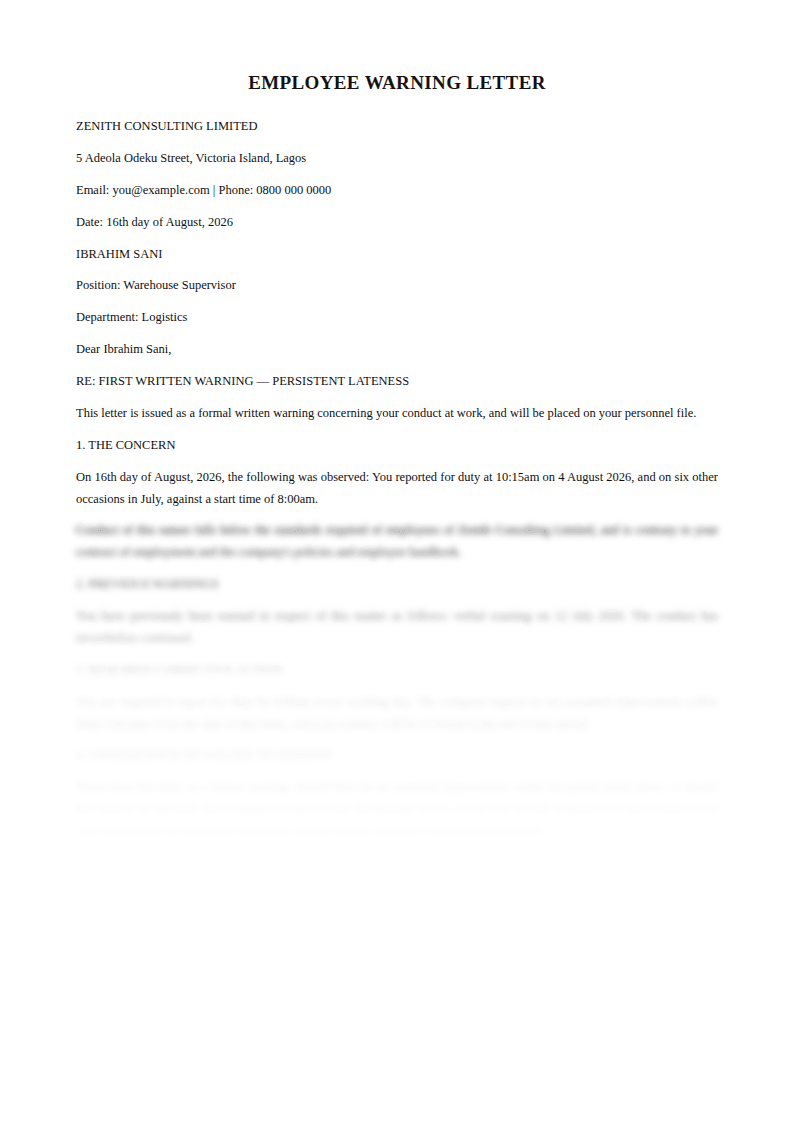
First written warning. The formal letter. Sets out the conduct, the standard expected, and the consequence of repetition.
Final written warning. States plainly that a further breach may result in dismissal.
Dismissal. Following a hearing, with notice or pay in lieu as the contract and the Labour Act require.
Gross misconduct is the exception. Theft, violence, serious dishonesty and similar may justify moving straight to a disciplinary hearing without prior warnings. Even then, the hearing itself is not optional.
What the Letter Must Contain
The employee's name, role and the date. Obvious, and routinely missing.
What happened, specifically. Dates, times, incidents. "Poor attitude" is not a fact. "Arrived at 10.15 on 3, 6 and 11 September when the shift starts at 8.00" is.
The standard expected. Reference the employment contract or the staff handbook clause if there is one.
What was said in response. Record that the employee was given a chance to explain and what they said. This single paragraph does more work than the rest of the letter.
What must change, and by when. A measurable expectation and a review date.
The consequence. What follows if the conduct continues.
How long it stays live. Six or twelve months is normal.
Signature blocks for both. Including a line for the employee to acknowledge receipt.
If the Employee Refuses to Sign
Common, and not a problem if you handle it properly. The signature acknowledges receipt, not agreement.
If they refuse, note the refusal on the letter, have a witness present sign to confirm it was handed over and refused, and send a copy by email or to their address on file. The record that it was delivered is what matters, not their signature.
Hearing the Employee First
Before issuing a formal written warning, let the employee put their side. It does not need to be elaborate: tell them the concern, give them a short time to prepare, meet with them, take notes, and let them bring a colleague if your handbook allows it.
Skipping this is the most common procedural failure in Nigerian workplaces and the easiest one for an employee to point to later. It costs an hour. Its absence can cost a year's salary in compensation.
Mistakes That Undermine the Warning
Vagueness. A letter that does not say precisely what happened proves nothing.
Emotion. Write it the day after, not the hour after.
Inconsistency. Warning one employee for lateness while ignoring another is the fact pattern that turns a discipline case into a discrimination case.
No review date. Without one, nobody can say whether the employee improved.
Not keeping the file. A warning that cannot be produced did not happen.
Frequently Asked Questions About Warning Letters in Nigeria
How many warnings before I can dismiss someone? There is no fixed statutory number. Common practice is a verbal warning, a first written warning and a final written warning, with dismissal after that. What matters at the National Industrial Court is that the process was fair and documented, not the count.
Can I dismiss without any warning? For gross misconduct such as theft, violence or serious dishonesty, yes, but you still need a disciplinary hearing where the employee is told the allegation and allowed to respond. Skipping the hearing is what loses these cases.
What if the employee refuses to sign? The signature confirms receipt, not agreement. Note the refusal on the letter, have a witness confirm it was handed over, and send a copy by email or to the address on file.
How long does a warning stay on file? Usually six or twelve months, and the letter should say which. After that it should not be relied on for further discipline unless your handbook provides otherwise.
Does the employee have to be paid during a suspension? Suspension pending investigation is normally on full pay unless the contract clearly says otherwise. Unpaid suspension imposed as a punishment without contractual authority is risky.
Getting Your Warning Letter Right
Read next: documenting misconduct properly and how to dismiss somebody without ending up at the National Industrial Court.
A good warning letter is specific about what happened, records that the employee was heard, and says plainly what happens next. That is the document that makes a later decision defensible.
Answer a few questions and you will have a warning letter written for Nigerian use, with the procedure and the wording the National Industrial Court expects to see, ready to download in Word and PDF.