
How to Write a Child Support Agreement
A child support agreement records what one parent pays the other for the children. Written down, it stops being a monthly negotiation.
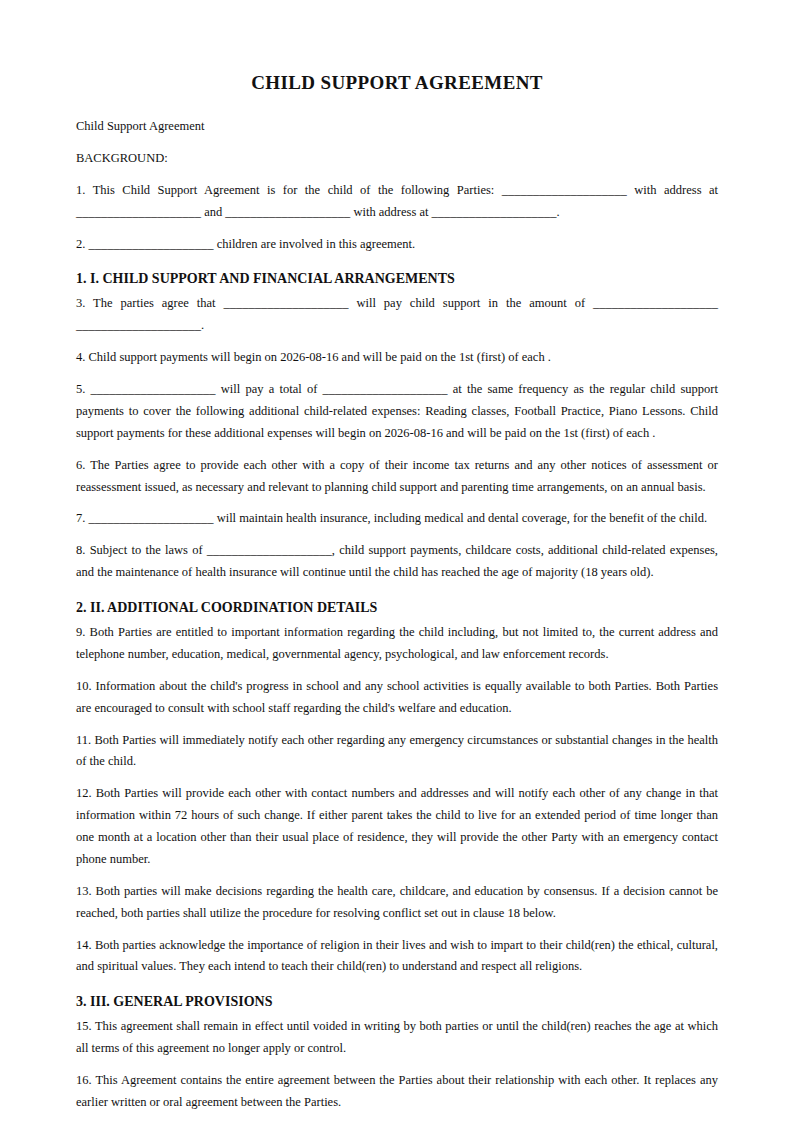
What a child support agreement is
A child support agreement records what one parent will pay the other towards the cost of raising their children.
It covers the regular amount, how often it is paid, when it starts, and what happens about costs that fall outside the routine figure: school fees, medical bills, lessons and activities.
Writing it down changes the dynamic. An informal arrangement is renegotiated every time money is short, and the parent receiving it has nothing to point to. A written agreement makes the obligation concrete and gives both sides a reference rather than a monthly conversation.
One thing to understand about its status: the obligation to maintain a child in Nigeria does not come from this agreement. It exists in law regardless, and under the Child's Rights Act a child's welfare is the paramount consideration. A court is not bound by what the parents agreed and can order something different where the child's needs require it. The agreement is what the parents have decided between themselves, and it is far better than nothing.
Who needs one
Separated or divorced parents settling maintenance without going to court.
Parents who were never married and are agreeing arrangements for their children.
Anybody whose informal arrangement keeps breaking down and needs something more definite.
Parents about to formalise a separation, where child support usually sits alongside the wider settlement.
Where the relationship between the parents is hostile, or where one parent is concealing income, a court order is more useful than an agreement, because it is directly enforceable.
Before you start
Work out the real numbers first.
What the children actually cost: school fees, food, clothing, healthcare, transport, activities.
What each parent can genuinely contribute, since an agreement set above what somebody can pay simply fails in month three.
Which expenses will be covered by the regular payment and which will be shared separately.
How the payment will be made, so it is traceable.
And how the figure will be reviewed, because school fees rise and children get more expensive as they grow.
The walkthrough
Filling in the form, step by step
Every question you will be asked, what it means, and an example of a good answer.
Step 1 of 2
Child Support Agreement
The parents and the children
This step names both parents and identifies the children the agreement is for.
The first party is the parent paying and the second is the parent receiving on the children's behalf. That phrasing matters: the money is for the children rather than for the other parent, and treating it as such tends to make these arrangements work better.
Name the children individually with their dates of birth. This is not a formality. Child support obligations usually run until a child reaches a certain age or finishes education, and an agreement that does not identify each child cannot say when the obligation for any of them ends.
Complete only the box matching the number of children, and use it to list each one properly. Where children have different needs, such as one in university and one in primary school, note that too, since it may justify treating them differently.
- First Party's Full name (the party making the child support payment)
- The full name of the parent making the payments, as it appears on their identification. This is the party taking on the obligation, so identify them precisely.
- First Party's Address
- Their address for correspondence about the arrangement. Keep it current, since a parent who moves without telling the other is a common practical problem.
- Second Party's Full name (the party receiving the payment on behalf of the child(ren)
- The full name of the parent receiving the payments on the children's behalf. The money is for the children rather than for this parent, and arrangements tend to work better when both sides treat it that way.
- Second Party's Address
- Their address, and where the children live if that is the same place. It also determines which state's courts would deal with any application about the children.
- How many dependent children?
- How many children the agreement covers. Complete only the box matching your answer, and list each child individually there.
- One child
- If one child, give their full name and date of birth. The date matters because the obligation usually runs until a certain age or the end of education, and without it the agreement cannot say when it ends.
- Two children
- If two children, list both with full names and dates of birth. Note any difference in their circumstances, such as one at university and one in primary school, since that may justify different treatment.
- Three children
- If three children, list each with full name and date of birth. Consider whether the total is a single figure or an amount per child, since the two behave differently as children age out.
- Four Children
- If four children, list each with full name and date of birth. With larger families it is worth stating whether the payment reduces as each child ceases to be dependent.
- Five Children or more
- If five or more, list each with full name and date of birth. Also say how the amount changes as individual children reach the end of the support period, otherwise the whole figure runs on indefinitely.
Step 2 of 2
Child Support Agreement
The money, the timing and the extras
This step sets the amount and, importantly, deals with the costs that fall outside it.
The regular payment is the predictable part. Set it against what the children actually cost and what the paying parent can genuinely afford, because an agreement pitched above someone's real capacity collapses within a few months and leaves everybody worse off.
Frequency should match how the paying parent is paid. A monthly payment from somebody paid monthly is far more reliable than a weekly one they have to remember four times.
The additional maintenance question is where these agreements earn their keep. School fees, uniforms, medical treatment, examination fees and activities are the costs that generate arguments, because they arrive irregularly and are often substantial. Say which of them the regular payment already covers and how the rest are shared, whether equally, in proportion to income, or by one parent taking specified categories.
Also worth adding, though the form does not ask: how the amount will be reviewed. Children get more expensive and school fees rise, and an agreement with no review mechanism becomes inadequate and then contentious.
- The Amount to be paid as child support?
- The regular amount. Set it against what the children genuinely cost and what the paying parent can actually afford, since a figure pitched too high collapses in a few months and helps nobody.
- How often will the payment be made?
- How often payment is made. Match it to how the paying parent is paid, since a monthly payment from somebody paid monthly is far more reliably made than a weekly one.
- Weekly
- If weekly, state the day, for example every Friday. A fixed day removes the ambiguity that turns a late payment into an argument.
- Monthly
- If monthly, state the date, for example the first of each month. Align it with the paying parent's payday where you can, since payments made from an empty account are the usual failure.
- State the period in which payment would be made?
- If another interval, describe it, for example quarterly on the first day of the quarter. Also say how long the obligation runs: until each child reaches a stated age or completes education.
- Date when the child support payment will begin?
- When payments start. Where support has already been paid informally, note that history rather than implying the obligation begins today.
- The amount to be paid as additional maintenance expenses not covered in the initial child support payment
- What is paid towards costs outside the regular figure. These are the ones that cause arguments, because school fees and medical bills are large and arrive irregularly, so being explicit here prevents most disputes.
- Describe the additional maintenance
- Which costs this covers, for example school fees, uniforms, examination fees, medical treatment and activities. Say whether they are shared equally, in proportion to income, or allocated by category to one parent.
- The state where the children reside?
- The state the children live in. It governs the agreement and determines which courts would deal with any later application about them, so it follows the children rather than either parent.
Ready to make yours?
Answer those questions in the builder and download a finished child support agreement in Word and PDF.
Start now, ₦10,000After you download it
Pay by traceable transfer
Bank transfer with a clear reference. Cash payments to a parent leave no record, and the argument about what was paid is the most common child support dispute.
Keep the payment record
Both parents should keep it. It protects the paying parent against a claim of arrears and the receiving parent against a claim that more was paid than actually was.
Agree a review point
Costs rise as children grow. Building in an annual review keeps the figure realistic and prevents the agreement quietly becoming inadequate.
Consider making it a court order
A consent order is directly enforceable in a way an agreement between parents is not. Where relations are difficult, that difference matters.
Questions people ask
Is a child support agreement legally binding in Nigeria?
It is a contract between the parents, but the duty to maintain a child exists in law regardless. A court is not bound by what the parents agreed and can order differently where the child's welfare requires it.
How much child support should be paid?
There is no fixed formula. Work from what the children actually cost and what the paying parent can genuinely afford, since a figure set above real capacity fails within months.
What about school fees and medical bills?
Deal with them separately from the regular payment. They are large, irregular and the most common source of argument, so say explicitly which are covered and how the rest are shared.
How long does child support last?
Usually until the child reaches a stated age or completes their education. State it in the agreement, and identify each child by date of birth so the end point is calculable.
What if the paying parent stops paying?
A written agreement gives you something to rely on, and a child support demand letter is the usual next step. A consent order is directly enforceable in a way an agreement is not.
Should payments be made in cash?
No. Use traceable bank transfers with a clear reference. Cash leaves no record, and disputes about what was actually paid are the most common problem in these arrangements.
Documents that go with this
Terms used on this page
Maintenance
Maintenance is financial support for a child or a spouse. Both parents owe it to their children regardless of whether they were married, and it is the child's entitlement rather than the other parent's.
Guardianship
Guardianship is legal responsibility for a child who is not your own, or for an adult who cannot manage their own affairs. For parents, the point of it is naming in advance who takes care of your children if you are not there.
Child Custody
Child custody is the court decision about who a child lives with and who makes decisions for them after a separation. In Nigeria the only test that matters is the welfare of the child.
Divorce
Divorce is the legal ending of a marriage by court order. In Nigeria there is only one ground, that the marriage has broken down irretrievably, and it has to be proved by one of the facts the law lists.
Settlement Agreement
A settlement agreement records the terms on which a dispute ends, including what is paid and what claims are given up. It is the cheapest way to end most disputes and the most commonly rushed.
Next of Kin
Next of kin is the person you name on a form as your closest relative and first point of contact. In Nigeria it is widely believed to decide who inherits your property. It does not.
Affidavit
An affidavit is a written statement of facts that you swear is true, signed in front of someone authorised to take oaths. Once sworn, it becomes evidence a court or government office can rely on.
Marriage
Marriage in Nigeria comes in three forms: statutory, customary and Islamic. They are governed by different laws, dissolved by different courts, and they produce different rights over property and inheritance.
Read more on this
Travel Consent for a Child in Nigeria: What Parents Must Know
Travel Consent for a Child in Nigeria: What Parents Must Know Before Any Domestic or International Trip Taking a child on a trip sounds routine until the paperwork comes into play. The moment a child is traveling alone,…
Where to Get Legal Documents Online in Nigeria
Where to Get Legal Documents Online in Nigeria Running a business or managing personal affairs often requires legal documentation. Whether you are starting a company, hiring a freelancer, creating a partnership agreement…
Understanding Prenuptial Agreements: All You Need to Know
Prenuptial agreements, often abbreviated as “prenups,” are legal contracts entered into by couples before marriage, outlining the ownership and division of assets in the event of a divorce or death. Historically viewed…
Step by step guides for every document on LegalDoc
Browse all guides