
How to Write a Divorce Settlement Agreement
A settlement agreement records what a separating couple have agreed about money, property and children. In Nigeria only a court dissolves the marriage.
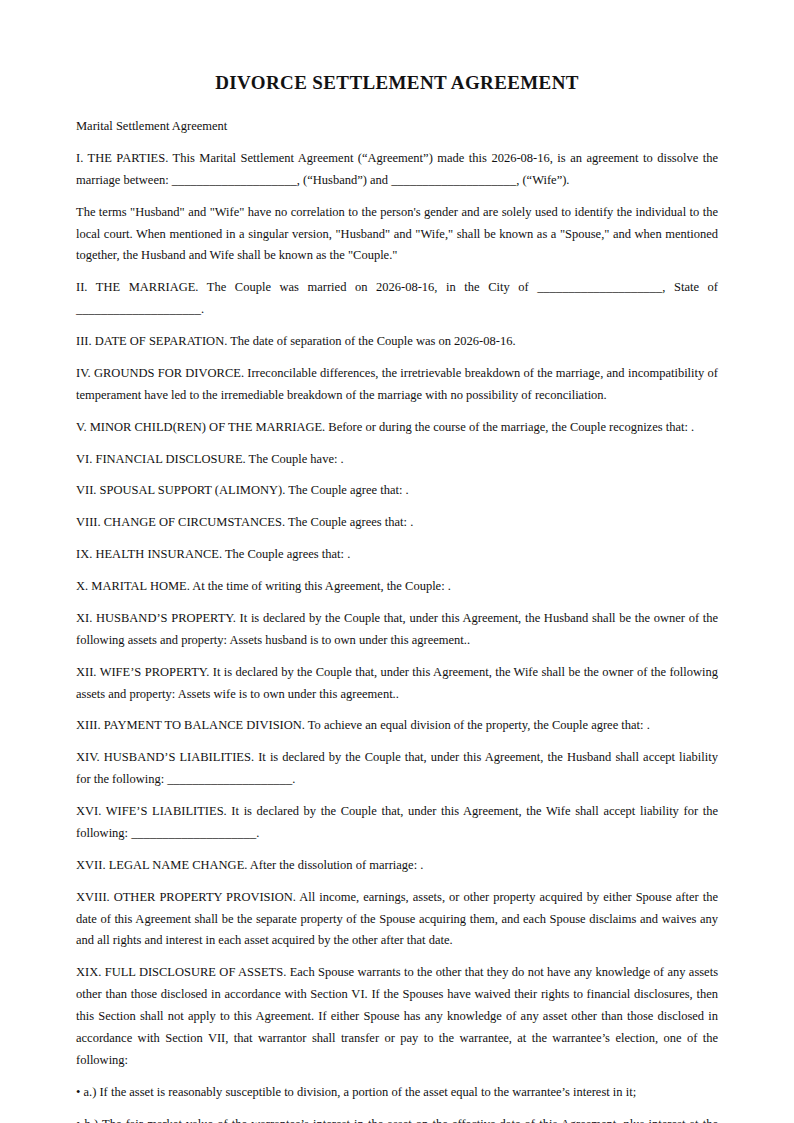
What a divorce settlement agreement is
A divorce settlement agreement records what a separating couple have agreed about their property, their finances and their children.
One thing to be clear about at the outset: this document does not end a marriage. In Nigeria a statutory marriage is dissolved only by a court, on a petition, where the court is satisfied the marriage has broken down irretrievably on one of the grounds the Matrimonial Causes Act provides. An agreement between the parties, however comprehensive, is not a divorce.
What it does is settle the terms, so that when the petition is filed the parties are asking the court to endorse an arrangement rather than to impose one. That difference is enormous in cost, time and acrimony.
The court retains its own jurisdiction over the children regardless of what the parents agreed, because a child's welfare is the paramount consideration and cannot be bargained away.
Who needs one
Couples who have decided to separate and want the terms recorded before instructing lawyers.
Parties preparing a petition who intend to ask the court to adopt agreed terms.
Separating couples who are not divorcing immediately but need clarity about property and children in the meantime.
Anybody who wants to reduce the cost and duration of a divorce, since contested financial proceedings are where most of the expense sits.
Where there has been violence, coercion, or where one party is concealing assets, an agreement negotiated directly is not appropriate and independent representation is needed.
Before you start
Both parties should do this before negotiating.
List every asset and every debt, honestly. An agreement built on concealed assets is liable to be set aside when the concealment surfaces.
Get advice separately. Shared advice in a matter with opposing interests is not advice.
Think about the children first, since their arrangements are the part a court will examine most closely.
Be realistic about what each party can afford afterwards, because an agreement that leaves one party unable to live is one that returns to court.
And take your time. An agreement signed in the first raw weeks of a separation is rarely a good one.
The walkthrough
Filling in the form, step by step
Every question you will be asked, what it means, and an example of a good answer.
Step 1 of 5
Divorce Settlement Agreement
The parties and the marriage
The agreement opens by identifying the couple and the marriage.
Name both parties in full. Where either has changed their name during the marriage, note the former name too, since property and accounts may be registered in it.
The city and state of the marriage matter because they establish which marriage this concerns and which registry holds the record. A certified copy of the marriage certificate will be needed for any petition, so it is worth locating now.
They also matter for a more substantive reason: whether the marriage was statutory under the Marriage Act or customary determines which framework applies to its dissolution, and the two are genuinely different. A statutory marriage is dissolved by the High Court under the Matrimonial Causes Act. A customary marriage follows a different route. If you are uncertain which you have, resolve that before going further, because it affects everything downstream.
- Date on this agreement
- The date the parties sign. Where the separation happened some time ago, this is the date of the agreement rather than of the separation, which is asked separately.
- Husband's full name
- His full legal name as on the marriage certificate and identification. Note any former name, since assets may be registered under it.
- Wife's full name
- Her full legal name, both as on the marriage certificate and as currently used if different, for the same reason.
- City where the parties were married?
- The city of the marriage, which together with the state identifies the record and the registry holding it.
- State where the parties were married?
- The state of the marriage. It also bears on whether the marriage was statutory under the Marriage Act or customary, which determines how it can be dissolved and by which court.
Step 2 of 5
Divorce Settlement Agreement
Separation, children, disclosure and support
This step covers the four foundational questions, and two of them carry particular weight.
The date of separation is significant beyond record keeping. It is relevant to the grounds for a petition and to how assets acquired afterwards are treated.
On children, whatever the parents agree, the court retains jurisdiction and will apply the welfare principle. Set out custody, access and maintenance in as much detail as you can, because a court asked to endorse a workable arrangement usually will, while a vague one invites the court to substitute its own.
Financial disclosure is the question to think hardest about. The form offers a right to waive it, and waiving it is almost always a mistake. Disclosure is what makes an agreement fair and what makes it durable. An agreement signed without knowing what the other party has is vulnerable to being set aside when the truth emerges, and the party who waived is the one who suffers.
Spousal support should be set against what each party can genuinely afford and genuinely needs. An agreement pitched beyond somebody's capacity simply returns to court.
- Date of Separation?
- When the parties separated. It is relevant to the grounds for a petition and to how assets acquired after that date are treated.
- Children
- Whether there are minor children. Their arrangements are the part a court examines most closely, since the child's welfare is the paramount consideration and cannot be bargained away by the parents.
- Yes, there minor children
- If there are minor children, set out custody, access and maintenance in detail: who they live with, when the other parent sees them, what is paid and by whom. A court will usually endorse a workable arrangement and substitute its own for a vague one.
- No, there are no minor children
- If there are no minor children, state it. Note any adult children with continuing needs, such as one still in education, since provision for them may still be worth recording.
- Financial Disclosure
- Whether the parties disclose their finances or waive that right. Choose disclosure. Waiving it makes an agreement vulnerable to being set aside later, and the party who waived is the one who loses by it.
- Disclosure
- If disclosing, describe what each party has provided: assets, income, debts, pensions and business interests. Attaching schedules is better than a general statement that disclosure took place.
- Waive
- If waiving, record that both parties understood what they were giving up and had independent advice. Understand that an agreement made without disclosure is the easiest kind for a court to disregard.
- Spousal Support
- Whether one party will support the other. Set it against what the payer can genuinely afford and the recipient genuinely needs, since an unaffordable figure returns to court within the year.
- No spousal support
- If no support is payable, record that both parties agreed it and that each is able to support themselves, since a court considering the agreement will want to see that this was a considered position.
- There shall be spousal support
- If support is payable, state the amount, the frequency, when it starts and how long it continues, whether for a fixed period, until remarriage, or otherwise.
Step 3 of 5
Divorce Settlement Agreement
Changing support, insurance, the home and assets
This step deals with the property and the durability of the financial terms.
The question about whether spousal support can change is more consequential than it appears. Fixing it permanently gives certainty and removes the ability to respond when circumstances shift, and circumstances do shift: people lose jobs, fall ill and remarry. Allowing variation preserves flexibility at the cost of certainty. Neither is wrong, and the choice should be deliberate rather than accidental.
The home is usually the largest asset and the hardest question. Whatever is agreed, the agreement is only half of it: the legal title has to be dealt with too. Where a property is transferred from one spouse to the other, that requires a deed of assignment, stamping, consent and registration in the ordinary way. An agreement saying the wife shall have the house, with nothing done at the land registry, leaves the title exactly where it was.
The asset schedules should be specific. Describe property by address, vehicles by registration, accounts by institution. A list saying the furniture and the car is an argument waiting to happen.
- Future change in spousal support
- Whether the support figure can be varied later. Fixing it gives certainty and removes flexibility when jobs are lost or health changes. Allowing variation does the reverse. Choose deliberately rather than by default.
- cannot change
- If fixed, record that both parties understood the amount cannot be revisited whatever happens to their circumstances, since that is a significant thing to accept.
- Can change
- If variable, say what triggers a review: a change in income, remarriage, a fixed interval. A right to vary with no mechanism produces a negotiation rather than an adjustment.
- Parties health insurance
- Whether health cover is provided for either party. Where one spouse was covered under the other's employment scheme, that usually ends with the marriage, which is worth addressing now rather than discovering later.
- No provision
- If no provision is made, state it, so neither party assumes cover continues when it does not.
- There is provision for insurance
- If provision is made, describe it: who is covered, under what policy, who pays, and for how long it continues.
- Do parties own a home (either jointly or inidividuallly
- Whether either party owns a home, jointly or individually. This is usually the largest asset and the hardest question in the settlement.
- do not
- If neither owns a home, state it, and note the position on any rented property: who remains in occupation and who is responsible for the rent.
- parties do own a home
- If a home is owned, describe it by address and title, and say what happens: sold and proceeds divided, transferred to one party, or retained jointly. Remember a transfer needs a deed, stamping, consent and registration, since the agreement alone does not move title.
- Husband's assets
- What he retains, described specifically: property by address, vehicles by registration, accounts by institution, business interests by company name. General descriptions are what later arguments are built on.
- Wife's asset
- What she retains, described with the same specificity. Anything valuable and not listed is something the parties will disagree about afterwards.
Step 4 of 5
Divorce Settlement Agreement
Cash payments and liabilities
This step deals with money moving between the parties and the debts each takes on.
A cash payment is often what balances an uneven division of assets, where one party keeps the house and compensates the other. State the amount, when it is paid, and how. An obligation to pay with no date attached is an obligation nobody performs.
The liability schedules matter as much as the asset schedules and get far less attention. Debts do not disappear on divorce, and, importantly, an agreement between spouses does not bind a lender. If a loan is in joint names, the bank can pursue either party regardless of which of them agreed to take responsibility for it.
That is the point to understand here. Agreeing that the husband will service the joint loan protects the wife only as between the two of them. If he stops paying, the bank comes to her, and her remedy is against him rather than against the debt. Where possible, joint debts should actually be refinanced into one name rather than simply allocated on paper.
- Cash payment
- Whether one party pays the other a sum. This is usually what balances an uneven division, such as one party keeping the family home.
- Cash payment made
- If a payment is made, state the amount, who pays whom, when, and by what method. An obligation with no date attached is one that does not get performed.
- No cash payment
- If no payment is made, record it, so neither party later suggests a balancing sum was contemplated.
- List of liabilities husband is willing to accept
- The debts he takes on, listed by lender and account. Note that this binds him to her, not to the lender: a joint debt remains enforceable against both whatever the parties agreed between themselves.
- List of liabilities wife is willing to accept
- The debts she takes on, on the same basis and with the same caution. Where a debt is joint, consider refinancing it into one name rather than allocating it on paper, since only that actually releases the other party.
Step 5 of 5
Divorce Settlement Agreement
Name change and anything else
The final step handles the name question and gives you space for everything the form has not asked.
A name change after divorce is a personal decision and the agreement simply records what was agreed. Reverting to a former name involves practical steps beyond this document: passport, bank accounts, identification and property records all need updating, and each institution has its own process.
The additional terms box is where the rest belongs, and there is usually a good deal.
What happens to a jointly owned business. How pensions and retirement savings are treated. Who keeps items of sentimental value. What happens to a joint bank account. Whether either party can claim against the other's estate. And how any future disagreement about this agreement will be resolved.
One further point worth recording: that both parties entered the agreement freely, with independent advice, after disclosure. A court asked to endorse the terms will look for exactly that, and stating it in the document is worth doing.
- Name change
- Whether either party will change their name. It is a personal decision and the agreement simply records what was agreed rather than compelling anything.
- no name change
- If no name change, record it. It closes off the assumption that a reversion was expected.
- Change of name
- If a name change is agreed, state the name being adopted. Note that the practical steps sit outside this document: passport, bank accounts, identification and property records each need updating separately.
- Any additional terms
- Everything the form has not asked, and there is usually a good deal: a jointly owned business, pensions and retirement savings, sentimental items, joint accounts, claims against each other's estates, and how a future disagreement about this agreement is resolved. Also record that both parties signed freely, after disclosure and with independent advice, since a court will look for exactly that.
Ready to make yours?
Answer those questions in the builder and download a finished divorce settlement agreement in Word and PDF.
Start now, ₦10,000After you download it
Remember this is not a divorce
A statutory marriage in Nigeria is dissolved only by a court on a petition. This agreement settles the terms; it does not end the marriage.
Each party takes their own advice
Separately, from different advisers. An agreement where one party had advice and the other did not is the easiest kind to challenge.
Actually transfer the property
A clause saying who gets the house does not move title. The transfer needs a deed, stamping, consent and registration in the ordinary way.
Deal with joint debts properly
Allocating a joint loan between yourselves does not release either party from the lender. Refinancing into one name is what actually achieves that.
Questions people ask
Does a settlement agreement end a marriage in Nigeria?
No. A statutory marriage is dissolved only by a court, on a petition, where it is satisfied the marriage has broken down irretrievably. The agreement settles the terms rather than the status.
Can we agree arrangements for the children ourselves?
You can propose them, and a court will usually endorse a workable arrangement. But the court retains jurisdiction, since a child's welfare is the paramount consideration and cannot be bargained away.
Should we waive financial disclosure?
Almost never. Disclosure is what makes an agreement fair and durable. One made without it is vulnerable to being set aside when the concealment emerges, and the party who waived loses by it.
Does the agreement transfer the house?
No. A clause saying who gets the property does not move legal title. The transfer requires a deed of assignment, stamping, consent and registration like any other conveyance.
What happens to joint debts?
They remain enforceable against both parties whatever you agreed between yourselves. Allocating a joint loan on paper does not bind the lender, so refinancing into one name is the only real solution.
Do we each need our own lawyer?
Yes. The interests are opposed, so shared advice is not advice. An agreement where only one party was advised is considerably easier to challenge later.
Documents that go with this
Terms used on this page
Divorce
Divorce is the legal ending of a marriage by court order. In Nigeria there is only one ground, that the marriage has broken down irretrievably, and it has to be proved by one of the facts the law lists.
Settlement Agreement
A settlement agreement records the terms on which a dispute ends, including what is paid and what claims are given up. It is the cheapest way to end most disputes and the most commonly rushed.
Marriage
Marriage in Nigeria comes in three forms: statutory, customary and Islamic. They are governed by different laws, dissolved by different courts, and they produce different rights over property and inheritance.
Maintenance
Maintenance is financial support for a child or a spouse. Both parents owe it to their children regardless of whether they were married, and it is the child's entitlement rather than the other parent's.
Child Custody
Child custody is the court decision about who a child lives with and who makes decisions for them after a separation. In Nigeria the only test that matters is the welfare of the child.
Guardianship
Guardianship is legal responsibility for a child who is not your own, or for an adult who cannot manage their own affairs. For parents, the point of it is naming in advance who takes care of your children if you are not there.
Deed of Assignment
A deed of assignment is the document that actually transfers land or property from a seller to a buyer in Nigeria. Without it, properly executed and registered, you have paid for land you cannot prove is yours.
Estate
An estate is everything a person owned when they died, less what they owed. It has to be gathered, the debts paid, and only what remains is distributed to the people entitled.
Read more on this
Understanding Prenuptial Agreements: All You Need to Know
Prenuptial agreements, often abbreviated as “prenups,” are legal contracts entered into by couples before marriage, outlining the ownership and division of assets in the event of a divorce or death. Historically viewed…
Travel Consent for a Child in Nigeria: What Parents Must Know
Travel Consent for a Child in Nigeria: What Parents Must Know Before Any Domestic or International Trip Taking a child on a trip sounds routine until the paperwork comes into play. The moment a child is traveling alone,…
Where to Get Legal Documents Online in Nigeria
Where to Get Legal Documents Online in Nigeria Running a business or managing personal affairs often requires legal documentation. Whether you are starting a company, hiring a freelancer, creating a partnership agreement…
Step by step guides for every document on LegalDoc
Browse all guides