
How to Write a Licensing Agreement
A licence lets somebody use what you own while you keep owning it. Territory, exclusivity and the royalty are where the money is.
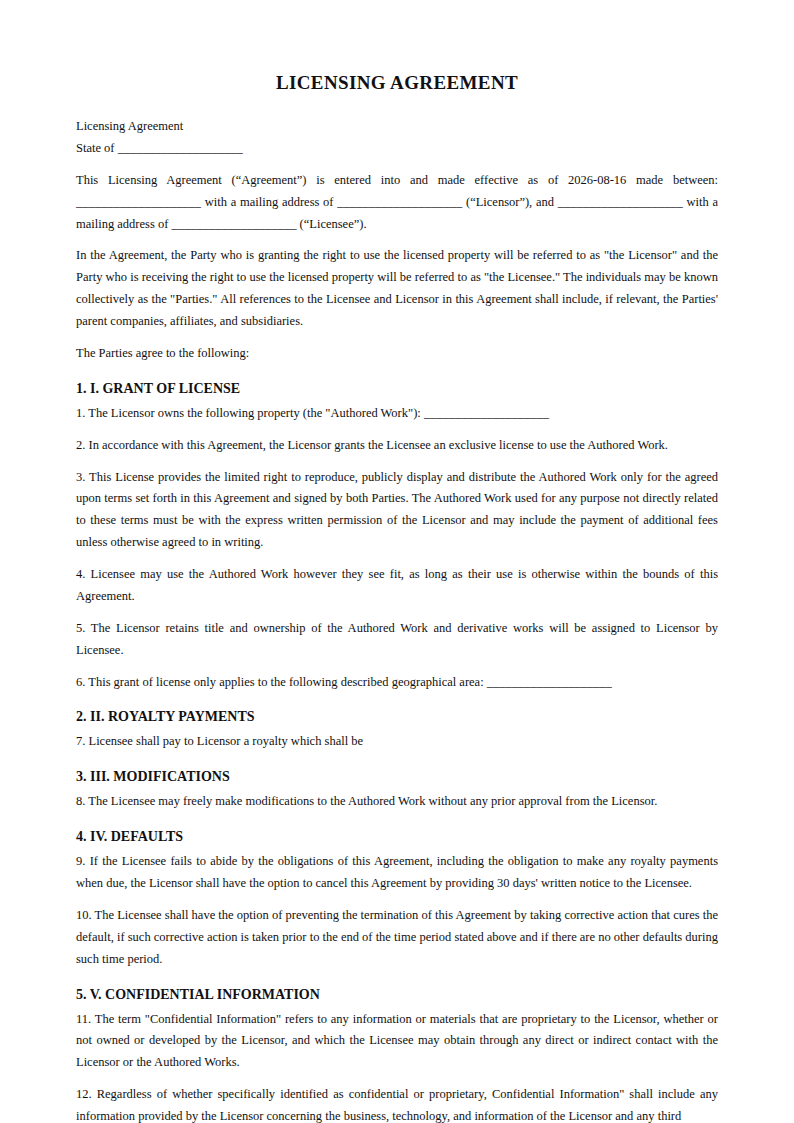
What a licensing agreement is
A licensing agreement gives one party permission to use something the other party owns, on defined terms, for a defined period.
What gets licensed varies. A trademark to a manufacturer, software to a business, a book to a publisher, a design to a producer, a recording to an advertiser. In each case ownership stays with the licensor and the licensee gets a right to use.
That is the distinguishing feature and the commercial appeal. The owner earns from an asset without parting with it, and can license it again elsewhere if the terms allow.
Three answers do most of the work in any licence: what exactly is covered, where it may be used, and whether anybody else may use it there. Everything else is machinery around those three.
Who needs one
Owners of intellectual property earning from it without selling it: brands, software, designs, recordings, written work, patented processes.
Businesses acquiring the right to use somebody else's asset in their own products or operations.
Manufacturers licensing a brand to produce goods under it.
Anybody who has been letting another business use their trademark or software on an informal understanding, which is common and unwise.
For a full business system including operating methods, training and ongoing support, a franchise agreement is the closer fit. A licence is narrower.
Before you start
Settle these before drafting.
Exactly what is licensed, identified precisely rather than generally.
The territory, which should be the smallest area that meets the licensee's actual need.
Whether the licence is exclusive, sole or non exclusive, since those are three different things and they price differently.
How you are paid: a single fee, a royalty, or a combination.
Whether the licensee may sublicense.
And how you will know whether they are reporting sales honestly, since a royalty you cannot verify is a royalty you cannot enforce.
The walkthrough
Filling in the form, step by step
Every question you will be asked, what it means, and an example of a good answer.
Step 1 of 2
Licensing Agreement
The law, the date and the parties
The agreement opens with the governing law and both parties, and it is worth noticing that the law question comes first.
That ordering reflects something real about licences. Intellectual property rights are territorial: a Nigerian trademark registration protects the mark in Nigeria and nowhere else. So the law governing the agreement and the territory the licence covers are related questions, and a licence of Nigerian rights sits most naturally under Nigerian law.
Name the licensor as the party that actually owns the asset. This deserves checking rather than assuming. A business licensing a trademark should hold the registration; a company licensing software should own it rather than having commissioned it without an assignment. A licensee acquires nothing from somebody who did not own what they purported to license.
The licensee should be the entity that will actually use the asset, since a licence to one company does not automatically extend to its group.
- What State laws will govern this agreement
- The state or country whose law governs. Intellectual property is territorial, so a licence of Nigerian rights sits most naturally under Nigerian law, and this should relate sensibly to the territory below.
- Date
- When the licence takes effect. Where the licensee has already been using the asset informally, use the honest date and deal with that earlier use expressly, since it was unlicensed.
- Licensor's Name
- The owner granting the licence. Verify they actually own it: a business licensing a trademark should hold the registration, and a company licensing software should own it rather than having commissioned it without an assignment.
- Licensor's Address
- The licensor's address, where royalty statements and notices are sent.
- Licensee's Name
- The party receiving the licence, named as the entity that will actually use the asset. A licence to one company does not automatically extend to its subsidiaries or affiliates.
- Licensee's Address
- The licensee's address for notices and for any audit or inspection the agreement provides for.
Step 2 of 2
Licensing Agreement
The work, the territory, the money and the end date
This step is the whole commercial bargain.
Describe what is licensed with precision. A trademark by its registration number, software by its name and version, a design by its reference, a recording by its title and date. Vague descriptions are how licensees end up using more than the licensor intended and how licensors end up unable to prove what was granted.
Use this space too for what the form does not separately ask, because these are the terms that decide the value of the licence.
Exclusivity. An exclusive licence prevents even the licensor from using the asset in that territory. A sole licence permits the licensor but nobody else. A non exclusive licence lets the licensor license others as well. Those are three different products at three different prices, and silence tends to be read against the party who drafted.
The permitted field of use. A licence to use a brand on clothing is different from one covering all products.
Whether the licensee may sublicense, and quality control over how the asset is used, which matters enormously for a trademark since uncontrolled use can undermine the mark itself.
On payment, a one off fee is simple and caps the licensor's upside. A royalty shares the success and creates a verification problem: state the rate, what it is calculated on, how often it is reported, and that you may inspect the records. A royalty you cannot audit is a royalty you cannot enforce.
- The Authored Work
- What is being licensed, identified precisely: a trademark by registration number, software by name and version, a design by reference. Use this space also to state whether the licence is exclusive, sole or non exclusive, the permitted field of use, whether sublicensing is allowed, and any quality control over how the asset is used. Those terms decide the value of the licence and the form does not ask for them separately.
- Geographical Area
- The territory the licence covers. Keep it to what the licensee actually needs, since intellectual property rights are territorial and worldwide is a far larger grant than one country. Granting more territory than the licensee can exploit takes it off the market for everybody else.
- Royalty
- How the licensor is paid. A one off fee is simple and caps your upside. A royalty shares the success and needs verification, so choose according to whether you can realistically monitor the licensee's sales.
- One-time fee
- If a single fee, the amount and when it is paid. Consider whether it should be staged, for example part on signature and part on first commercial use, rather than all at the outset.
- Alternative arrangement
- If a royalty or other arrangement, state the rate, what it is calculated on, how often the licensee must report, and that the licensor may inspect the records to verify. A royalty with no reporting and no audit right is one you cannot enforce.
- Termination Date
- When the licence ends. State also what happens at that point: whether stock already produced may be sold through, and that the licensee must stop using the asset. A licence that expires with no run off provision leaves both sides with a problem.
Ready to make yours?
Answer those questions in the builder and download a finished licensing agreement in Word and PDF.
Start now, ₦10,000After you download it
Register the underlying right first
Licensing a trademark you have not registered is licensing very little. Nigerian trademark registration is first to file, so secure the right before granting rights in it.
Keep quality control over a brand licence
A trademark licensed with no control over how it is used can be damaged by the licensee. Reserve approval rights over products and marketing.
Make the royalty auditable
Reporting obligations and an inspection right. Without them you are relying entirely on the licensee's own account of their sales.
Say what happens at the end
Whether remaining stock can be sold through, and confirmation that use stops. A licence that simply expires leaves both parties guessing.
Questions people ask
What is a licensing agreement?
Permission for one party to use something the other owns, on defined terms and for a defined period. Ownership stays with the licensor, who earns from the asset without parting with it.
What is the difference between exclusive, sole and non exclusive?
An exclusive licence stops even the licensor using the asset in that territory. A sole licence permits the licensor but nobody else. A non exclusive licence lets the licensor grant others too.
One off fee or royalty?
A fee is simple and caps your upside. A royalty shares the success but needs reporting and an audit right, since a royalty you cannot verify is one you cannot enforce.
How wide should the territory be?
As wide as the licensee can actually exploit and no wider. Intellectual property is territorial, and granting worldwide rights to a business operating in one country removes the asset from every other market.
Do I need to register a trademark before licensing it?
You should. Nigerian trademark registration operates on a first to file basis, and licensing an unregistered mark grants considerably less than either party assumes.
What is the difference between a licence and a franchise?
A licence permits use of a specific asset. A franchise licenses a whole business system including operating methods, training and ongoing support, and is a much more controlled relationship.
Documents that go with this
Terms used on this page
Licensing
Licensing is permission to use something you own without giving it away. The owner keeps the asset, the licensee gets defined rights for a defined period, and money usually flows as a royalty or a fee.
Intellectual Property
Intellectual property is the legal ownership of things you create rather than things you can touch, including trademarks, copyright, patents and designs. In Nigeria each type has its own registry and its own rules.
Trademark
A trademark is a sign that identifies your goods or services and distinguishes them from everybody else's, such as a name or a logo. Registering it in Nigeria is what makes it enforceable.
Copyright
Copyright is the automatic right you get over original work you create, such as writing, music, film, photographs and software. It protects the expression, not the underlying idea.
Royalty
A royalty is a payment for using something somebody else owns, usually calculated as a share of the revenue it generates. Musicians, authors, franchisors and patent holders all earn this way.
Exclusivity
Exclusivity gives one party sole rights: to distribute in a territory, to supply a customer, or to negotiate a deal without the other side talking to anybody else. It is valuable, and it should be earned.
Infringement
Infringement is using somebody's intellectual property without permission. What you have to prove, and what you can recover, depends on which right was infringed.
Distribution Agreement
A distribution agreement appoints somebody to buy your product and resell it in a territory. The distributor trades on their own account, which is what separates them from an agent.
Read more on this
Trademark Your Business Name in Nigeria Before Someone Else Does
What to Do When Someone Else Trademarks Your Brand
What to Do When Someone Else Trademarks Your Brand Few things are more frustrating for a business owner than discovering that someone else has registered a trademark that looks suspiciously similar to the brand you have…
How to Trademark a Catchphrase or Slogan
How to Trademark a Catchphrase or Slogan A catchphrase or slogan is often the most memorable part of a brand. Short, distinctive phrases such as advertising taglines, campaign slogans, or promotional expressions help con…
Step by step guides for every document on LegalDoc
Browse all guides