
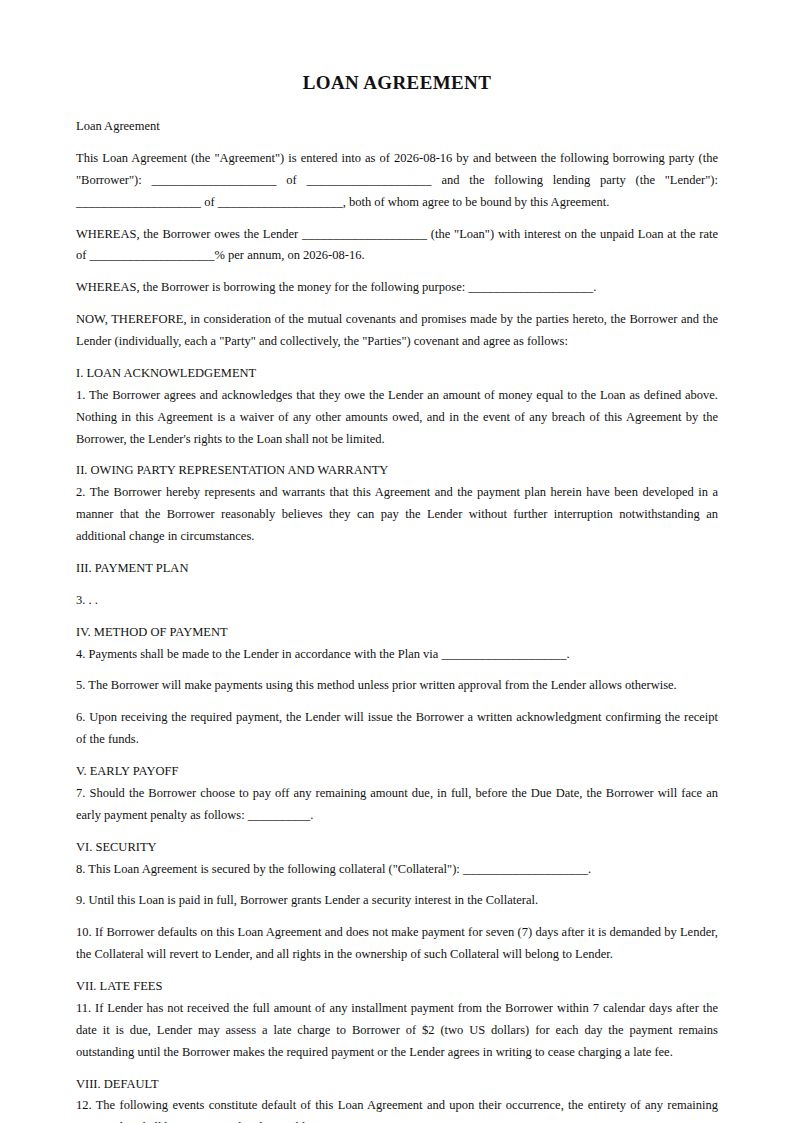
Loan Agreement in Nigeria: Putting It in Writing Before the Money Moves
A loan agreement records the terms on which one person or business lends money to another: how much, on what terms, when it comes back, and what happens if it does not.
Most loans between people who know each other are never written down, which is precisely why so many of them end friendships. The agreement is not a sign of distrust. It is the thing that lets both sides remember the same arrangement in twelve months.
Why a Written Agreement Changes Everything
An oral loan can be enforceable in Nigeria. Proving its terms is another matter entirely.
Without writing, you are asking a court to decide between two accounts of a conversation. Was it a loan or a gift? Was interest agreed? When was repayment due? The borrower says one thing, the lender says another, and the person with the weaker memory or the better story wins.
A signed agreement settles all of it in advance. It also starts the limitation clock clearly: under the Limitation Law in most states you have six years on a simple contract debt, running from when repayment fell due, and a written due date tells you exactly when that is.
What Belongs in the Agreement
The parties. Full legal names and addresses. For a company, the name exactly as registered at the Corporate Affairs Commission.
The amount, in figures and words. And the date the money is actually advanced, which is often not the date of the agreement.
Interest, or the absence of it. If interest is charged, state the rate, whether it is simple or compound, and the period. If the loan is interest free, say so explicitly. Silence invites an argument.
The repayment schedule. Lump sum or instalments, the dates, and the amount of each payment. Attach a schedule if there are many.
How payment is made. Account details, and confirmation that transfer to that account discharges the obligation.
Default. What counts as default, what notice the borrower gets, and what the lender may then do. Include default interest if you want it, at a rate that is defensible.
Security, if any. Described precisely enough to be identified and enforced.
Governing law and forum. Nigerian law, and the state whose courts will hear a dispute.
Security: What It Means and What It Costs
Security is property the lender can look to if the borrower does not pay. It turns an unsecured promise into something with an asset behind it.
Common forms in Nigeria include a legal mortgage over land, a charge over company assets, a pledge of shares, or a personal guarantee from a director or third party.
Two practical points. First, security over land requires the Governor's consent under the Land Use Act for a legal mortgage to be effective, and that takes time and money. Second, a charge created by a company must be registered at the Corporate Affairs Commission within the period CAMA 2020 allows. An unregistered charge can be void against a liquidator and other creditors, which means the lender is unsecured at exactly the moment security mattered.
A personal guarantee is the lighter option and is common for small business lending. The guarantor should understand that they are agreeing to pay the debt themselves, not merely to encourage the borrower to pay.
Interest, and Where Lenders Overreach
Parties are generally free to agree a rate. That freedom is not unlimited in practice.
A rate so high that it is oppressive can be challenged, and Nigerian courts have reduced default interest that looked more like a penalty than a genuine pre-estimate of loss. A default rate of a few points above the ordinary rate is defensible. A rate that multiplies the debt in months is asking to be struck down.
If you are lending as a business rather than privately, be aware that moneylending is regulated in most states, and lending commercially without the relevant licence can affect your ability to enforce. Occasional private lending to somebody you know is a different matter.
Signing, Witnessing and Stamping
Both parties sign, and each signature should be witnessed by somebody who is not a party and does not benefit under the agreement. The witness signs at the same time and writes their name, address and occupation.
Stamp the agreement under the Stamp Duties Act. Duty on a loan agreement is modest, and an unstamped instrument can be objected to when you try to tender it in evidence.
Each party keeps an originally signed copy. Initial every page. If money is advanced in tranches, record each advance in writing as it happens rather than relying on the agreement alone.
If the Borrower Stops Paying
Follow the agreement. Give the notice it requires, in writing, and keep proof of sending.
A demand letter setting out the arrears, the total now due, and a deadline is the usual next step and resolves a great many defaults without a claim. If it does not, your route depends on the amount: the Magistrate Court or a Small Claims Court for smaller sums, the High Court for larger ones or where security is being enforced.
If you took security, enforcing it has its own procedure and its own costs, and this is the point at which advice is worth paying for rather than improvising.
Frequently Asked Questions About Loan Agreements in Nigeria
Is a verbal loan agreement enforceable in Nigeria? It can be, but proving the terms is the difficulty. Without writing a court has to choose between two accounts of what was agreed. A signed agreement removes that problem and fixes the repayment date, which also fixes when the limitation period starts running.
What interest rate can I charge? Parties can generally agree a rate, but a rate that is oppressive can be challenged, and courts have reduced default interest that looks like a penalty rather than a genuine estimate of loss. Lending commercially may also require a moneylender's licence in your state.
Does a loan agreement need to be stamped? Yes, under the Stamp Duties Act. The duty is modest and an unstamped instrument can be objected to when you try to rely on it in court.
What is the difference between security and a guarantee? Security is property the lender can look to, such as a mortgage over land or a charge over company assets. A guarantee is a person promising to pay the debt if the borrower does not. A company charge must be registered at the Corporate Affairs Commission or it can be void against a liquidator.
How long do I have to recover the money? Generally six years from the date repayment fell due, under the Limitation Law of most states. Acknowledgement of the debt in writing or a part payment can restart that period.
Getting Your Loan Agreement Right
Read next: why every loan needs a proper agreement and the dispute resolution clause most lenders leave out. Taking somebody else as security too? See the personal guarantee.
The loans that end in court are almost always the ones where the terms were obvious to both sides at the time and remembered differently afterwards.
Answer a few plain questions and you will have a loan agreement written for Nigerian use, covering the amount, the interest, the schedule, default and any security, ready to download in Word and PDF.