
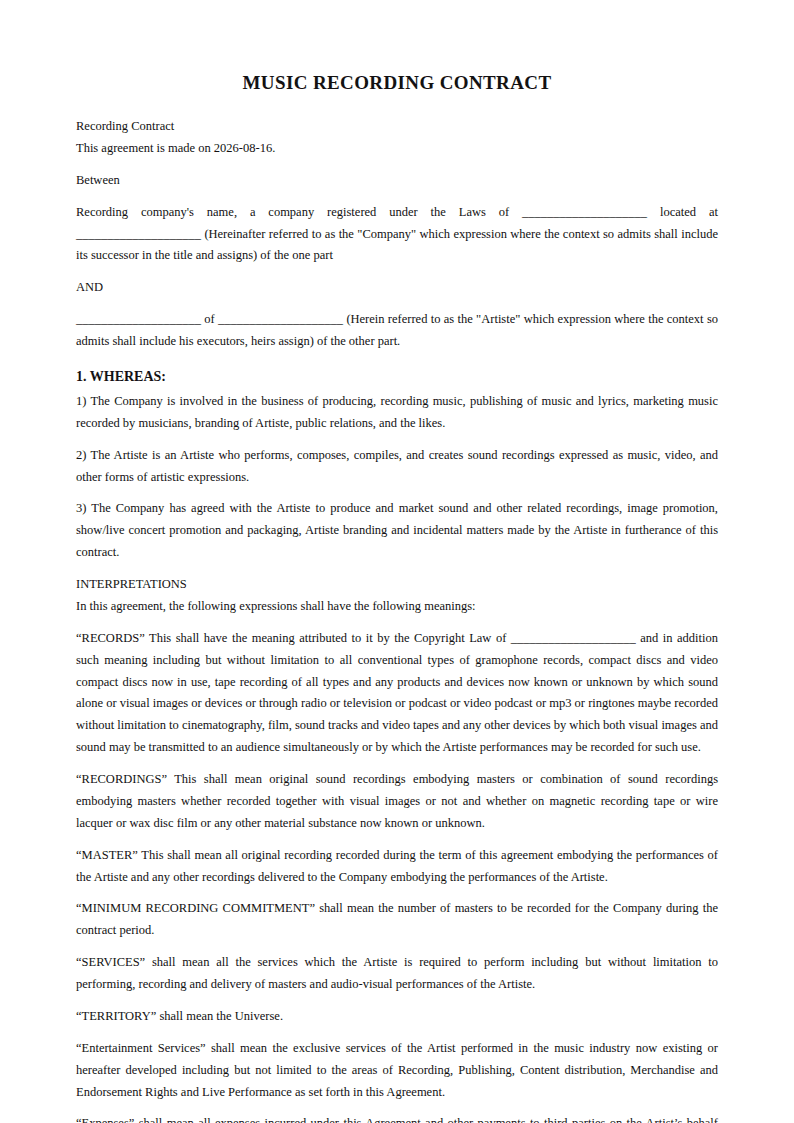
Music Recording Contract in Nigeria
A recording contract sets out the relationship between an artist and whoever is funding, recording, releasing and promoting their music. It decides who owns the recordings, how the money is split, how long the artist is tied in, and what happens when the relationship ends.
Nigerian music travels globally now, and the value in a catalogue can appear years after it was signed away. Which means the contract signed by a nineteen year old in a studio in Surulere is doing work a decade later, in markets nobody mentioned at the time.
Two Separate Things People Confuse
Every song has two distinct copyrights, and conflating them is the commonest and costliest mistake in Nigerian music deals.
The sound recording, called the master. This is the specific recorded performance. Labels normally want to own or control it, because it is what streams and gets licensed to adverts and films.
The musical work, the composition: the melody, the lyrics, the underlying song. This belongs to the writers and is the publishing side.
A recording contract should deal with the master. If it also sweeps up the publishing, the artist is giving away two assets for one payment. Separate them, and price them separately.
Under the Copyright Act 2022 an assignment of copyright and an exclusive licence must be in writing, so whatever is transferred has to be spelled out on the page. Nothing moves by handshake.
Assignment or Licence, and For How Long
If the label takes an assignment of the masters, it owns them, potentially for the full copyright term. If it takes an exclusive licence, it controls them for the licence period and they revert to the artist afterwards.
A licence with reversion after a defined period, commonly seven to fifteen years from release, is far better for an artist and is entirely negotiable. So is a reversion trigger tied to the label failing to exploit the recordings, or to recoupment being achieved.
Also nail down territory and the number of recordings. A deal for "all recordings during the term, worldwide, in perpetuity" is the widest grant there is, and it should cost accordingly.
Advances, Recoupment and Why Royalties Arrive Late
An advance is not a fee. It is money paid up front and recovered from the artist's future royalties. Recording costs, video budgets, marketing spend and tour support are commonly recoupable too, meaning the artist pays them back out of their share before seeing anything.
This is why an artist with a hit record can still be told there is nothing to pay out. The royalties existed; they went against the balance.
The clauses to negotiate are which costs are recoupable and which are the label's own, whether recoupment is from the artist's share only or from gross receipts, and whether advances are cross collateralised across albums. Cross collateralisation means a successful second album pays off the first album's deficit, and an artist should resist it where possible.
Royalty Rates and What They Are Calculated On
The percentage is less important than the base. A twenty per cent royalty on net receipts after deductions can be worth less than a fifteen per cent royalty on gross.
So define the base. For streaming, the cleanest structure is a share of net receipts actually received by the label from the platforms, defined as gross less only the platform's own cut and identified distribution fees. Watch for deductions with no modern justification: packaging deductions on digital sales, free goods allowances, and reserves against returns on streams.
Ask for accounting twice a year with a statement showing the calculation, and an audit right allowing the artist's accountant to inspect the books on notice. Without an audit right, the artist has to accept whatever the statement says.
Publishing, Collecting Societies and Neighbouring Rights
Songwriters in Nigeria collect performance and mechanical income through a collecting society, and an artist who is also a writer should be registered with one and should know which. The contract should not quietly assign the writer's share to the label without separate consideration.
Performers and producers of sound recordings also have neighbouring rights, which generate income when recordings are broadcast and publicly performed. Say in the contract who collects that income and how it is shared, because if nobody claims it, it simply sits uncollected.
Moral rights, including the right to be credited as author, sit with the creator and cannot be sold in the way economic rights can. Make sure credits are specified in the contract anyway, on the release, the metadata and the videos.
The 360 Deal, and What It Is Taking
A 360 deal gives the label a share of income beyond recordings: touring, merchandise, brand endorsements, appearances, sometimes acting work.
For an artist with nothing, a label that genuinely invests across all of that can be a fair partner. The problem arises where the label takes a share of endorsement income the artist generated alone, years later, without having contributed anything to it.
If you sign a 360 deal, limit it. Carve out income streams the label does not work on, put a sunset on the label's share after the recording term ends, and require the label to actually provide the services it is being paid a share for.
Frequently Asked Questions About Nigerian Recording Contracts
Who owns my masters? Whoever the contract says. Labels usually want an assignment, which means permanent ownership. An exclusive licence with reversion after a defined period keeps the long term value with the artist and is negotiable more often than artists assume.
What is the difference between a master and publishing? The master is the recording. Publishing is the underlying song, the melody and lyrics. They are separate copyrights with separate income, and a recording contract should not take both unless it pays for both.
Do I have to pay back an advance? Not out of your pocket, but it is recovered from your royalties before you receive anything. Recording, video and marketing costs are often recoupable too, which is why a charting record can still show a nil balance.
Does a recording contract need to be in writing in Nigeria? Yes for any transfer of copyright. Under the Copyright Act 2022 an assignment or an exclusive licence must be in writing, so an oral label deal cannot move ownership of your recordings.
Should I sign a 360 deal? Only with limits. Carve out income the label does not contribute to, require it to actually deliver the services it takes a share for, and end its share of non recording income when the recording term ends.
Getting Your Recording Contract Right
Read next: recording contracts and who they protect and whether you need a trademark or a copyright. To license one song or recording to somebody instead of signing a full label deal, see the copyright licence agreement.
The terms that decide an artist's career are ownership of the masters, the length of the term, what is recoupable and what the royalty is calculated on.
Answer a few questions and you will have a recording contract written for Nigerian use under the Copyright Act 2022, ready to download in Word and PDF.