
Partnership Agreement in Nigeria: The Document You Write While You Still Like Each Other
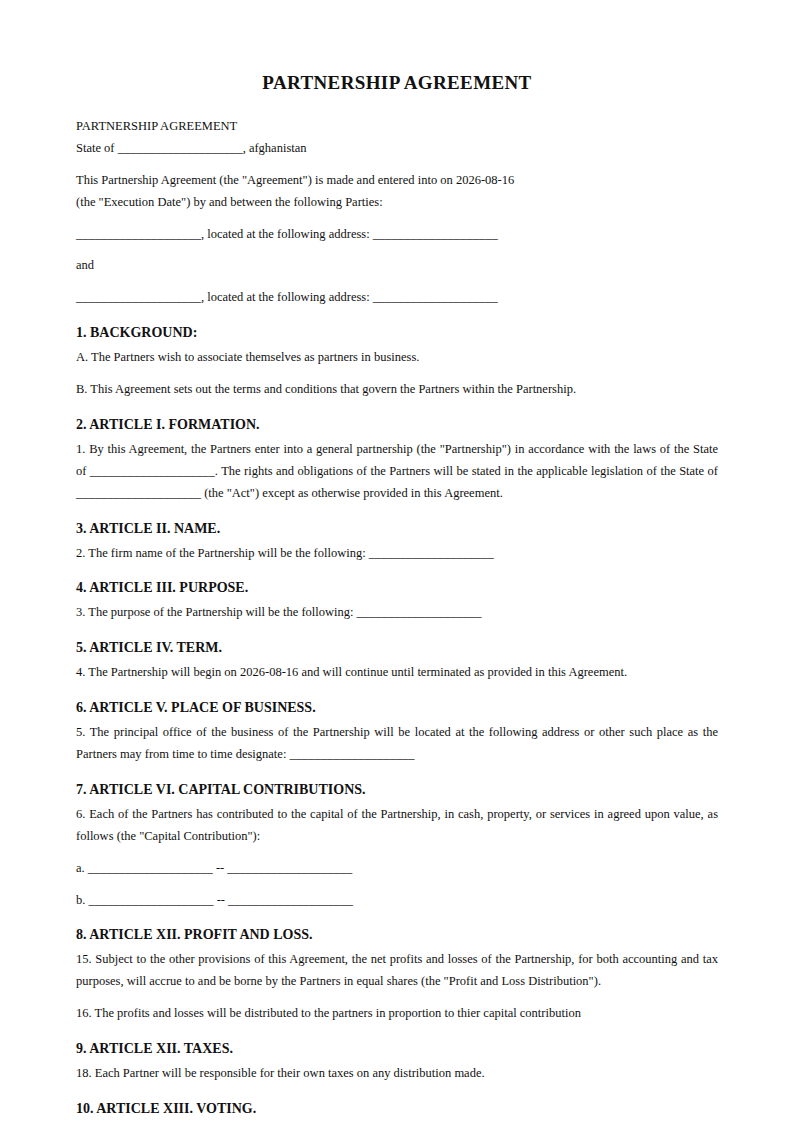
A partnership agreement records what two or more people going into business together have actually agreed: what each is putting in, what each takes out, who decides what, and what happens when one of them wants to leave.
Almost nobody writes one at the start. The business is exciting, everyone trusts everyone, and drafting terms feels like planning for failure. Then three years later the business is worth something, one partner wants out, and there is nothing on paper about how that works.
What Happens If You Do Not Have One
You still have a partnership. Nigerian law will treat you as partners based on how you have behaved, whether or not you ever signed anything.
What you lose is the ability to decide the terms. Without an agreement, default rules fill the gap, and those defaults are rarely what anybody intended. Profits may be treated as shared equally even though one partner put in most of the capital. Decisions may require unanimity you never agreed to. And the partnership may be dissolved by the departure of a single partner, which can end a working business overnight.
The agreement is not about distrust. It is about the two of you deciding your own terms while you are both reasonable, instead of a court deciding them later while you are not.
What the Agreement Needs to Cover
Contributions. Who is putting in money, property, equipment, or work. Value the non-cash contributions now, in writing. Arguments about what somebody's unpaid effort was worth are unwinnable after the fact.
Profit and loss shares. The percentages, and when distributions happen. If one partner takes a salary as well as a share, say so and say how much.
Decision making. Which decisions any partner can take alone, which need a majority, and which need everybody. Put a naira threshold on spending. The absence of this clause is the single most common source of partnership disputes.
Roles and time. What each partner actually does, and whether they are full time. A partner who is quietly running another business on the side is a problem best prevented by a clause.
New partners. How somebody is admitted and on what terms.
Exit. What happens when a partner wants to leave, becomes incapacitated, or dies. How their share is valued and who may buy it.
Dispute resolution. Where a disagreement goes. Arbitration or a named court, and which state.
The Exit Clause Is the Whole Document
If you read one part of the agreement carefully, read this one. Every other clause governs the business while it is working. This one governs the moment it stops working, which is when the money is actually at stake.
It needs to answer three questions. How is a departing partner's share valued, and by whom? Who has the right to buy it, and in what order? Over what period is it paid?
A valuation mechanism agreed in advance, even a rough one, is worth more than a perfect valuation argued about later. Naming an independent valuer, or setting a formula based on turnover or net assets, removes the fight before it starts.
Partnership, Limited Company, or Business Name
Worth being clear about what you are choosing, because the liability consequences differ sharply.
In a general partnership, partners are personally liable for the debts of the business. If the partnership cannot pay, creditors can come for the partners' personal assets, and each partner can be liable for the whole debt rather than just their share.
A limited liability company registered at the Corporate Affairs Commission under the Companies and Allied Matters Act 2020 is a separate legal person. Its debts are its own. For most businesses with real money moving through them, that separation is worth the extra registration.
A business name registration is not a separate legal person at all. It registers the name you trade under. It does not limit your liability.
CAMA 2020 also introduced limited partnerships and limited liability partnerships, which sit between these. If your partnership is substantial, this is a conversation worth having with a lawyer before you choose.
Registration and Formalities
Partnerships in Nigeria are generally registered as business names at the Corporate Affairs Commission. The agreement itself is a private contract between the partners and is not filed publicly.
Stamp it under the Stamp Duties Act. Each partner should hold an originally signed copy, and each page should be initialled so nobody can argue later about which version was agreed.
Open the business account in the partnership's name, not in one partner's personal account. Mixing partnership money with personal money is the fastest way to turn a commercial disagreement into an argument about honesty.
Mistakes That Cost Partners Money
Equal shares by default. Fifty fifty feels fair at the start. If one partner is funding the business and the other is working in it, decide deliberately rather than by habit.
No decision threshold. Without a naira figure above which spending needs agreement, one partner can commit the business to obligations the other never sanctioned.
Silence on intellectual property. Who owns the brand, the designs, the code, the client list. If the partnership ends, this is what people fight over.
No non-compete or confidentiality. A partner who leaves and immediately sets up next door with your client list is a foreseeable problem.
Never updating it. The agreement written for two people starting out does not fit the business five years and six staff later.
Frequently Asked Questions About Partnership Agreements in Nigeria
Is a partnership agreement required by law in Nigeria? No. A partnership can exist without one, and will be governed by default rules if there is no agreement. Those defaults are rarely what partners would have chosen, which is the reason to write one.
Are partners personally liable for business debts? In a general partnership, yes. Creditors can pursue partners personally, and a partner can be liable for the whole debt rather than a share of it. A limited liability company registered under CAMA 2020 keeps business debts separate from personal assets.
What happens if a partner wants to leave? Whatever the agreement says. Without one, the departure of a partner can dissolve the partnership entirely. This is why the exit and valuation clauses matter more than any other part of the document.
Do we have to register the partnership? Partnerships are generally registered as business names at the Corporate Affairs Commission. The agreement between the partners is private and is not filed.
Can we change the agreement later? Yes, in writing and signed by all partners. Review it whenever the business changes shape: new partners, new funding, a new line of business.
Getting Your Partnership Agreement Right
Read next: what a partnership actually is under Nigerian law. If you are incorporating rather than partnering, the founders agreement and the shareholders agreement cover that ground instead.
The partnerships that end badly are almost never the ones that disagreed. They are the ones that never wrote down what they agreed, and then discovered they had each remembered it differently.
Answer a few plain questions and you will have a partnership agreement written for Nigerian use, covering contributions, shares, decisions and exit, ready to download in Word and PDF and sign.