
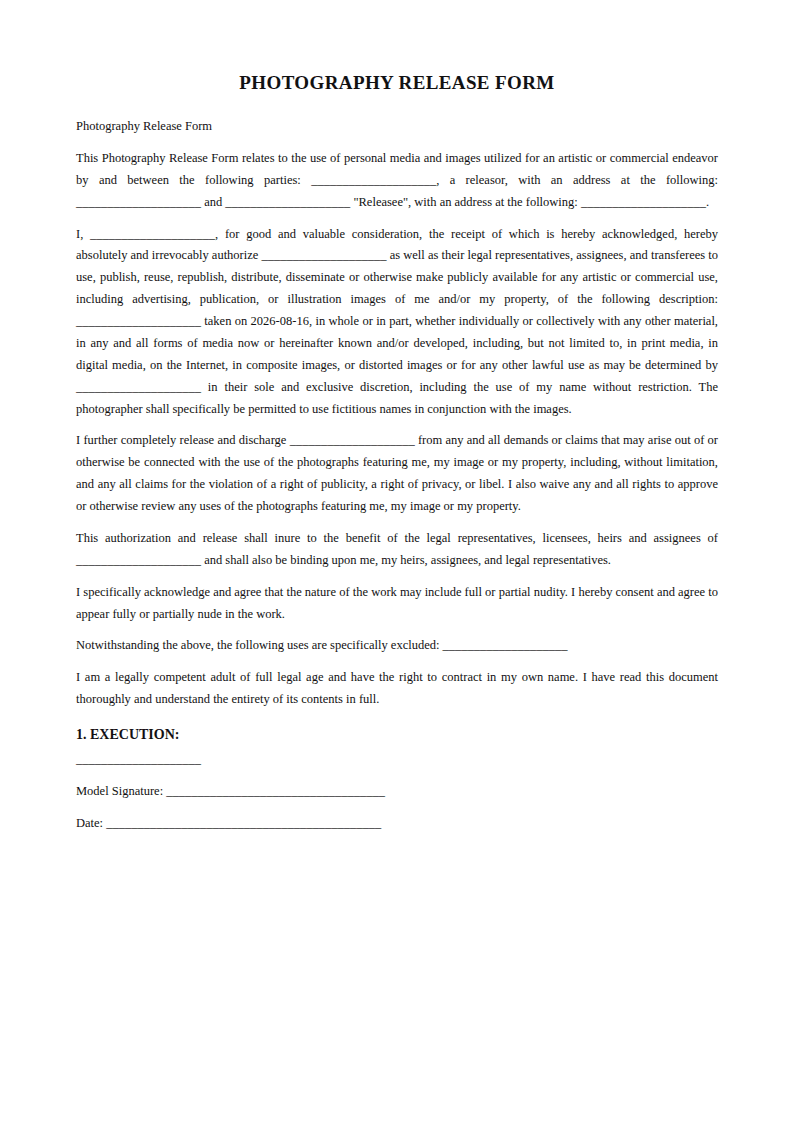
Photography Release Form in Nigeria
A photography release is written permission to use images of a person, or taken on somebody's property, for stated purposes. Photographers get them signed by subjects. Brands get them before running a campaign. Agencies will not license an image without one.
It answers a question that gets asked at the worst possible moment: are we allowed to use this picture. Finding out after the billboard is up is expensive.
Copyright and Consent Are Two Separate Problems
People treat these as one thing and they are not, and almost every dispute over an image comes from mixing them up.
Copyright in a photograph belongs to the photographer as author, unless it has been assigned in writing. Under the Copyright Act 2022 an assignment or an exclusive licence has to be in writing, so a client who commissioned and paid for photographs does not automatically own the copyright in them.
Consent is about the person in the image. The photographer owning the copyright does not entitle them to use a recognisable person's image for any purpose they like.
So a commercial shoot usually needs two documents: an agreement dealing with copyright between photographer and client, and a release signed by each identifiable person. A release alone does not give the client ownership, and an assignment alone does not give anybody permission to use somebody's face in an advert.
Why Consent Is Legally Necessary
Two sources of law bear on it in Nigeria.
The Constitution guarantees the right to private and family life, and Nigerian courts have been willing to treat the unauthorised commercial use of a person's image as an interference with that right.
Separately, the Nigeria Data Protection Act 2023 applies. A photograph of an identifiable individual is personal data, and using it in marketing is processing that needs a lawful basis and proper information given to the person. A signed release is the clearest way to establish and evidence that basis.
Put together, the position is straightforward. If somebody is recognisable and the use is commercial, get it in writing.
What the Release Must Cover
Who is consenting, with full name, contact details and signature.
Which images. Identified by shoot, date and location, and by reference to a contact sheet or folder where possible.
What they may be used for. This is the clause that does the work. Editorial, advertising, packaging, social media, website, print, television, out of home. If artificial intelligence training or synthetic derivatives are contemplated, say so expressly, because a general release drafted years ago does not plainly cover it.
Territory and duration. Nigeria or worldwide, for a set period or indefinitely. A shorter, clearly stated term is easier to get signed than an open ended one.
Whether editing is permitted. Cropping, retouching, colour work, compositing, and whether the subject can be placed in a different context.
Payment or its absence. Whether a fee is paid, or whether consent is given without payment.
Credit. Whether the subject is named, and whether the photographer is credited.
Data protection. Who holds the images, how long, and how the person can make a request about their data.
Minors, Employees and Crowds
Children. A minor cannot give valid consent. A parent or legal guardian must sign, and the release should record the relationship and the child's date of birth. For school, church or event photography, get the consent before the shoot rather than trying to collect it afterwards.
Employees. Do not rely on the employment contract. A clause buried in a handbook is weak consent at best, and an employee who leaves and finds their face still on your homepage has a legitimate complaint. Get a separate release, and agree what happens to the images when they leave.
Crowds and public places. Nobody expects individual releases from a crowd, and genuinely editorial or journalistic use of a public scene is a different situation. But the moment an individual becomes the focus of a commercial image, they need to have consented, whether the picture was taken in public or not.
Property Releases, and Withdrawal
If the shoot features a recognisable private building, interior, artwork or a distinctive branded object, get permission from the owner as well. Venues, hotels, galleries and private homes frequently have their own rules about commercial photography, and a shoot done without permission can be stopped or the images blocked after the fact.
On withdrawal, be honest in the drafting. A subject may ask to withdraw consent, particularly where the lawful basis is consent under the data protection legislation. What is realistic is to stop future use and remove the images from your own channels within a stated period, while accepting that print already distributed cannot be recalled. Say exactly that, rather than promising either that consent is irrevocable or that everything can be undone.
Frequently Asked Questions About Photography Releases in Nigeria
Do I own photographs I paid a photographer to take? Not automatically. Under the Copyright Act 2022 the photographer is the author and first owner, and copyright only moves to you by a written assignment or exclusive licence. Paying the invoice is not enough.
Do I need a release to photograph someone in a public place? For genuine editorial or news use, generally not. For commercial use where the person is recognisable and is the focus of the image, yes, because their privacy and data protection rights apply regardless of where the photograph was taken.
Who signs for a child? A parent or legal guardian, with the relationship and the child's date of birth recorded. A minor's own signature does not give valid consent.
Can somebody withdraw their consent later? They can ask, and where consent is the lawful basis under the Nigeria Data Protection Act 2023 you should act on it by stopping future use and removing the images from your own channels. Material already printed and distributed cannot realistically be recalled, and the release should say so.
Do I need a release from my own staff? Get a separate one rather than relying on the employment contract, and agree what happens when they leave. A former employee still appearing in your advertising is a complaint waiting to happen.
Getting Your Photography Release Right
Read next: photographer or model, who owns the photograph. To license the images for a defined use rather than rely on a release, see the copyright licence agreement, and for a paid shoot the freelance agreement.
A release that holds up names the permitted uses specifically, states the territory and the term, deals with editing, and is signed by the right person.
Answer a few questions and you will have a photography release written for Nigerian use, ready to download in Word and PDF.