
Purchase Order: the Document That Controls Your Spending
A purchase order is a buyer's written instruction to a supplier to provide specified goods or services at a specified price. It is issued before delivery, and it is the point at which a business decides what it is buying rather than discovering it on an invoice.
Businesses that run on purchase orders have fewer disputes with suppliers and far fewer surprises in their accounts. Businesses that order by phone call and WhatsApp message reconcile those calls later, at a cost.
What a Purchase Order Is In Law
A purchase order is normally an offer. The supplier accepts it by acknowledging it or by delivering, and at that moment there is a contract on the purchase order's terms.
That timing is why the purchase order matters. Whoever gets their terms in front of the other side first, and gets them accepted, governs the deal. A buyer who issues a purchase order carrying its own terms and conditions is in a stronger position than one who receives a quotation carrying the supplier's.
The complication is the battle of the forms. You send your purchase order with your terms; the supplier acknowledges with its own terms attached; each document says its terms prevail. The cleanest way out is to require written acknowledgement of your purchase order without qualification before any delivery, and to say on the face of the order that acceptance is on the buyer's terms only.
What Goes On the Order
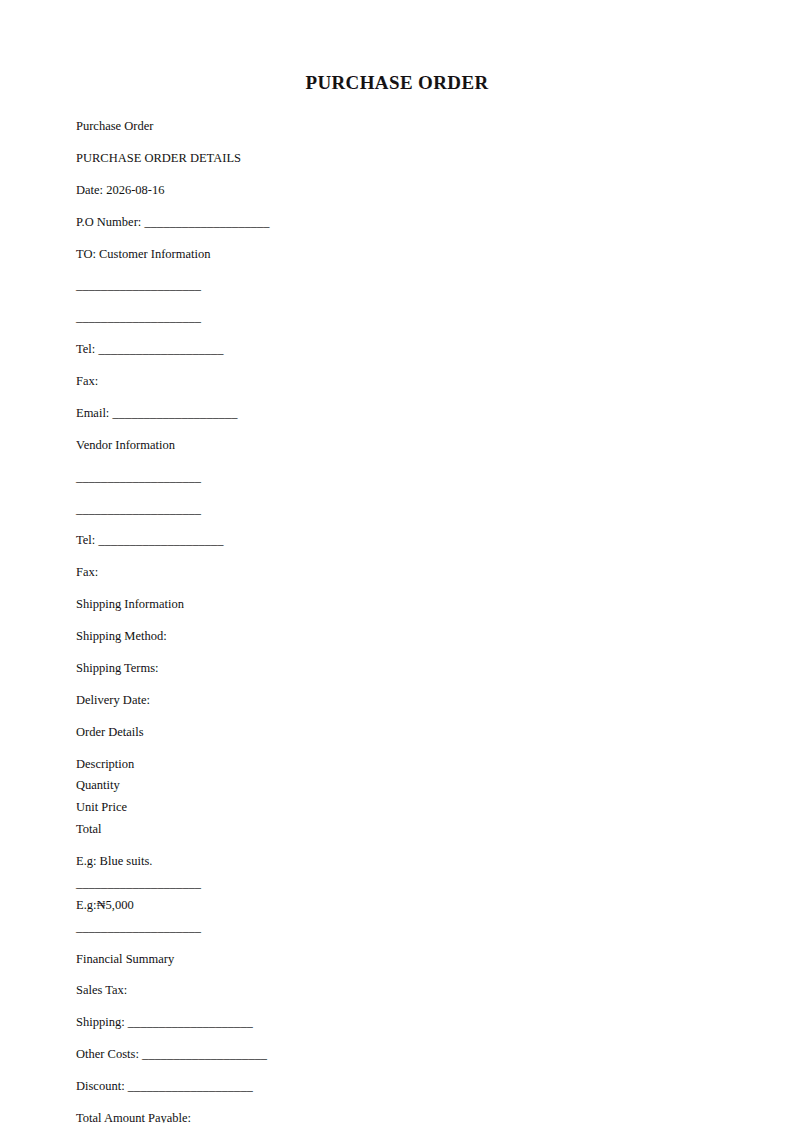
A unique purchase order number. Everything else depends on this: the acknowledgement, the delivery note, the invoice and the payment all have to quote it.
The date, and a validity period. An order with no expiry can be accepted six months later at a price that has moved.
Buyer and supplier details. Registered names, addresses, and the contact responsible on each side.
Line items. Description, specification or part number, quantity, unit, unit price and line total. Vague descriptions are how the wrong thing arrives.
Totals, tax and currency. Subtotal, value added tax at the prevailing rate, delivery charges, and the grand total. State the currency.
Delivery. Address, required date, and whether partial deliveries are accepted.
Payment terms. Net days from invoice or from delivery, and the method.
Authorisation. Name, title and signature of whoever approved it, within their authority limit.
Tax Details Your Finance Team Needs
Get these on the order rather than chasing them at payment. The supplier's tax identification number, whether they are registered for value added tax, and whether the quoted prices include it.
Where the order is for professional, technical or consultancy services, withholding tax will normally have to be deducted at source and remitted, with a credit note issued to the supplier. The applicable rate depends on the service and the type of payee, so confirm the current rate rather than carrying over an old one. Say on the order that payment is subject to any deduction required by law, so the supplier is not surprised by a net payment.
A supplier who cannot produce a tax identification number is a supplier your auditors will ask about.
Making It Work Inside the Business
A purchase order only controls spending if the process around it is enforced.
Set authority limits by value, so that below one figure a manager can approve and above it a director must. Require an order before a commitment is made, with no invoice paid without a matching order.
Then run the three way match before payment: the purchase order says what was ordered, the goods received note says what arrived, the invoice says what is being charged. All three must agree. This one control catches overcharging, short delivery and duplicate invoicing, and it is the reason finance teams insist on purchase orders at all.
Keep the paperwork together: order, acknowledgement, delivery note, invoice and payment reference, filed against the order number.
Changes, Cancellation and Public Sector Orders
Orders change. Handle it with a written variation quoting the original order number and stating what has changed, rather than a phone call. Verbal amendments are how the wrong quantity gets delivered and nobody can prove what was agreed.
Set out cancellation on the order: that the buyer may cancel before dispatch without charge, and what is payable if the supplier has already incurred cost on made to order items.
If you are supplying to a Nigerian government ministry, department or agency, expect a different regime. Public procurement is governed by the Public Procurement Act 2007 and its procedures, and the purchase order will sit inside a tender and contract framework you do not control. Read what is issued to you rather than assuming your own terms apply.
Frequently Asked Questions About Purchase Orders
Is a purchase order a binding contract? It is usually an offer, which becomes a binding contract when the supplier accepts it by acknowledgement or by delivering. That is why getting your terms onto the order, and getting an unqualified acknowledgement, puts you in control of the deal.
What is the difference between a purchase order and an invoice? The buyer issues a purchase order before delivery to say what it is ordering. The supplier issues an invoice after delivery to request payment. The invoice should quote the order number, and the two should match.
Whose terms apply if the supplier sends back their own? Whichever set was accepted last without objection, which is why this gets litigated. Avoid it by stating on the order that acceptance is on your terms only and requiring written acknowledgement before any delivery.
Do I need to deduct withholding tax when paying a purchase order? For professional, technical and consultancy services, generally yes, with a credit note issued to the supplier. Confirm the current rate for the service and the payee type, and say on the order that payment is subject to lawful deductions.
Can I cancel a purchase order? Before acceptance, yes. After acceptance, only on the terms the order sets out, so include a cancellation clause covering costs the supplier has already properly incurred on made to order items.
Getting Your Purchase Order Right
Read next: the benefits of running on purchase orders. For a recurring supply arrangement, the sale of goods agreement sets the terms your orders then sit under.
A purchase order earns its place through the order number, a precise specification, stated tax treatment, and a real approval signature.
Answer a few questions and you will have a purchase order written for Nigerian business use, ready to download in Word and PDF.