
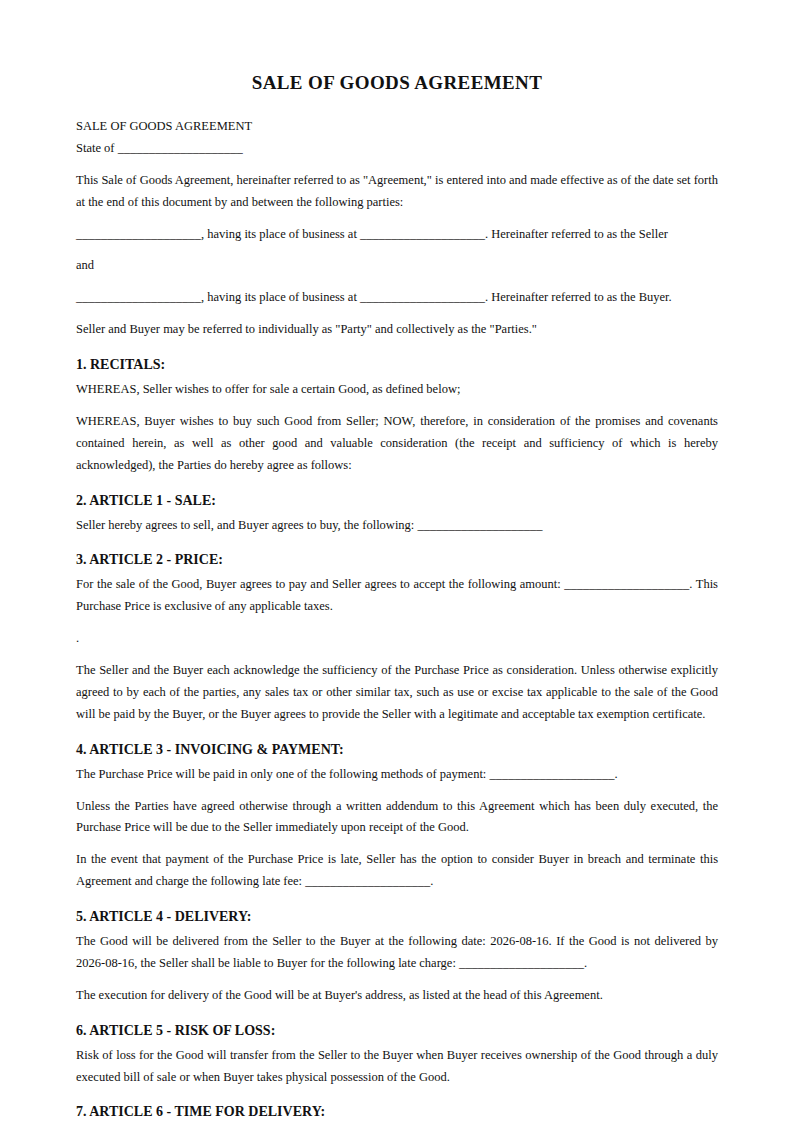
Sale of Goods Agreement in Nigeria
A sale of goods agreement records the terms on which one business sells physical items to another: what is being sold, for how much, when it arrives, who carries the risk on the way, and what happens if it is faulty.
For a one off purchase of stationery nobody needs one. For a recurring supply, a large consignment, or anything shipped, the agreement is what stops a delivery problem becoming a six month argument.
The Law Behind It
Sale of goods in Nigeria is governed by the sale of goods legislation applicable in the relevant state, which imports a set of terms into the contract whether or not you write them down.
The most important are the implied conditions: that the seller has the right to sell, that goods sold by description correspond with that description, that goods sold in the course of a business are of merchantable quality, and that where the buyer makes known a particular purpose, the goods are reasonably fit for it.
Where the buyer is a consumer rather than a business, the Federal Competition and Consumer Protection Act 2018 adds protections that the contract cannot exclude. Between two businesses there is more freedom to vary the position, but an exclusion has to be clearly drafted to work.
Describing the Goods and the Price
Use a schedule rather than a sentence. Specification, model, grade, quantity, unit of measure, packaging. Where quality is measurable, state the standard or tolerance. Where samples were provided, say that the bulk must correspond with the sample.
For price, state the currency, whether it includes value added tax, and whether it includes delivery, loading, insurance and any duties. Say whether the price is fixed or can be varied, and if it can, on what trigger and with how much notice. For goods with an import component, decide now who carries the exchange rate risk between order and delivery, because in Nigeria that risk is real and it will otherwise be argued about later.
Set payment terms properly: deposit, balance, credit period, and interest on late payment.
Delivery, and Who Carries the Risk
State the place and date of delivery, and whether the buyer collects or the seller delivers. Say whether partial deliveries are allowed and whether time is of the essence, because if it is, late delivery lets the buyer reject rather than just claim damages.
Then deal with risk separately from ownership, because they are different things that people assume move together. Risk is who bears the loss if the goods are damaged or stolen. Ownership is who legally owns them.
The usual positions are risk passing on delivery to the buyer, or on collection by the buyer's carrier. Whichever you choose, say it, and say who insures the goods while they are in transit. For international sales, an Incoterm such as FOB or CIF settles this in a word, provided both sides know what the word means.
Retention of Title
A retention of title clause says that although the buyer has the goods and bears the risk, ownership stays with the seller until the price is paid in full.
For a seller giving credit this is the single most valuable clause in the agreement. If the buyer fails to pay, or goes into insolvency, the seller has a claim to the goods themselves rather than joining the queue of unsecured creditors.
It needs care to work. The clause should be clear that title does not pass until payment, require the buyer to store the goods so they remain identifiable, and give the seller a right to enter and recover them. Be aware that its effect weakens once goods are mixed, processed into something else, or resold to a third party who bought in good faith.
Inspection, Rejection and Warranties
Give the buyer a defined period to inspect on arrival and to reject non conforming goods, commonly three to seven working days, with a clear route for notifying a rejection. Without a period, disputes arise months later about goods nobody can now examine.
Set out the warranty separately: how long it lasts, what it covers, and what the remedy is, whether repair, replacement or refund at whose option. Exclude the things you genuinely cannot stand behind, such as misuse, ordinary wear, or modification by the buyer.
Then limit liability sensibly: exclude indirect and consequential loss, cap the total at the contract price or a multiple of it, and add the line preserving liabilities that cannot lawfully be excluded, including under consumer protection law.
Frequently Asked Questions About Sale of Goods Agreements in Nigeria
When does ownership of the goods pass to the buyer? When the contract says. Without a clause, the sale of goods rules supply a default based on the type of goods and the parties' intention, which is rarely what either side expected. State it expressly, and state separately when risk passes.
What is a retention of title clause and do I need one? It keeps ownership with the seller until payment in full. If you supply on credit, you want one, because it gives you a claim to the goods rather than an unsecured claim for money if the buyer fails.
Can I exclude the implied terms about quality? Between businesses there is some scope to limit them if the wording is clear and the limitation is reasonable. Against a consumer you cannot, because the Federal Competition and Consumer Protection Act 2018 protects those rights.
Who pays if the goods are damaged in transit? Whoever bears the risk at that moment under the contract. That is why the risk clause matters, and why the agreement should also say who is required to insure the goods while they are in transit.
How long should the buyer have to inspect and reject? Long enough to examine the goods properly, commonly three to seven working days from delivery, with a longer period for defects that could not reasonably have been found on inspection.
Getting Your Sale of Goods Agreement Right
Read next: why purchase orders matter. For the delivery and returns side of the same sale, see the shipping policy and the returns policy.
The clauses that decide real disputes are the specification, the delivery and risk terms, retention of title, and the inspection window. Everything else is supporting detail.
Answer a few questions and you will have a sale of goods agreement written for Nigerian use, ready to download in Word and PDF.