
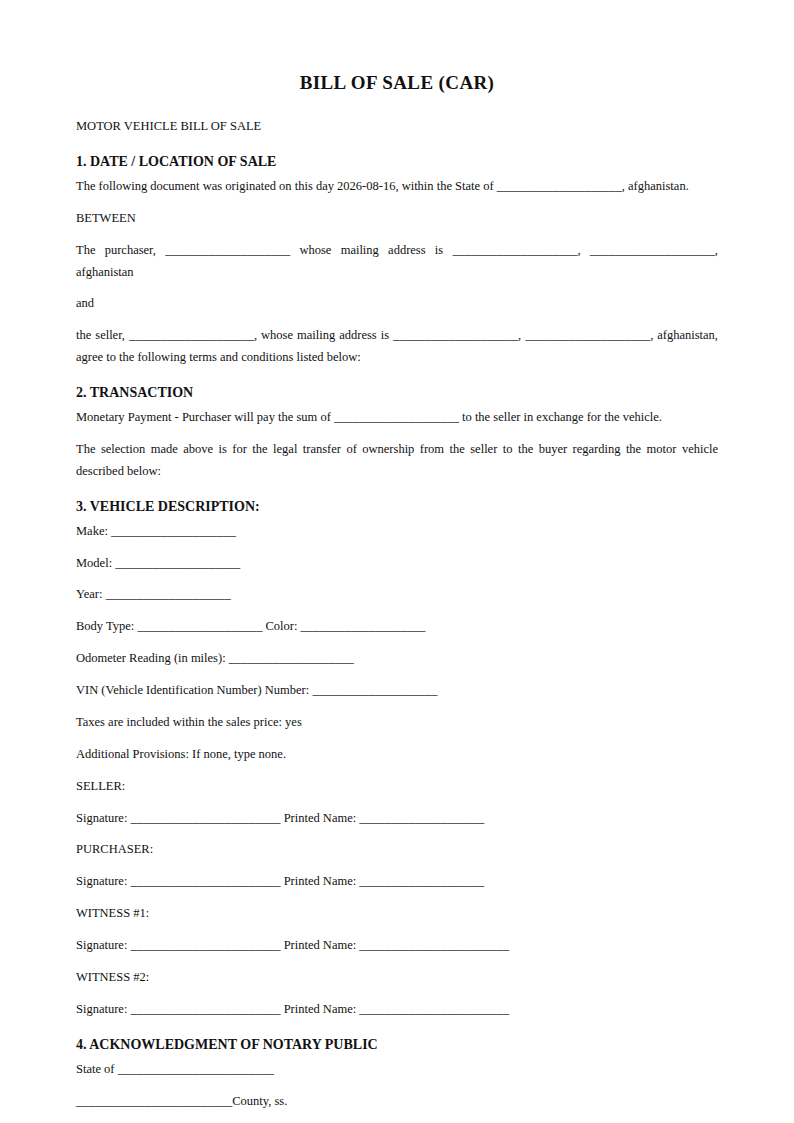
Bill of Sale for a Vehicle in Nigeria
A bill of sale records that a vehicle has been sold: who sold it, who bought it, which vehicle, for how much, and on what terms. It is the buyer's proof of purchase and the seller's proof that they no longer have anything to do with the car.
In Nigeria most used vehicles change hands on a handwritten receipt, or on nothing at all. That works right up until the buyer is stopped at a checkpoint and asked to prove the vehicle is theirs, or the seller starts receiving traffic notices for a car they sold two years ago.
What the Document Does For Each Side
For the buyer it establishes the chain of ownership. Without it, you own a vehicle registered to somebody else with nothing linking it to you, which is a problem at a checkpoint, at the licensing office, and with an insurer.
For the seller it is the cut off. It fixes the date and time possession passed, which matters because traffic offences, accidents and impoundment after that moment are not yours. A seller with no bill of sale is answering for whatever the new driver does.
It also records what was said about condition, which limits arguments a fortnight later about a fault the buyer says was hidden.
Identifying the Vehicle Properly
Registration number alone is not enough, because plates change. Record the chassis or vehicle identification number, the engine number, the make, model, year, colour, body type and the odometer reading on the day.
Then physically verify the chassis number on the vehicle against the number on the papers. They are stamped on the body and shown on the customs and licensing documents, and a mismatch is the clearest warning sign there is that something is wrong with the vehicle's history.
List what is included: spare tyre, jack, tools, how many keys, the stereo, the radio code. Small items, and the source of most post sale friction.
Checks a Buyer Should Make First
Confirm who owns it. The name on the vehicle licence and proof of ownership should match the person selling. If it does not, ask why, and expect a documented answer rather than an explanation.
Ask for the paper trail. Proof of ownership, vehicle licence, roadworthiness certificate, insurance, and for an imported vehicle the customs documents. A seller who cannot produce customs papers for an imported car is selling you a problem.
Have the vehicle checked. By your own mechanic, not the seller's, and preferably away from the seller's premises.
Check for encumbrances. A vehicle under hire purchase or used as security for a loan is not the seller's to sell free of that claim, and the financier's rights survive the sale.
Verify the vehicle is not stolen. A police clearance or verification at the relevant authority costs little against the loss of a vehicle seized months later. A buyer of a stolen vehicle generally does not acquire good title, however much they paid and however innocent they were.
Condition, and How Far Sold As Seen Goes
Private sellers commonly want the vehicle sold as it is, with no warranty. That is a legitimate position, and the bill of sale should state it plainly: the buyer has inspected the vehicle, accepts it in its present condition, and no warranty is given as to its state or fitness.
Two limits are worth knowing. A clause like that does not protect a seller who actively concealed a fault or lied about the vehicle's history, because that is misrepresentation rather than a matter of warranty. And where the seller is a dealer selling to a consumer, the Federal Competition and Consumer Protection Act 2018 imposes quality standards that a sold as seen clause cannot simply remove.
So for a private sale, record the disclaimer and record the known faults. Listing the faults honestly protects the seller more than a broad disclaimer does.
Payment and Change of Ownership
State the price, the currency, how it was paid, and whether it was paid in full. If instalments are involved, say whether possession or ownership passes before final payment, and say what happens on default. A part paid vehicle handed over with nothing written down rarely ends well for the seller.
Bank transfer with a reference beats cash for both sides, because it evidences itself.
Then do the change of ownership. The bill of sale proves the transaction; it does not update the records. Transfer of ownership is processed through the relevant state motor vehicle administration authority, with new particulars issued in the buyer's name, and the buyer needs to arrange their own insurance before driving.
Both parties should push for this promptly. A buyer without it cannot prove ownership. A seller without it stays on the record as the owner of a vehicle somebody else is driving, which is exactly the position nobody wants to be in when something happens.
Frequently Asked Questions About Vehicle Bills of Sale in Nigeria
Is a bill of sale enough to transfer ownership of a car? It proves the sale between the parties, but the official records still have to be updated. Change of ownership is processed through the state motor vehicle authority, and new particulars issued in the buyer's name.
What should I check before buying a used car? That the seller's name matches the ownership papers, that the chassis number on the vehicle matches the documents, that customs papers exist for an imported vehicle, that it is not under hire purchase or used as loan security, and that it is not reported stolen.
Does sold as seen protect the seller completely? No. It works for ordinary defects the buyer could have found on inspection, but it does not cover concealment or false statements about the vehicle, and it does not remove consumer protections where the seller is a dealer.
What happens if the car turns out to be stolen? The buyer generally does not acquire good title and can lose the vehicle to its true owner, with a claim left against the seller who may be untraceable. This is why a verification check before payment is worth the small cost.
Do both parties need a copy? Yes, each signed and dated, ideally witnessed. The buyer needs it to prove ownership and the seller needs it to prove the date responsibility passed, which matters when traffic notices arrive later.
Getting Your Bill of Sale Right
Read next: the sale of goods agreement if you are selling as a dealer rather than privately, and the vehicle lease agreement if you would rather lease the vehicle out than sell it.
The details that matter are the chassis number, the condition statement, the payment record, and both parties completing the change of ownership afterwards.
Answer a few questions and you will have a bill of sale written for Nigerian vehicle sales, ready to download in Word and PDF.