
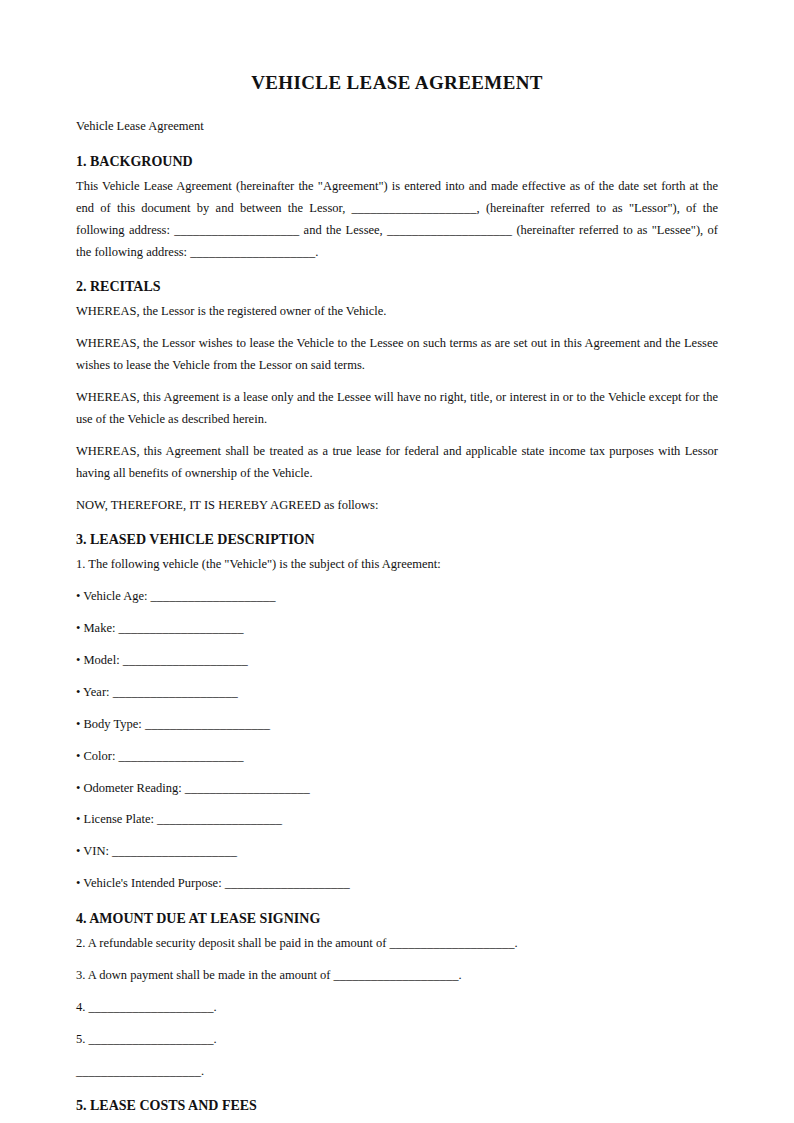
Vehicle Lease Agreement in Nigeria
A vehicle lease agreement lets one party use another party's vehicle for a period in return for payment, while ownership stays with the lessor. It covers company car schemes, fleet hire, staff bus arrangements, and the operating leases that keep a lot of Nigerian logistics moving.
The clauses that matter are not the obvious ones. Rent and term are easy. Insurance, maintenance, traffic offences and what happens after an accident are where the money is actually decided.
Lease, Hire Purchase or Sale
Settle the structure first, because all three are described loosely as leases in conversation and they are legally different.
An operating lease is pure use. The lessee pays to use the vehicle, returns it at the end, and never owns it.
A finance lease runs for most of the vehicle's useful life, with the lessee carrying the economic risk, often with an option to buy for a nominal sum at the end.
Hire purchase is a purchase paid by instalments, with ownership passing on the final payment. It is governed by the Hire Purchase Act where the value falls within the Act's limits, and that brings statutory protections for the hirer that an ordinary lease does not carry.
If the parties intend ownership to pass, say so and structure it as hire purchase or a sale. A document titled lease that is really a sale by instalments creates confusion about repossession rights exactly when somebody wants to exercise them.
Identifying the Vehicle and Its Condition
Describe the vehicle so it cannot be confused with another: make, model, year, colour, chassis or vehicle identification number, engine number and registration number. Attach copies of the vehicle licence, proof of ownership and the roadworthiness certificate.
Then record condition at handover properly. A written inspection schedule signed by both parties, with dated photographs of each panel, the interior, the tyres and the dashboard showing the odometer. Note existing damage, the spare tyre, the jack, the tools and the number of keys.
This single schedule prevents most end of lease disputes. Without it, every scratch becomes an argument about whether it was already there.
Insurance, Which Is Not Optional
Third party motor insurance is compulsory in Nigeria, and driving without it is an offence. So the agreement must say who insures, at what level, and whose name the policy is in.
For anything beyond a short hire, comprehensive cover is the sensible requirement rather than third party only. Say who is named on the policy, who pays the premium, what the excess is and who bears it, and require the insuring party to produce the certificate at the start and on each renewal.
Then deal with what happens after an accident: who reports it, within how long, who deals with the insurer, whether rent continues while the vehicle is off the road, and whether a replacement vehicle is provided. A lease that is silent on rent during repairs produces a dispute in the first week of every claim.
Maintenance, Licensing and Who Pays What
Split the running costs explicitly. Fuel is normally the lessee's. Routine servicing, tyres and consumables can go either way and should be stated with a service interval. Major mechanical repairs and anything arising from fair wear and tear are usually the lessor's, unless caused by the lessee's misuse.
On the paperwork side, say who keeps the vehicle licence, insurance, roadworthiness certificate and, where the vehicle is used commercially, the hackney permit current. An expired document produces an impounded vehicle and an argument about who caused the loss of use.
Also allocate traffic offences and penalties. Fines from the Federal Road Safety Corps, state traffic authorities and the Vehicle Inspection Office should be the responsibility of whoever was driving, and the agreement should say the lessee indemnifies the lessor for anything incurred during their possession. Lessors receive these notices months later, and without an indemnity they absorb them.
Use Restrictions and Getting the Vehicle Back
Say who may drive: named individuals, or any employee holding a valid licence, and require licences to be produced. Prohibit subletting, use as a commercial taxi unless agreed, carrying goods beyond capacity, racing, and taking the vehicle outside a defined area without consent. Set a mileage allowance if that matters, with a stated rate for excess.
Then the return terms. Where, when, in what condition, with what documents and how many keys. Define fair wear and tear against damage, using the inspection schedule as the reference. State the daily charge for late return.
And set out repossession properly. Say what constitutes default, what notice is given, and how the vehicle is recovered. Self help seizure without following the agreed process invites a confrontation and a claim, and where hire purchase applies there are statutory restrictions on repossession once a proportion of the price has been paid.
Frequently Asked Questions About Vehicle Leases in Nigeria
Who is responsible for insurance on a leased vehicle? Whoever the agreement says, and it must be said. Third party cover is compulsory in Nigeria, and for anything longer than a short hire comprehensive cover is the sensible standard, with the certificate produced at the start and on renewal.
Who pays traffic fines? The driver, in fairness, and the agreement should make the lessee indemnify the lessor for fines and penalties incurred while they hold the vehicle. These notices reach the registered owner long after the event, so the indemnity matters.
What is the difference between leasing and hire purchase? A lease is use without ownership. Hire purchase is a purchase by instalments with ownership passing on the last payment, and where the Hire Purchase Act applies it gives the hirer statutory protections, including limits on repossession once part of the price is paid.
Can the lessor just take the vehicle back if I stop paying? Only by following the default and repossession process in the agreement, and where hire purchase applies, only within the statutory restrictions. Seizing a vehicle without following the agreed process risks a claim.
Does rent keep running while the vehicle is being repaired? Only if the agreement says so. This should be decided at the outset along with who provides a replacement vehicle, because it comes up in the first week of any accident claim.
Getting Your Vehicle Lease Right
Read next: how to terminate a contract properly, which matters when a lease ends early. Selling the vehicle instead of leasing it? Use the bill of sale.
The lease terms that decide disputes are the condition schedule at handover, the insurance arrangement, the split of running costs, and the fines indemnity.
Answer a few questions and you will have a vehicle lease agreement written for Nigerian use, ready to download in Word and PDF.