
Service Level Agreement in Nigeria: Promises You Can Measure
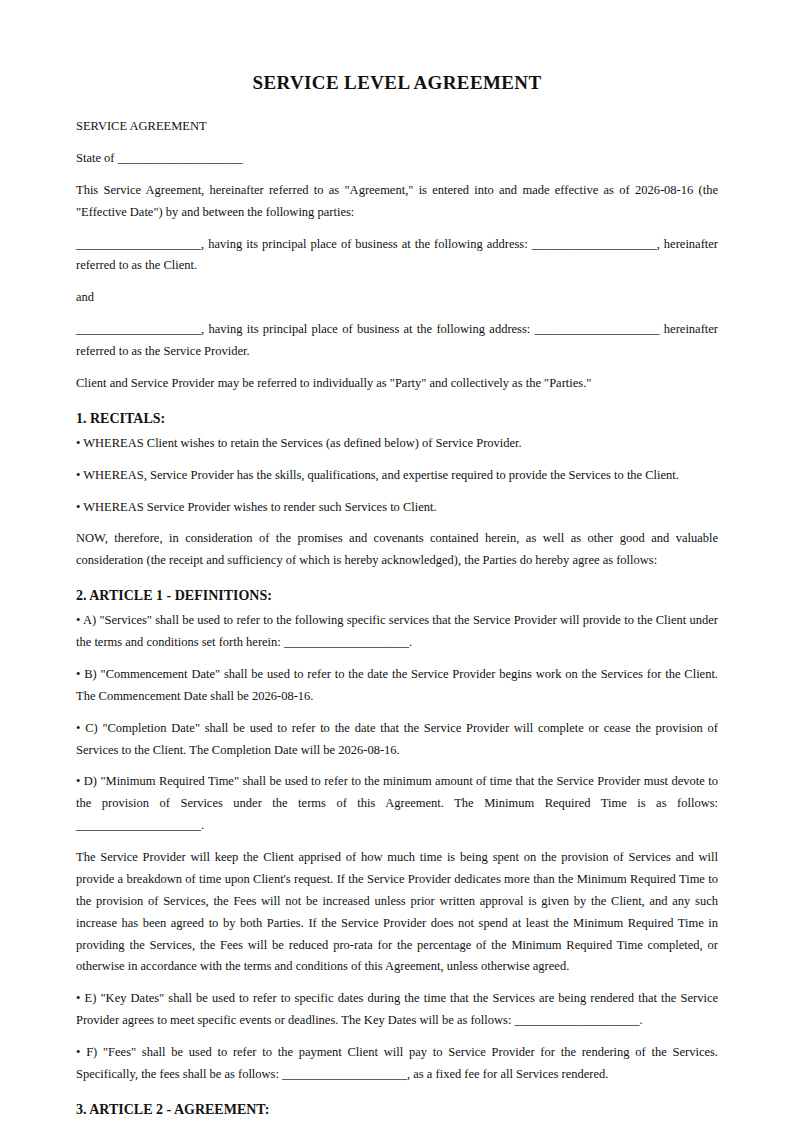
A service level agreement sets out the standard of service a provider commits to and what happens when the standard is missed. It sits alongside the main contract, which covers price and term, and deals only with performance.
Most service level agreements fail for the same reason. They contain numbers nobody measures. An uptime commitment with no defined measurement method and no reporting is a marketing claim, not an obligation.
What Belongs In It
The services covered, and just as importantly the ones that are not.
The metrics, each with a target, a measurement method and a measurement period.
Support hours and channels, with response and resolution targets by severity.
Reporting, how often performance is reported and by whom.
Service credits, what the customer gets when a target is missed.
Exclusions, what does not count against the target.
Escalation, who to call when the normal channel is not working, with names and levels.
Review, when the targets get revisited.
Uptime, and What the Percentages Mean
Uptime is the headline metric and the one customers understand least, because the percentages sound close together and are not.
Over a thirty day month, 99 per cent allows about seven hours of downtime. 99.5 per cent allows about three and a half hours. 99.9 per cent allows about forty three minutes. 99.99 per cent allows about four minutes.
So promise what you can actually deliver. A small Nigerian provider committing to 99.99 per cent is committing to four minutes of downtime a month, which means no maintenance window and near instant failover. Most cannot do it, and a broken promise costs more than a modest one honestly kept.
Then define how uptime is measured: from where, at what interval, by what tool, and whether partial degradation counts as downtime. Two parties measuring from different places will disagree about the same month.
Response and Resolution Are Different Promises
Customers conflate these and providers should not. Response time is how long before somebody acknowledges the issue and starts work. Resolution time is how long before it is fixed.
Commit firmly to response times, because they are within your control. Be more careful with resolution times, because some faults depend on a third party such as an upstream network or a hardware supplier. The honest structure is a firm response target, a resolution target expressed as a goal with regular progress updates, and a firm commitment to keep the customer informed.
Tier the targets by severity, and define the tiers. Critical means the service is down or unusable for all users. High means major functionality is broken or a large group is affected. Medium means something is broken with a workaround. Low means a question or a cosmetic issue. Without written definitions, every customer's issue is critical.
Exclusions, Including the Nigerian Ones
Some downtime should not count. Scheduled maintenance inside an agreed window, with notice. Faults caused by the customer's own equipment, network or misuse. Force majeure. Third party failures outside your control.
In Nigeria two exclusions deserve naming rather than hiding under force majeure: national grid failure beyond your backup power capacity, and failures in upstream internet connectivity or undersea cable capacity. These are real, they are outside a provider's control, and pretending otherwise leads to arguments during the exact week everybody is already under pressure.
Name them honestly, and then say what you do have: generator and inverter capacity, redundant links, a failover arrangement. An exclusion paired with a stated mitigation reads as competence. An exclusion on its own reads as an excuse being prepared in advance.
Service Credits and Their Limits
A service credit is the agreed consequence of missing a target, normally a percentage of the monthly fee scaled to how badly the target was missed. Say how it is claimed, within what period, and whether it is applied automatically or on request.
Providers usually want credits to be the sole remedy for a missed target, and customers should notice that. A sole remedy clause means a customer who lost a day of trading gets a fraction of one month's fee and nothing else. That may be a fair bargain at the price, but it should be a conscious one.
The balance most agreements settle on is credits as the sole remedy for ordinary misses, plus a right to terminate without penalty if targets are missed persistently, commonly three months in a rolling six.
Data, Security and Exit
If the service holds customer data, the service level agreement should say where it is hosted, who may access it, how it is backed up, and how quickly it can be restored. Backup frequency and recovery time are service levels like any other and should carry targets.
Where the data includes personal data, the Nigeria Data Protection Act 2023 applies and the parties need to be clear who is the controller and who is the processor, with the processor's obligations written down.
And deal with exit. On termination, in what format is the data returned, how quickly, at whose cost, and when is the provider's copy deleted. A customer who cannot get their data out is not really free to leave, whatever the notice period says.
Frequently Asked Questions About Service Level Agreements in Nigeria
What uptime should I promise? Whatever you can measure and meet with a margin. 99.5 per cent allows about three and a half hours of downtime a month and is realistic for many Nigerian providers. 99.99 per cent allows four minutes and requires infrastructure most do not have.
Are service credits the only remedy for a missed target? Only if the agreement says so, and many provider drafts do. Customers should push for a right to terminate without penalty where targets are missed repeatedly, since credits alone are a weak remedy for sustained failure.
Can I exclude power and internet failures? Yes, and you should name them specifically rather than relying on a general force majeure clause. Pair the exclusion with what you do provide, such as backup power and redundant links, so the customer knows what they are buying.
How do we resolve a disagreement about whether a target was met? Agree the measurement method, the tool and the reporting in advance, and name whose figures govern. Most service level disputes are really disputes about measurement, and they are avoidable at drafting stage.
Does the Nigeria Data Protection Act affect my service level agreement? If the service processes personal data, yes. The agreement should identify who is controller and who is processor, set out the processor's security obligations, and deal with breach notification and deletion on exit.
Getting Your Service Level Agreement Right
Read next: service level agreements for small businesses. The commercial terms usually sit in a separate consulting agreement or freelance agreement.
The agreements that work contain targets you can measure, exclusions you can justify, and a remedy both sides considered before signing.
Answer a few questions and you will have a service level agreement written for Nigerian use, ready to download in Word and PDF.