

Setting up another company? Start it with the filings in order
Incorporation at the CAC under CAMA 2020. Name reservation, memorandum and articles, certificate of incorporation and your TIN.
Register my companyMost people find out the same way. The bank asks for a status report before approving the overdraft, or a client's procurement team runs a CAC search before signing the contract, and the result comes back with one word on it: inactive.
Nothing was posted to you. No letter, no warning. The company kept trading, kept paying its staff, kept doing everything a company does, except file a short return with the Corporate Affairs Commission once a year. That is all it takes.
This guide covers what an annual return is, what the CAC does when you stop filing, and how to get a company back to active without making it worse.
The short answer
Every company registered under CAMA 2020 files an annual return with the CAC each year, whether or not it traded. Stop filing and the company is marked inactive on the public register, the CAC stops processing its other filings, penalties build for every year missed, and in time it can be struck off altogether. Catching up means filing every outstanding year, oldest first, and paying the penalty on each.
What an annual return actually is
An annual return is a snapshot of the company, filed once a year, that confirms to the CAC who is running it and who owns it. The Companies and Allied Matters Act 2020 requires every company to make one.
It records the registered office address, the directors, the shareholders and how many shares each holds, the share capital, and the people with significant control over the company. Companies that do not qualify as small also attach audited accounts.
The confusion that causes the most trouble is this one:
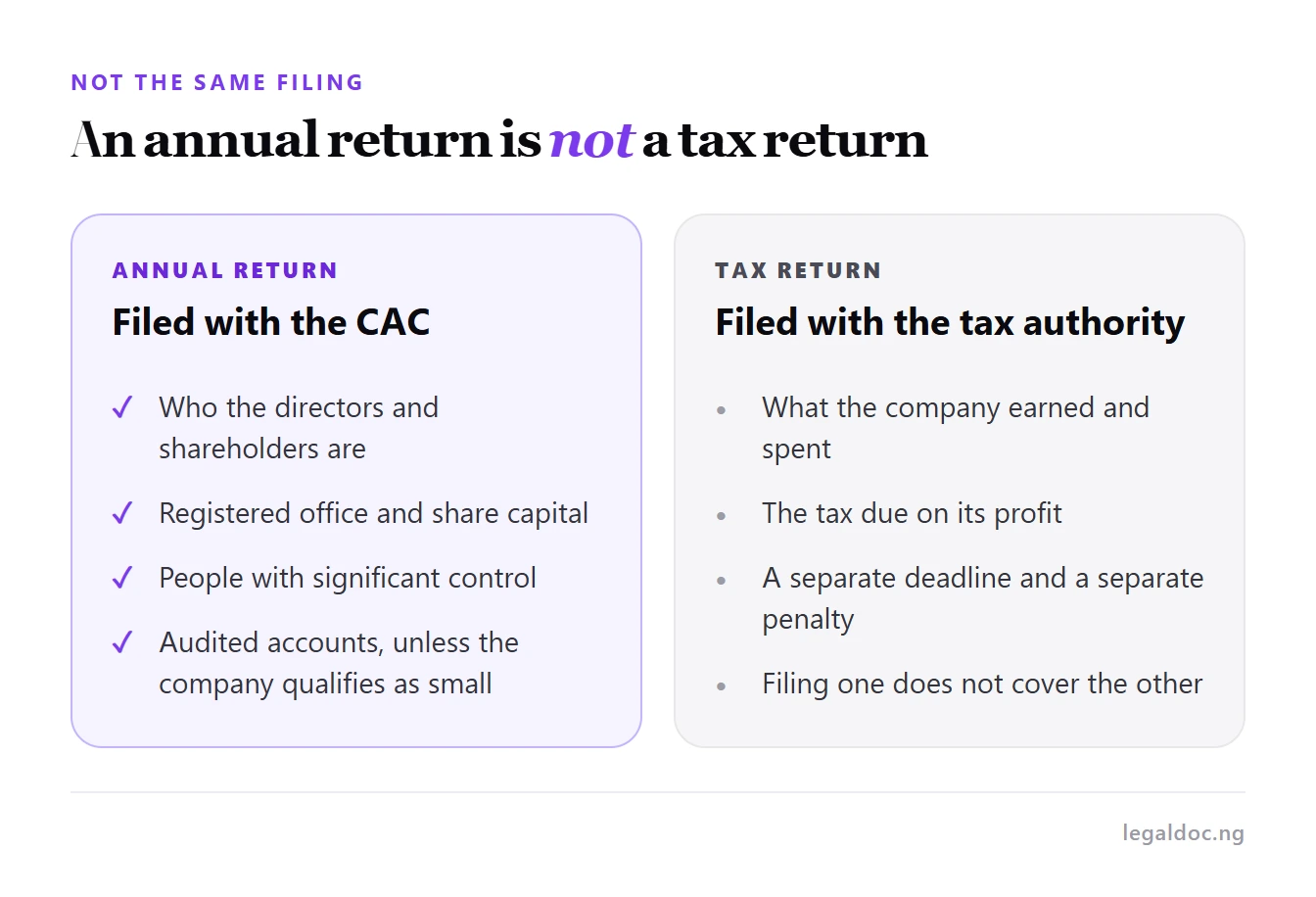
Two different filings, to two different bodies, on two different deadlines.
Plenty of business owners believe their accountant has the annual return covered because the accountant files their tax returns. Sometimes that is true. Often it is not, because the two are entirely separate obligations and one does nothing for the other. Ask the question directly rather than assume.
When it is due
The annual return runs on the company's own calendar, not the calendar year. Each return falls due after the anniversary of the date the company was incorporated, so a company registered in March has its deadline in the weeks after each March, and one registered in November has its deadline after each November.
A new company is not expected to file in the year it was incorporated. The obligation starts the year after, and carries on every year from then for as long as the company exists.
The simplest way to know where you stand is to look. The CAC's online portal shows the company's record, including which years have been filed and which are outstanding. If you have not looked in a while, do that before anything else in this guide.
What happens when you stop filing
None of this happens with a bang. It accumulates quietly until the day you need the company to be in good standing and it is not.
The company is marked inactive
The first and most visible consequence is the status on the public register. Anybody can search a company on the CAC portal, and banks, lenders, landlords and large clients routinely do. A company with outstanding returns shows as inactive.
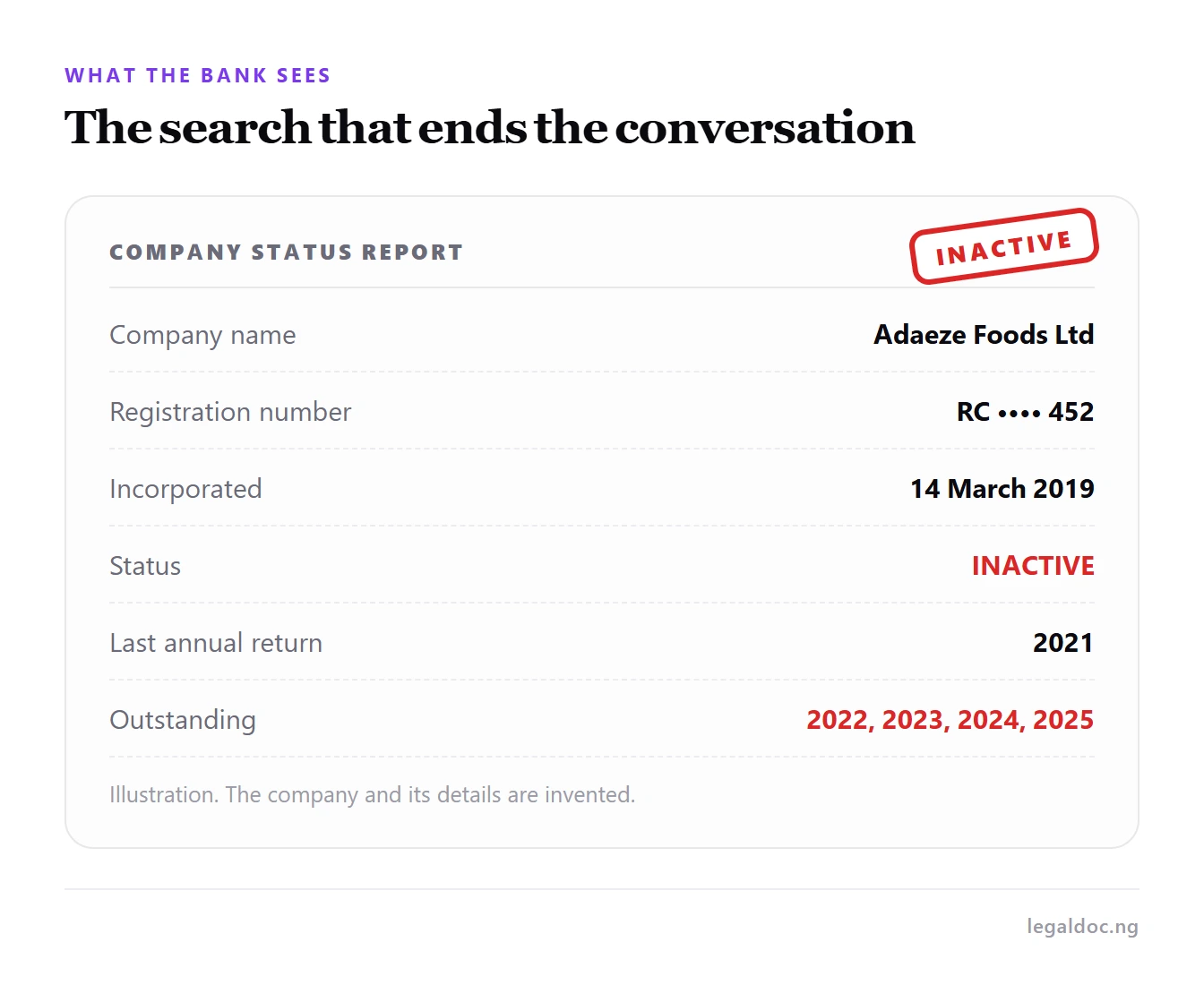
An illustration. The company and its details are invented.
That single word is enough for a bank to pause an account opening or a loan, for a corporate client to stop an onboarding, and for a tender to be rejected at the compliance stage. Nobody is going to wait while you sort it out.
The CAC stops processing your other filings
This is the consequence that catches people mid-transaction. Want to appoint a new director, remove one who has left, allot shares to an investor, increase the share capital or change the company's name? The CAC will not process those filings for a company whose annual returns are not up to date.
So the investor who has wired money and is waiting for their shares, or the co-founder who left eighteen months ago and is still on the record as a director, are both stuck until the returns are cleared. The annual returns come first, whatever else is urgent.
Penalties for every year in default
Each late return attracts a penalty, and it attaches to each year that was missed rather than to the default as a whole. Four missed years means four penalties, set by the CAC's regulations and payable when you file. The company is liable, and so, under CAMA 2020, are the officers responsible for it.
The amounts for a single year are not usually what hurts. What hurts is discovering four years at once, in the week a bank needs a clean status report.
Eventually, the company can be struck off
CAMA 2020 lets the CAC strike a company off the register where it has reasonable cause to believe the company is not carrying on business, and years of silence on annual returns is exactly the kind of evidence it relies on. The CAC has published notices of companies it intends to remove for long periods of non-filing.
Years of missed filings? Ask what it takes to get back in good standing
Tell LegalDoc+ when you last filed and it explains what the CAC will expect and the order to do it in.
Ask about my filingsA struck-off company is dissolved. Its property can pass to the government, its bank accounts become a problem, and bringing it back requires an application to court. That is far more expensive than the returns would ever have been.
"But my company has not traded"
This is the most common reason companies fall behind, and it does not help. A company that has not traded still exists, still has directors and shareholders, and still files an annual return every year.
Founders often register a company early, for a project that stalls or a deal that never closes, then forget about it. Three or four years later they want to use it for something new, and it is inactive with a stack of penalties attached.
If a company genuinely has no further purpose, the right thing is to wind it up properly rather than leave it to drift. If there is any chance you will use it again, keep the returns going. A dormant company filing a short return each year costs very little. A dormant company that has not filed in five years costs a great deal to revive.
How to catch up
Getting back to active is not complicated. It is just methodical, and it has to be done in order.
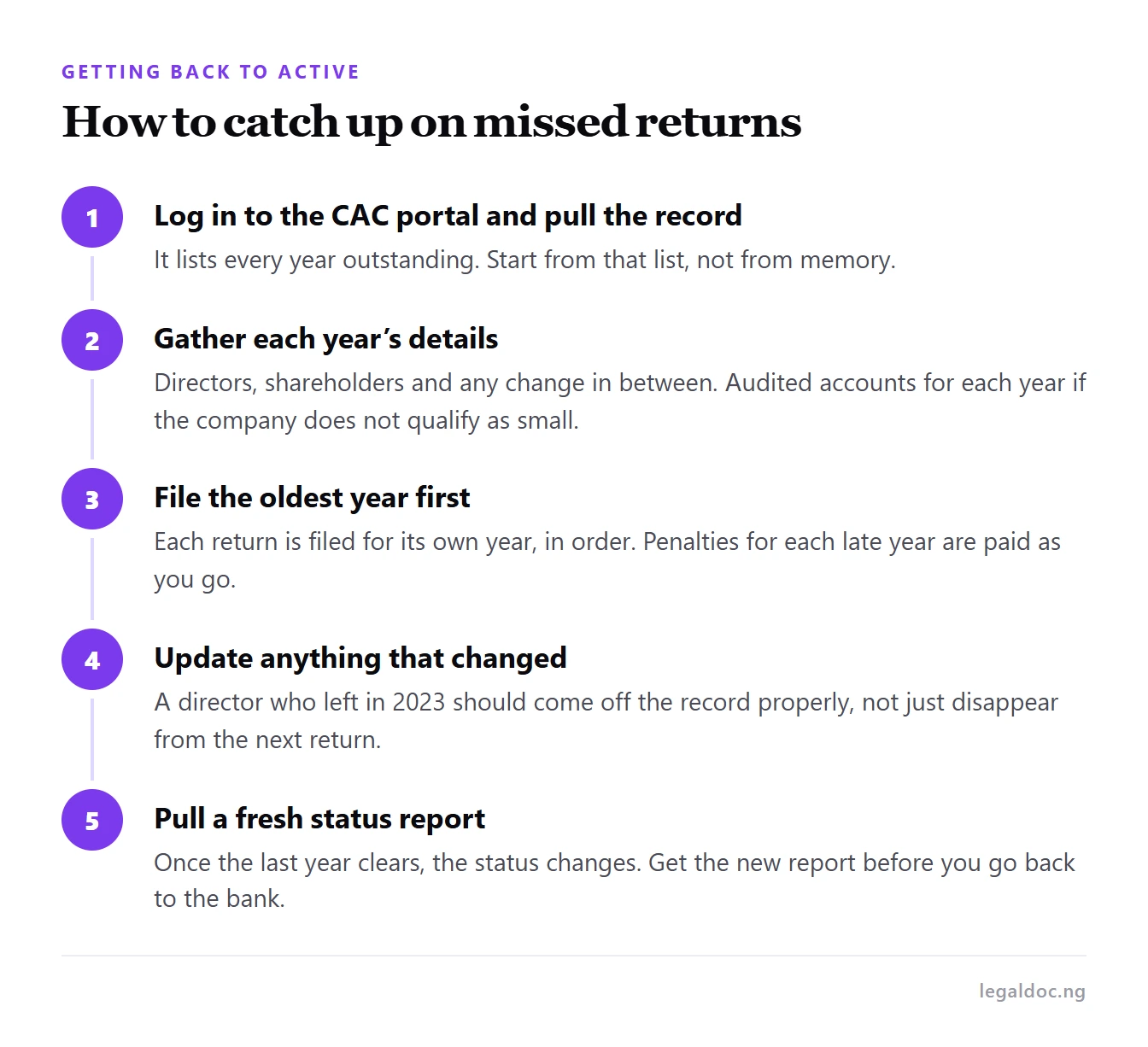
Each outstanding year is filed separately, oldest first.
A few things worth knowing before you start.
Each year is its own return. You cannot file one catch-up return that covers everything. Every missed year needs its own filing reflecting the company as it stood in that year.
Changes need filing properly too. If a director resigned or shares changed hands during the years you missed, those changes have their own filings. Leaving somebody off a later return is not the same thing as removing them, and the mismatch will show up later. Record the change with a board or shareholder resolution and file it, so the record is right going forward.
Get the new status report in writing. Once the last outstanding year is filed and processed, pull a fresh status report from the CAC. That document is what the bank or the client actually wants to see, so have it ready rather than asking them to search again.
Small companies and audited accounts
CAMA 2020 lightened the load considerably for small companies. A private company that meets the Act's conditions on turnover, assets and ownership qualifies as small, and a small company is exempt from having its accounts audited.
That makes the annual filing much simpler for most owner-managed Nigerian businesses. It does not make the annual return optional. The exemption is from the audit, not from the return, and a small company files its return every year like any other.
If you are not sure whether your company qualifies as small, ask your accountant to check it against the conditions in the Act, because the answer decides what has to be attached each year.
Keeping it from happening again
Once the company is back to active, the goal is to make sure nobody has to go through this again.
- Put the anniversary in the calendar. With a reminder two weeks before. It is the same date every year.
- Decide who owns it. Your accountant, your company secretary, or you. Write it down. "I thought you were doing it" is how four years go missing.
- Check the status before anything important. Before a loan application, a tender, an investment or a big contract, pull a status report first, while there is still time to fix it.
- Keep the register up to date. When a director leaves or shares change hands, file the change when it happens, not when the next return is due.
If you are still deciding how to structure the business in the first place, the obligations differ: a business name and a limited company are not maintained the same way. And if you run an NGO rather than a company, its filings work differently again; we cover those in annual returns for incorporated trustees.
Frequently Asked Questions About Annual Returns in Nigeria
Does a company that has not traded still need to file annual returns? Yes. The obligation comes from the company existing, not from it trading. A dormant company files a return every year like any other, and falling behind is how many founders end up with an inactive company they cannot use.
Is an annual return the same as a tax return? No. The annual return goes to the CAC and confirms who runs and owns the company. The tax return goes to the tax authority and covers what the company earned. They are separate filings with separate deadlines, and filing one does nothing for the other.
What does inactive status on the CAC portal mean? It means the company has annual returns outstanding. The company still exists, but the status is visible to anybody who searches it, the CAC will not process its other filings, and banks and large clients will usually not proceed until it is cleared.
Can I file all my missed years in one return? No. Each year is filed separately, oldest first, reflecting the company as it stood in that year, and the penalty for each late year is paid as you file it.
Can the CAC close my company for not filing? Yes. CAMA 2020 allows the CAC to strike off a company it has reason to believe is not carrying on business, and years without annual returns is the usual evidence. Restoring a struck-off company requires an application to court.
When is my first annual return due? Not in the year the company was incorporated. The first return falls due after the following anniversary of incorporation, and every year after that on the same cycle.
Where this leaves you
An annual return is a small, dull filing that only becomes urgent at the worst possible moment. Check your company's status today, before somebody else does, and if anything is outstanding, start with the oldest year.
If you are setting up a new company and want it done properly from the start, we handle the CAC registration end to end.