

Registering a company? Record who controls it correctly from day one
Incorporation at the CAC with shareholders, directors and persons with significant control filed properly the first time.
Register my companyFor most of Nigeria's company history, the CAC only needed to know whose names were on the share register. Whether those people were the real owners, or were holding shares for somebody else, was nobody's business but theirs.
CAMA 2020 changed that. Every company now has to identify the individuals who actually own or control it, the people behind the names, and give their details to the Corporate Affairs Commission. The law calls them persons with significant control. Most of the world calls it beneficial ownership.
It is one of the least understood parts of the Act, which is why so many companies get it wrong without knowing.
The short answer
A person with significant control is an individual who, directly or indirectly, holds at least 5% of a company's shares or voting rights, can appoint or remove most of its directors, or otherwise has significant influence over it. Every company has to identify these people, keep their details on record and notify the CAC, including when somebody becomes or stops being one. Nominees do not count; the person they hold for does.
Why this exists
The rules are part of a worldwide effort to stop companies being used to hide money. A company is a very good place to conceal who owns an asset, because the register only shows the shareholders, and a shareholder can be another company, or a friend, or a lawyer acting on instructions.
Requiring companies to name the actual human beings at the end of the chain makes that harder. It also explains why the question keeps coming up outside the CAC. Banks ask about beneficial owners when you open a corporate account, investors ask during due diligence, and large clients increasingly ask before they will put you on their supplier list.
For an ordinary business with nothing to hide, the rules are not a threat. They are paperwork that has to be done properly, and done again whenever ownership changes.
Who counts as a person with significant control
A person counts if they meet any one of the tests below. Meeting one is enough; they do not need to meet all of them.
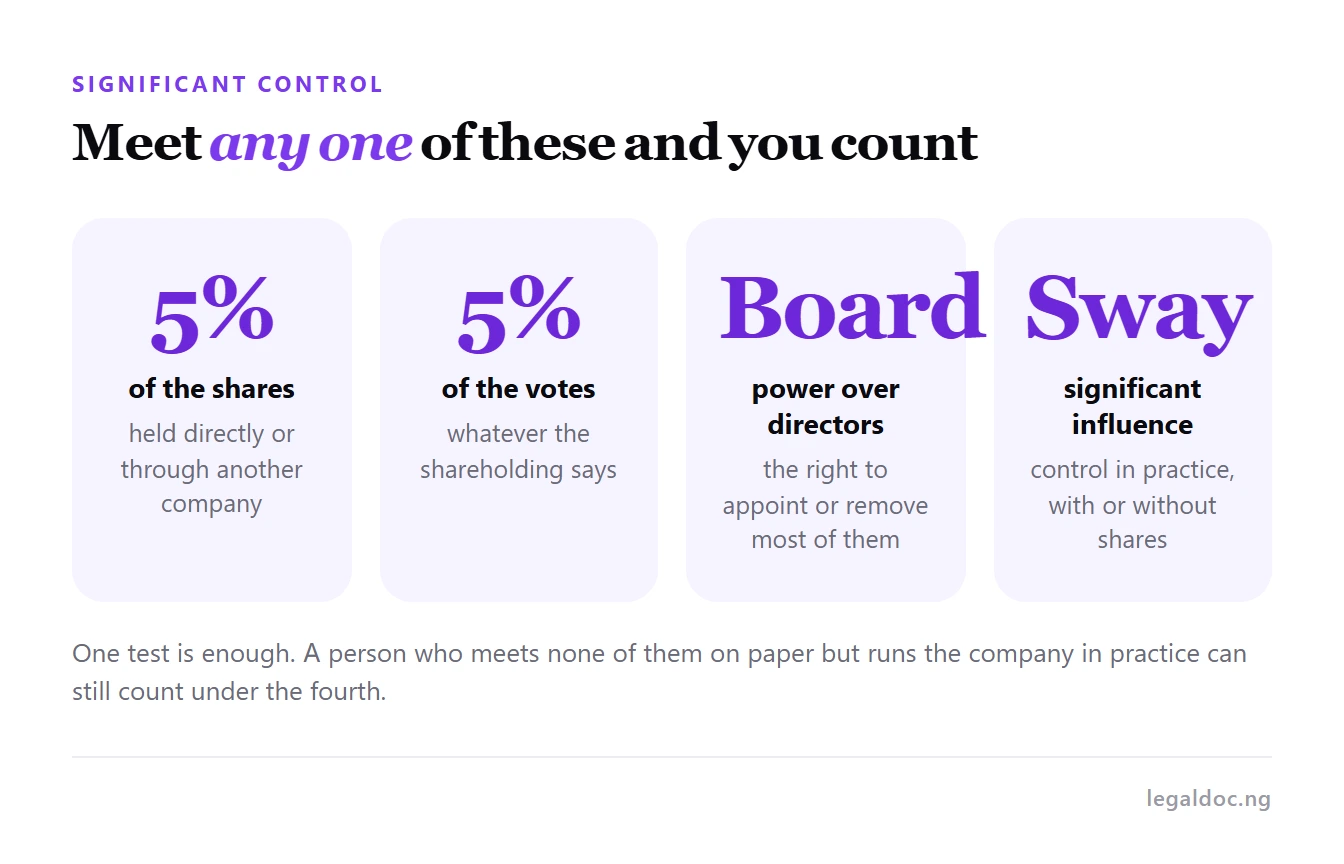
Any one test is enough to put somebody on the register.
Two things trip people up here.
The threshold is low. Five per cent is a small stake. In a company with several investors or a staff share scheme, there can be more people above the line than the founders expect.
"Indirectly" means looking through other companies. If you own a company that owns shares in another company, you can be a person with significant control of the second one, even though your name appears nowhere on its share register. You follow the chain up until you reach a human being.
A worked example
It is easier to see in practice. Here is an invented company with four people connected to it.
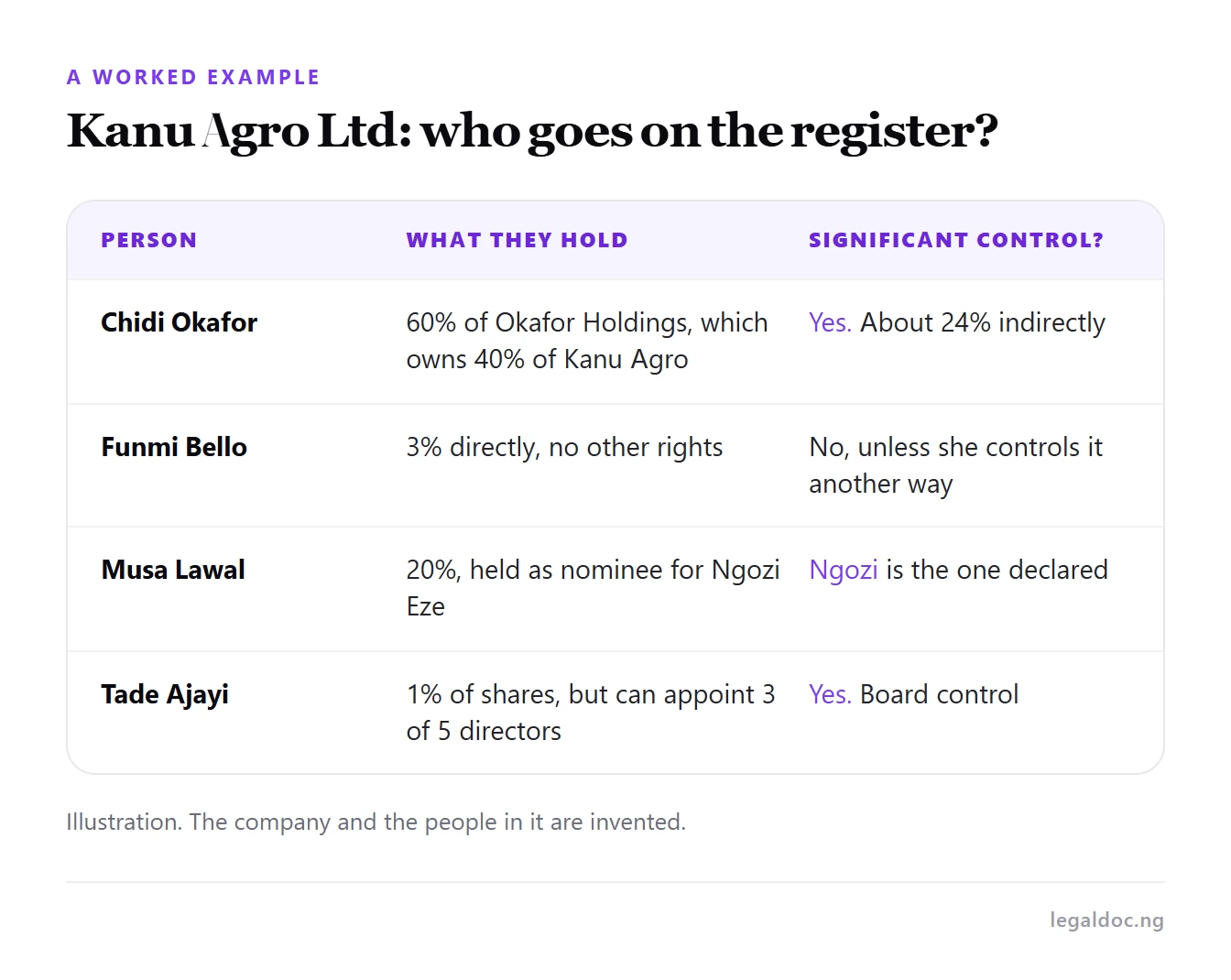
An illustration. The company and the people in it are invented.
Chidi never appears on the company's own share register, because his shares are held through Okafor Holdings. But he controls 60% of a company that owns 40%, which puts roughly 24% in his hands. He is declared.
Funmi's 3% sits below the threshold, so unless she has some other form of control, she is not.
Musa is on the register of members, but he holds those shares for Ngozi. The person declared is Ngozi, because she is the one who actually owns them.
Tade owns almost nothing, but the shareholders agreement lets him appoint three of the five directors. That is control of the board, and he counts.
Nominee shareholders
Nominee arrangements are common in Nigeria and entirely lawful. People use them for privacy, for convenience when the real owner lives abroad, or because an investor's own rules prevent them holding shares directly.
What CAMA 2020 changed is that a nominee can no longer be the end of the story. The nominee's name stays on the register of members, but the person behind them is the one the company declares as having significant control.
That makes the nominee agreement itself more important, not less. It should say clearly who the beneficial owner is, oblige the nominee to act on their instructions, and require both of them to cooperate with the company's disclosure duties. A nominee shareholder agreement that is silent on this leaves the company guessing. We cover the arrangement itself in more detail in shareholder against nominee shareholder.
Not sure who counts as a person with significant control?
Describe your shareholding and LegalDoc+ tells you who must be declared and what the CAC expects.
Ask LegalDoc+What you have to record and file
For each person with significant control, the company records their details and tells the CAC. The information asked for follows the same pattern for everybody.
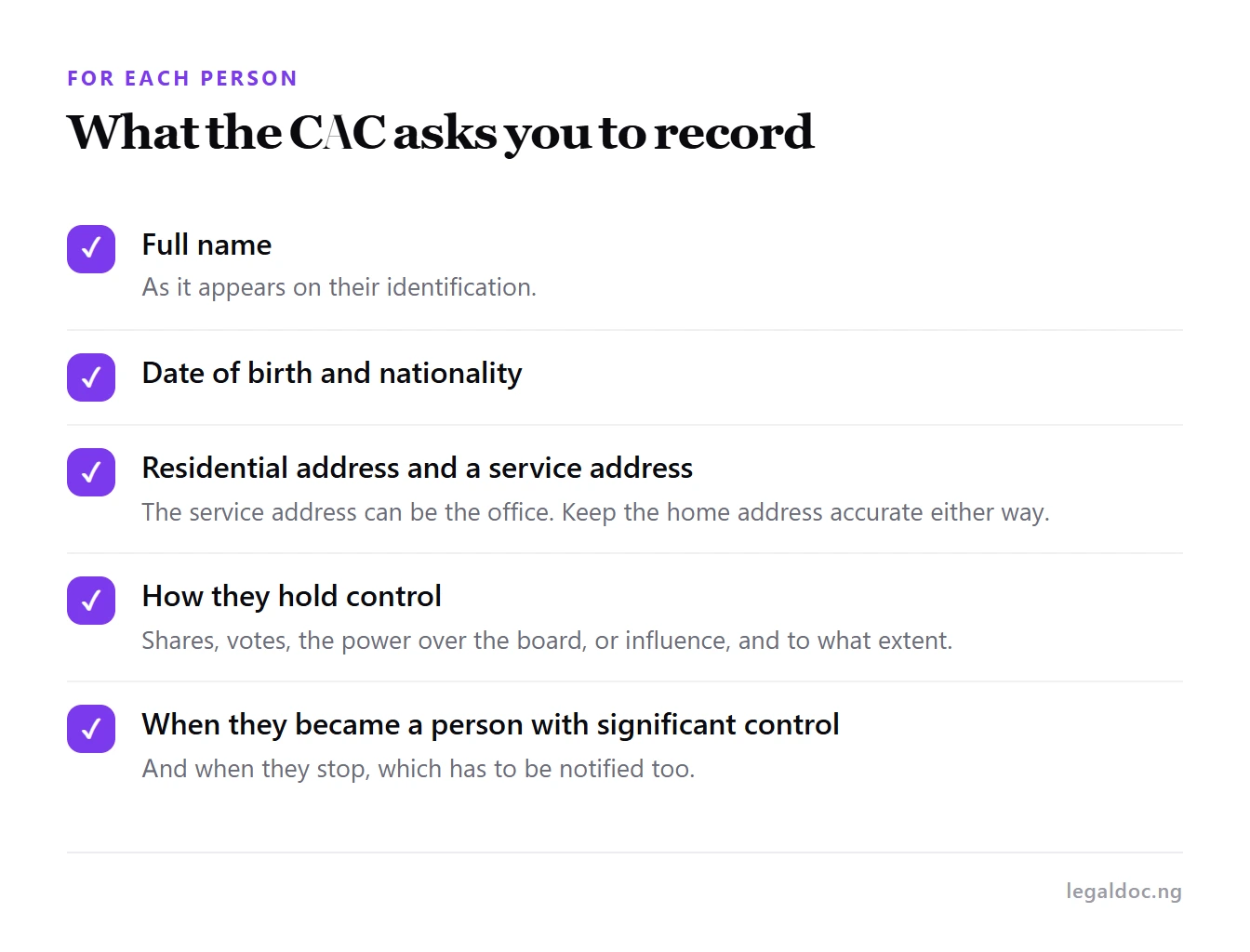
The same details are recorded for every person on the list.
New companies give this information as part of registration, so a company incorporated under CAMA 2020 starts with the right record. The trouble usually comes later, when ownership changes and nobody updates it.
Changes have to be notified too
The register is not a one-off filing. When somebody becomes a person with significant control, stops being one, or the nature of their control changes, that has to be notified within the time limits in the Act and the CAC's regulations. Those limits are short, measured in days and weeks rather than at the next annual return.
The events that trigger an update are the ordinary events of a growing company: a new investor coming in above 5%, a founder selling down, shares moving into a holding company, a shareholders agreement giving somebody new rights over the board. Each one is a moment to ask whether the register still tells the truth.
What happens if you get it wrong
The consequences arrive in a few different forms.
Penalties. Failing to disclose, or disclosing late, exposes the company and its officers to penalties under the Act. Giving false information is treated more seriously still.
Filings that stall. When the CAC's records do not match what a company is trying to file, the filing does not go through. A share allotment, a transfer or an annual return can all be held up by an ownership record that is out of date.
Banks and investors walking away. This is the one that costs real money. A bank onboarding a corporate customer, or an investor doing due diligence, will compare what you tell them with what the CAC holds. A mismatch is a red flag, and it stops the process until it is explained.
And because the CAC now makes beneficial ownership information available on a public register, a record that is wrong is not just wrong privately. Anybody looking at your company can see it.
Getting it right
For most small companies, this is not difficult. It just needs somebody to sit down with the share register and ask the right questions.
- List every shareholder and their percentage. Anybody at 5% or above is on the list, unless they are a nominee, in which case their principal is.
- Follow corporate shareholders up the chain. If a shareholder is a company, find out who owns that company, and keep going until you reach individuals.
- Read the shareholders agreement. Rights to appoint directors, vetoes over major decisions and similar powers can create significant control without any shares at all.
- Write down who is responsible for updates. And make checking the register part of every investment, share transfer and change of directors.
If the company's ownership is still being set up, this is also the moment to get the paperwork that sits behind it right. A shareholders agreement records who has which rights, and makes the disclosure question much easier to answer honestly.
Frequently Asked Questions About Persons with Significant Control
What percentage makes somebody a person with significant control in Nigeria? Holding at least 5% of the shares or voting rights, directly or indirectly. A person can also count without shares if they can appoint or remove most of the directors or otherwise exercise significant influence over the company.
Do I declare my nominee or the real owner? The real owner. The nominee's name remains on the register of members, but the person they hold the shares for is the one declared as having significant control.
What if a company owns shares in my company? You look through it. Find out which individuals own or control the corporate shareholder, and work out whether their indirect interest in your company reaches the threshold.
Do small companies have to comply? Yes. The duty applies to companies generally, regardless of size. For most owner-managed companies the answer is simple, but it still has to be recorded and kept up to date.
Is the information public? Much of it is. The CAC makes beneficial ownership information available on a public register, which is one more reason to keep it accurate.
Do I need to update the CAC when ownership changes? Yes. A person becoming or ceasing to be a person with significant control, or a change in the nature of their control, has to be notified within the short time limits in the Act and the CAC's regulations.
Where this leaves you
If your company has one or two shareholders who hold their shares in their own names, this probably takes ten minutes to confirm. If there are nominees, holding companies or investors in the structure, it is worth taking an hour to trace it properly, before a bank or an investor does it for you.
And if your company has fallen behind on its CAC filings more generally, the place to start is the annual returns. We explain how to catch up in annual returns for Nigerian companies.