

Registering an NGO, church or association?
We register incorporated trustees from start to finish: the trustee documents, the newspaper publication and the CAC filing.
Register my NGOYou have the idea: a foundation in your late mother's name, an alumni association that finally needs a bank account, a women's health initiative that wants grant funding, a church that has outgrown the pastor's living room. Before any of it can sign a lease, open an account or receive a donor's money, it needs a legal form.
In Nigeria, a non-profit is usually registered in one of two ways: as a company limited by guarantee, or as incorporated trustees. Both are recognised by the CAC, both can own property and receive grants, and neither can share profits among its members. But they are built differently, registered differently and run differently, and choosing the wrong one makes life harder for years. Here is how to choose.
The short answer
Incorporated trustees suit most Nigerian NGOs, faith organisations, associations and community groups. The organisation is run by a body of trustees under its own constitution, and registration does not need the Attorney General's consent. A company limited by guarantee suits non-profits that want to be run like a company, with a board of directors and members under company law, such as corporate foundations, professional bodies and think tanks. It needs the consent of the Attorney General of the Federation before the CAC will register it. If you are unsure, incorporated trustees is usually the simpler and more familiar choice.
The two structures, side by side
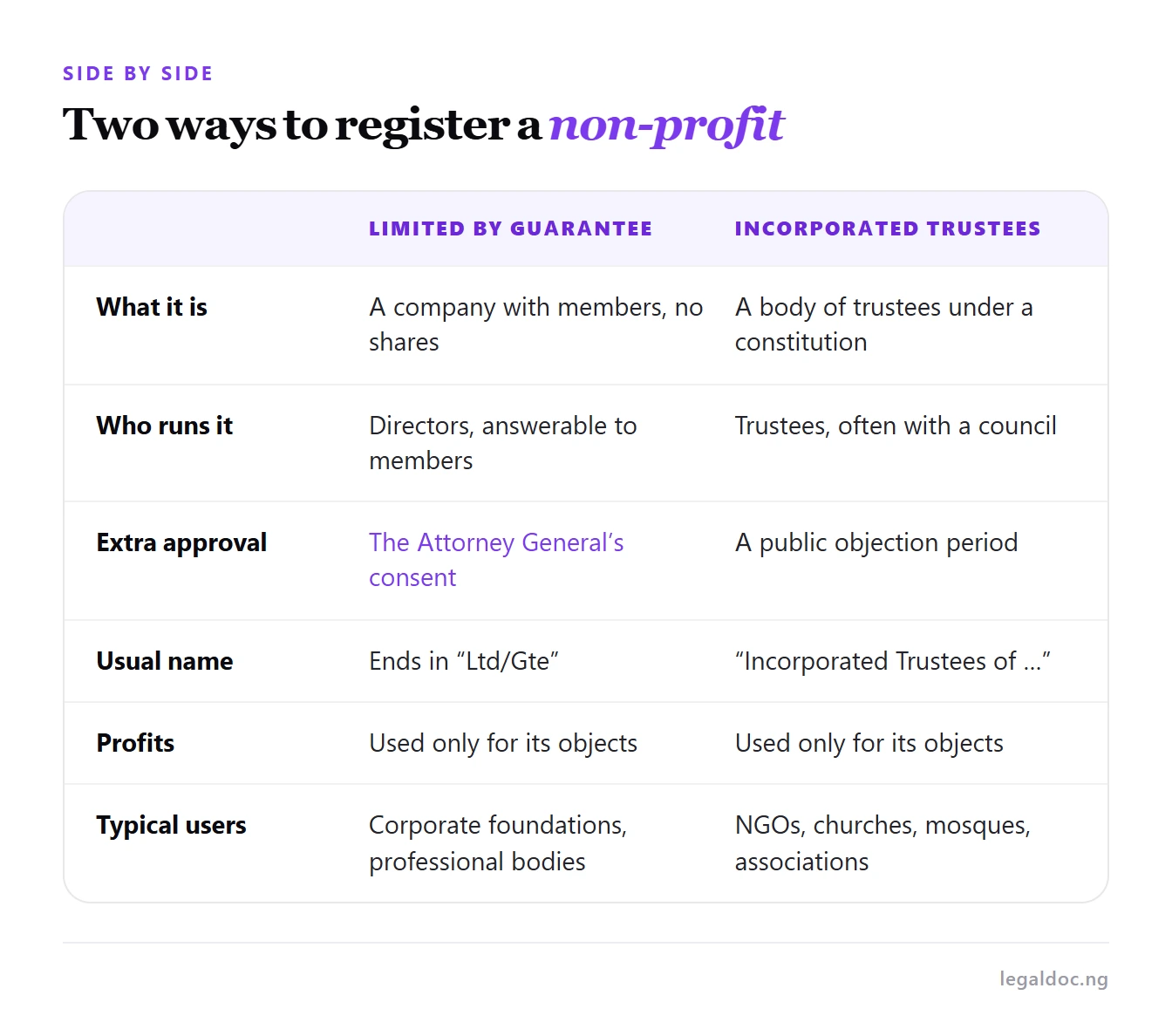
Both are non-profit and both are registered by the CAC. The difference is in how they are built.
How a company limited by guarantee works
A company limited by guarantee is a company in every sense except that it has no shares and makes no profit for its members. Instead of buying shares, each member guarantees to contribute a small fixed sum if the company is ever wound up. Its income must be used only to pursue its objects, such as education, research, charity, culture or sport, and nothing can be paid to members as dividends.
It is run like any company: directors manage it, members hold them to account, and it keeps the registers, holds the meetings and files the accounts that company law requires. Its name usually ends in "Ltd/Gte". Before the CAC registers one, the Attorney General of the Federation must consent. CAMA 2020 now gives the Attorney General a set period to respond, after which the promoters can advertise for objections and proceed, but it remains an extra step.
How incorporated trustees work
Incorporated trustees are a body of trustees registered to act for an association or community: a religious body, a charity, a development organisation, a club, a town union or an alumni group. Once registered, the trustees become a single legal person, usually named "The Incorporated Trustees of" the organisation, which can own land, sue and be sued, and carry on for as long as the organisation exists, whoever the individual trustees are.
The organisation is governed by its own constitution, which sets out its aims, how trustees are appointed and removed, and how decisions are made. The application is published so that the public can object, and once registered the organisation files annual returns with the CAC. CAMA 2020 also gives the CAC power to suspend trustees and appoint interim managers where there is misconduct or mismanagement, so good records and proper meetings matter.
Which structure fits your organisation?
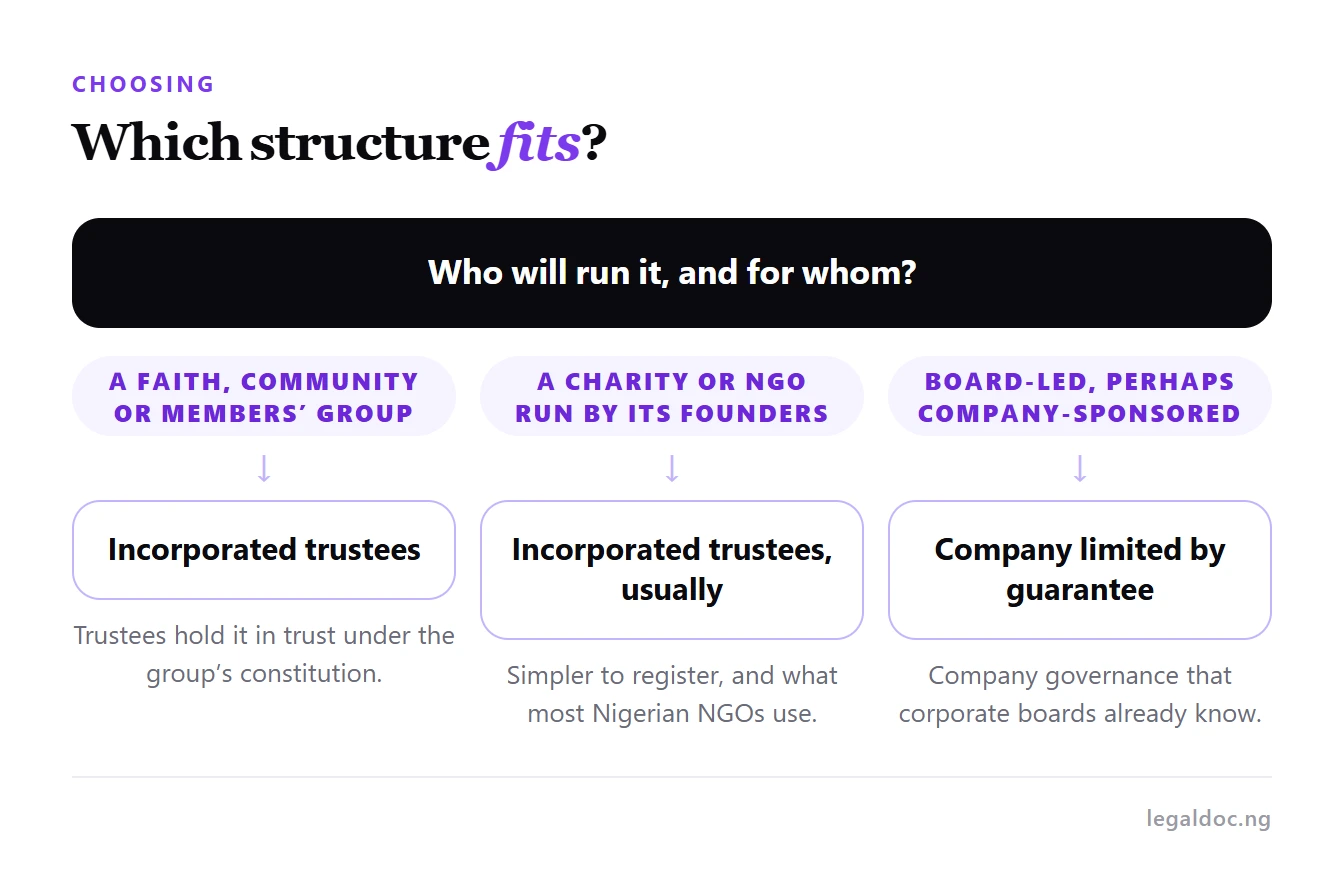
Most Nigerian NGOs, churches, mosques and associations land in the first two columns.
A few questions settle most cases.
Who will run it
If it will be run by a small group of founders or elders who hold it in trust for a cause or a community, incorporated trustees fit naturally. If it will be run by a board answerable to members, perhaps with representatives of a sponsoring company, a company limited by guarantee may suit better.
Who it is for
Faith organisations, community associations, alumni groups and most charities are what incorporated trustees were designed for. Professional and trade bodies, research institutes and corporate foundations often prefer the company form, because their boards already know how it works.
Not sure which structure fits? Ask LegalDoc+
Describe who will run the organisation, who funds it and what it does, and get an answer under CAMA 2020.
Ask LegalDoc+How quickly you need it
The Attorney General's consent adds a step to a company limited by guarantee. Incorporated trustees avoid it.
Whichever you choose, both can open bank accounts, employ staff, receive grants and donations, and apply for tax exemption on income that does not come from trading. For the wider picture, see the benefits of setting up an NGO.
What you need to register incorporated trustees
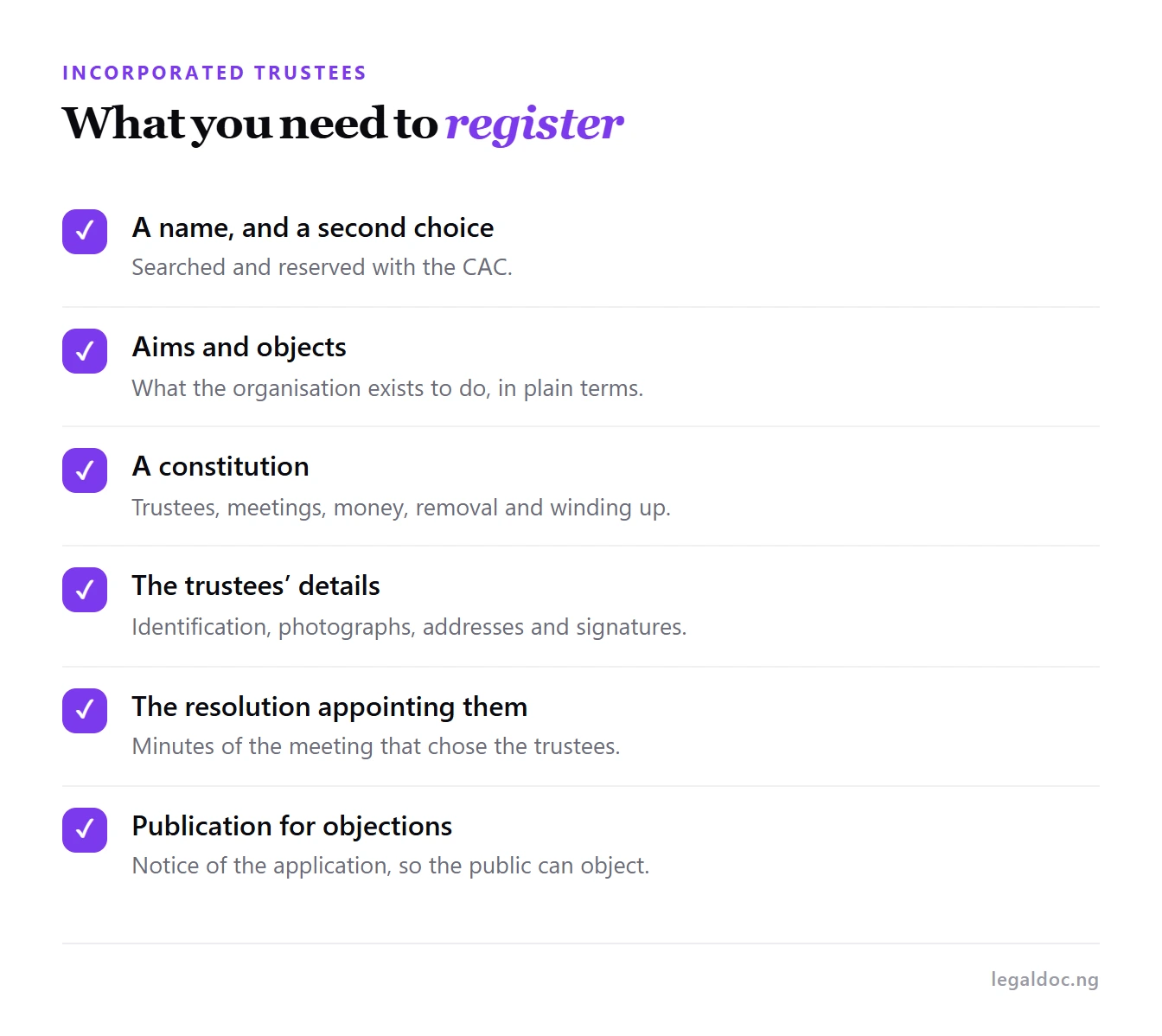
Most delays come from the constitution and the trustees' documents. Get those right first.
The constitution deserves the most care. It decides who can become a trustee, how trustees are removed, how money is approved and spent, and what happens if the organisation winds up. A vague constitution is the root of most later disputes, including the ones that end up in court. If trustees change later, our guide to changing trustees in a registered NGO covers the process.
The first year after registration
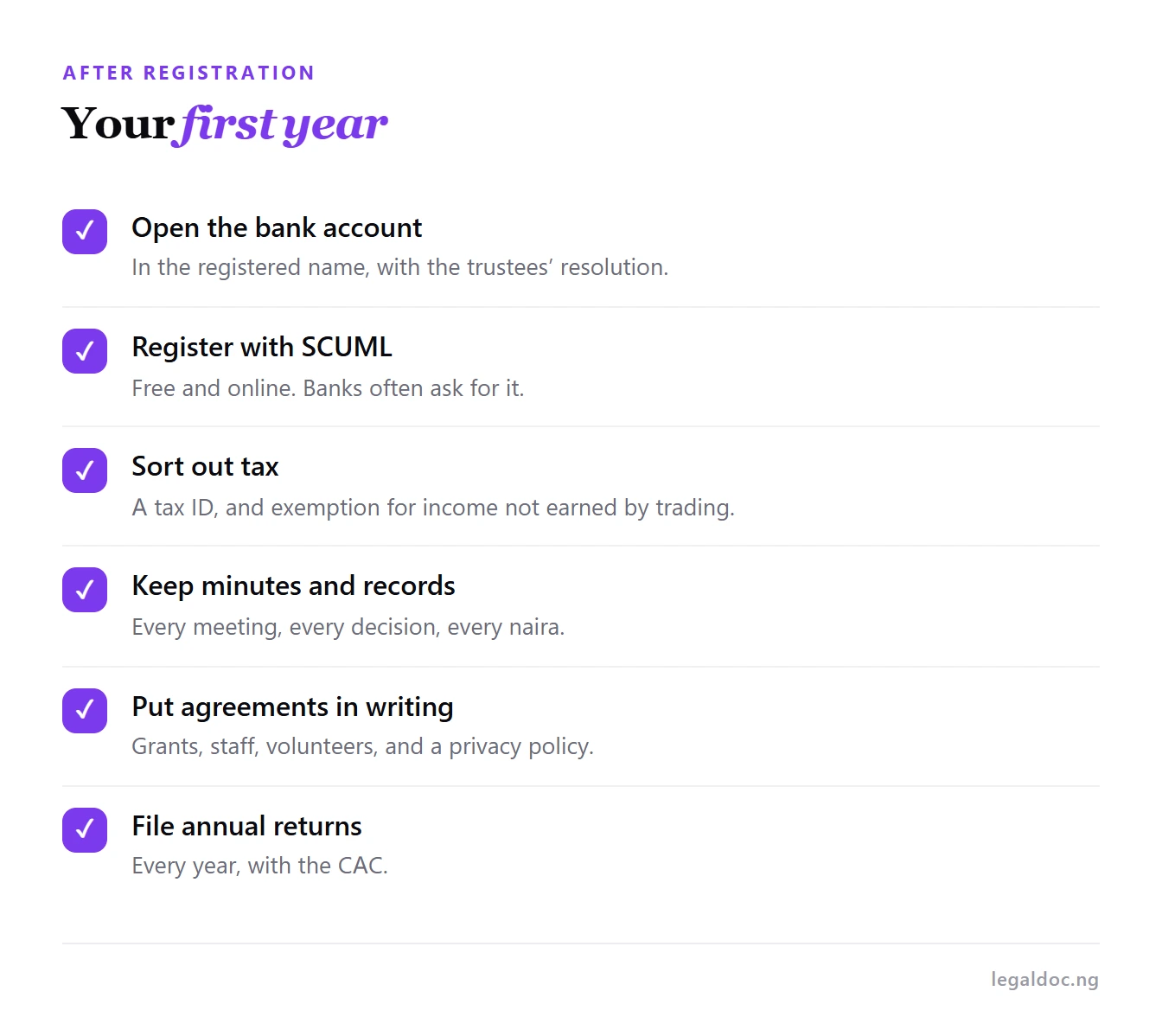
Registration is the start. These keep the organisation in good standing.
Two of these trip people up. The first is SCUML: the Special Control Unit Against Money Laundering supervises non-profit organisations, with particular attention to those assessed as at risk of being misused, and banks often ask NGOs for the SCUML certificate before they will run the account smoothly. Registration is free and done online, and our guide to SCUML registration walks through it. The second is annual returns, which incorporated trustees file with the CAC every year. We explain those in annual returns for incorporated trustees.
Put proper agreements in place from the start, too. A grant agreement sets out what a donor's money is for and how you will report on it. Employment contracts protect the organisation and its staff alike. And if the NGO has a website or collects donors' details, it needs a privacy policy.
Register with LegalDoc
For most organisations, incorporated trustees is the right answer, and LegalDoc registers incorporated trustees from start to finish: the trustee documents, the newspaper publication and the CAC filing. Foundations, associations and faith organisations across Nigeria have been registered this way. For the costs involved, see how much it costs to register an incorporated trustee.
If you are still weighing the two structures, describe your organisation to LegalDoc+, including who will run it, who will fund it and what it will do, and it will tell you which form fits and why under CAMA 2020. It can also review a draft constitution before you file it.
Frequently Asked Questions About Company Limited by Guarantee and Incorporated Trustees
What is the difference between a company limited by guarantee and incorporated trustees? A company limited by guarantee is a company with members and directors but no shares, governed by company law. Incorporated trustees are a body of trustees registered to act for an association under its own constitution. Both are non-profit.
Which is better for an NGO in Nigeria? For most NGOs, faith organisations and associations, incorporated trustees are simpler and more familiar. A company limited by guarantee suits organisations that want company-style governance, such as corporate foundations and professional bodies.
Does a company limited by guarantee need the Attorney General's consent? Yes. CAMA 2020 kept the requirement, though it now sets a period for the Attorney General of the Federation to respond.
Can an NGO make a profit? It can earn more than it spends, but the surplus must be used for its objects. Neither structure can pay profits to its members or trustees.
Does an NGO need SCUML registration? Many do. SCUML supervises non-profit organisations, especially those assessed as at risk, and banks often ask NGOs for the certificate. Registration is free and done online.
Where this leaves you
Both structures do the same essential job: they give your cause a legal identity that can own property, open accounts and take donors' money. Choose incorporated trustees if your organisation is a community, a congregation, an association or a charity run in trust. Choose a company limited by guarantee if you want a board and members under company law. Then write a constitution that will hold up when people disagree, and keep the records that keep you in good standing.