

Write your leave policy down once
Annual, sick, maternity and paternity leave set out in a staff handbook, so every request is handled the same way.
Draft an employee handbookAsk ten Nigerian employers how much leave the law says their staff are entitled to, and you will get ten different answers. Some are confidently generous, some confidently wrong, and a surprising number have never looked.
The Labour Act does set minimums, and they are lower than most people assume. That is not an invitation to give the bare minimum. It is useful to know where the legal floor is, so that your policy sits clearly above it and nobody can argue about what was owed.
The short answer
Under the Labour Act, a worker is entitled to at least six working days of paid annual leave after twelve months' continuous service, up to twelve working days of paid sick leave a year with a doctor's certificate, and twelve weeks of maternity leave, six before the birth and six after, paid at not less than half wages where she has six months' service. Nursing mothers get two half-hour breaks a day. Paternity leave is not in the Act. Contracts and handbooks that promise more must be honoured.
The three numbers to know
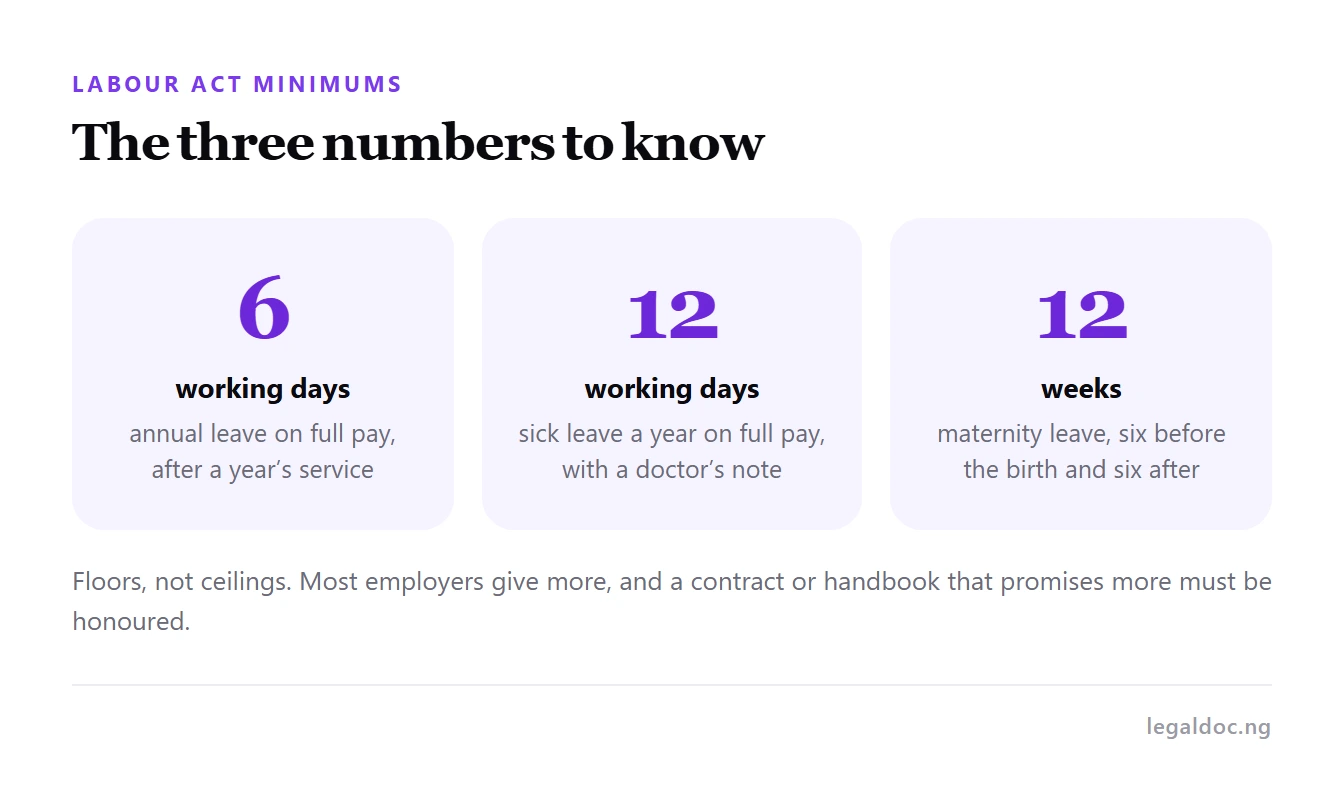
Legal floors. Most good employers give more.
Annual leave
Section 18 of the Labour Act entitles a worker to a holiday with full pay of at least six working days after twelve months of continuous service. Young workers under sixteen, including apprentices, get at least twelve.
Six days is low by any modern standard, and most Nigerian employers comfortably exceed it, often giving fifteen to twenty-one working days for permanent staff. That is fine; the Act sets the minimum, not the norm. What matters is that whatever you give is written down, so there is no argument about it later.
Two things to decide and state clearly:
- When leave starts. Under the Act, entitlement follows twelve months' service. Many employers let staff take leave earlier, accruing it month by month. Either is fine if it is clear.
- What happens to unused leave. Whether it carries over to the next year, is lost, or is paid out when somebody leaves. Silence on this is where exit disputes start.
Sick leave
Section 16 entitles a worker to be paid wages for up to twelve working days in a calendar year while absent through temporary illness certified by a registered medical practitioner.
Two parts of that matter in practice. The illness has to be certified, so it is reasonable to ask for a medical certificate. And the twelve days are the paid minimum, not a cap on how long somebody can be ill. What happens beyond twelve days, whether further paid leave, half pay, unpaid leave, or a longer-term illness procedure, is for your policy to say.
A sensible policy also deals with short absences. Many employers accept a day or two of self-certified sickness without a doctor's note and require a certificate after that. Whatever you choose, apply it consistently.
Maternity leave
Section 54 of the Labour Act protects women before and after childbirth, and it is the provision employers most often get wrong.
A woman is entitled to stop work once she produces a medical certificate stating that she is likely to give birth within six weeks, and she must not be made to work during the six weeks after the birth. That makes twelve weeks in total.
During that leave she must be paid at least half of the wages she would otherwise have earned, provided she has worked for the employer continuously for at least six months before the leave. And an employer may not give her notice of dismissal while she is away on maternity leave, or time a notice so that it expires during her absence.
When she returns, a nursing mother is entitled to half an hour twice a day during working hours to nurse her child.
Not sure what leave you owe? Ask before you answer
LegalDoc+ explains what the Labour Act requires, what your contracts promise, and where the two differ.
Ask about leaveAgain, these are minimums. Many private employers now give longer maternity leave on full pay, and the federal and several state public services give considerably more than the Act requires. Public service rules bind the government as employer, not private businesses, but they do shape what staff expect.
Paternity leave
The Labour Act does not provide for paternity leave. Some public services have introduced it for their own staff, but a private employer is not legally required to give it.
Many do anyway, typically a week or two, because it costs little and matters a great deal to the people who take it. If you give it, put it in writing like every other kind of leave, so it is applied the same way to everybody.
Everything in one table
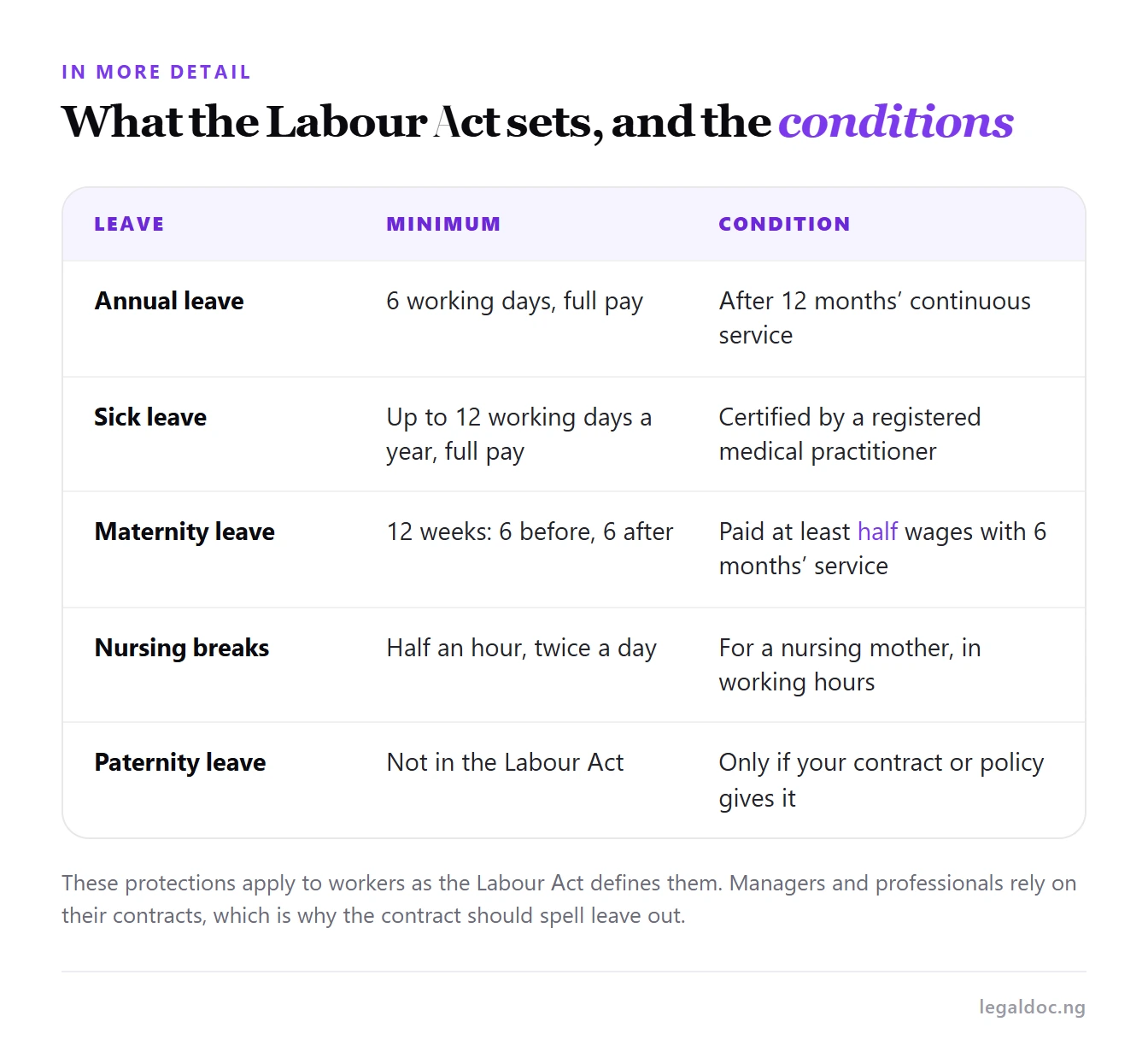
Note the last line of the table: these protections are framed for workers as the Act defines them.
Who the Labour Act covers
This is the point most articles skip. The Labour Act's protections apply to "workers", and the Act's definition leaves out people employed in administrative, executive, technical or professional roles. So in strict terms, a senior manager's leave is governed by their contract rather than the Act.
That is a reason to write leave into every employment contract and the staff handbook, not a reason to give managers less. In practice, employers apply one leave policy across the workforce, and the National Industrial Court expects fair treatment for everyone. If leave is not in the contract at all, you leave the court to decide what was reasonable, which is rarely where an employer wants to be.
What a proper leave policy says
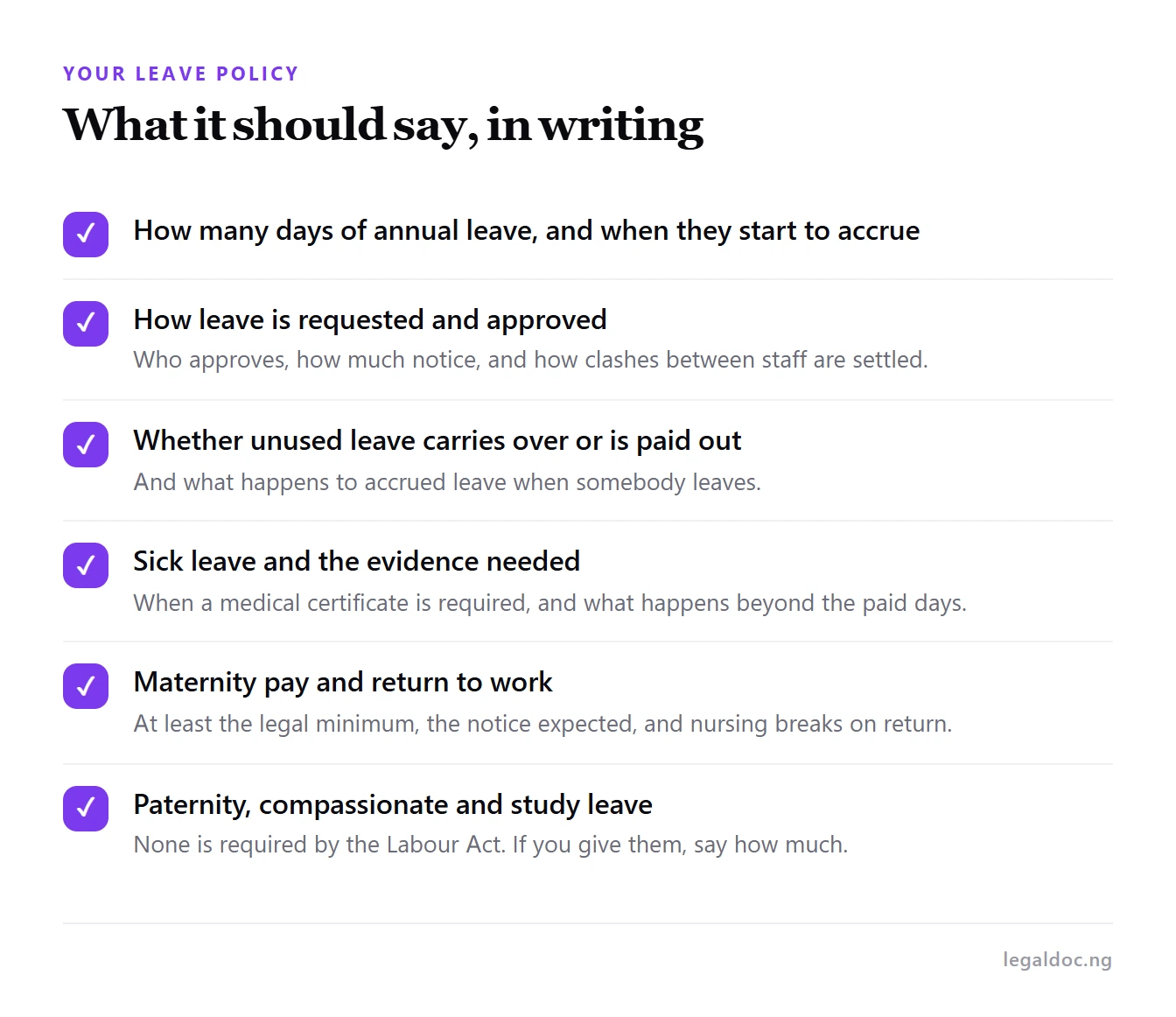
Write it once, apply it to everyone.
The place for all of this is your employee handbook, with the headline entitlements repeated in each employment contract. The handbook lets you set the detail once and change it with notice; the contract makes the core entitlement binding for each person.
Common mistakes
Unpaid maternity leave. Telling a woman with six months' service that maternity leave is unpaid is simply unlawful. At least half pay is required.
Dismissing during maternity leave. Serving notice while she is away, or timing it to expire while she is away, is prohibited by the Act and is the fastest way to a claim at the NICN.
No written policy. Leave granted case by case, at a manager's discretion, produces resentment at best and discrimination claims at worst.
Docking pay for certified sickness. Within the twelve paid days, a worker with a valid medical certificate is entitled to their wages. Deductions here are a frequent complaint, and we cover deductions more broadly in when salary deductions are legal.
Frequently Asked Questions About Leave in Nigeria
How many days of annual leave does the Labour Act give? At least six working days on full pay after twelve months' continuous service, or twelve for workers under sixteen. Most employers give considerably more, and whatever the contract promises must be honoured.
How long is maternity leave in Nigeria? Under the Labour Act, twelve weeks: up to six weeks before the expected birth, once a doctor certifies it, and six weeks after. Many employers and public services give longer.
Is maternity leave paid in Nigeria? Yes. The Labour Act requires at least half of her normal wages during maternity leave, provided she has worked for the employer continuously for six months or more before the leave.
Is paternity leave compulsory in Nigeria? Not for private employers. The Labour Act does not provide for it, though some public services give it to their own staff and many private employers choose to.
How many sick days are workers entitled to? Up to twelve working days a year on full pay for temporary illness certified by a registered medical practitioner. What happens after that is for the employer's policy to set.
Can I dismiss an employee while she is on maternity leave? No. The Labour Act prohibits giving notice of dismissal during maternity leave, or timing notice so that it expires while she is away.
Where this leaves you
The Labour Act sets a low floor. A good leave policy sits comfortably above it, is written down, and is applied the same way to everyone. If yours lives only in people's heads, now is the time to put it in the handbook.