

Write the redundancy procedure down before you need it
Selection criteria, consultation, notice and redundancy payments in the staff handbook, applied the same way to everyone.
Draft an employee handbookBusiness slows down. A contract you depended on is not renewed, a branch closes, or a new system does in an afternoon what three people used to do in a week. You have more staff than you have work, and somebody has to go.
That is a redundancy, and in Nigeria it is not simply a matter of handing out termination letters. The Labour Act sets out a procedure, the National Industrial Court expects fairness that goes beyond it, and employers who treat a redundancy like an ordinary termination are the ones who end up defending it in court.
The short answer
Under section 20 of the Labour Act, an employer making workers redundant must tell the union or workers' representatives the reasons and the extent of the redundancy, select using last in, first out adjusted for skill, ability and reliability, and use its best endeavours to negotiate redundancy pay. Notice or pay in lieu, final salary, accrued leave and pension remittances all have to be settled. The NICN will look closely at whether the redundancy was genuine and the process fair, even for staff the Labour Act does not strictly cover.
What redundancy actually means
The Labour Act describes redundancy as an involuntary and permanent loss of employment caused by an excess of manpower. In plain terms: the job goes because the business needs fewer people to do that kind of work, not because of anything the employee did.
That distinction is the whole point. Dismissal is about the person: their conduct or their performance. Redundancy is about the role. If you are letting somebody go because they are not good enough, that is a performance or conduct process, with warnings and a hearing, which we cover in how to legally fire an employee in Nigeria. Calling it redundancy does not make it one.
Who the Labour Act covers, and why it does not end there
Section 20 protects "workers" as the Labour Act defines them. That definition leaves out people employed in administrative, executive, technical or professional roles, so in strict terms the section is aimed at manual and clerical staff.
Employers sometimes take that as permission to handle managers and professionals however they like. That is a mistake. Their contracts still have to be honoured, and the National Industrial Court can apply international best practice and fairness in deciding employment disputes. In practice, the court increasingly expects the same basics for everybody: a genuine reason, consultation, fair selection and a reasonable settlement.
The safest approach is to run one fair process for everyone affected, whatever their grade.
The procedure, step by step
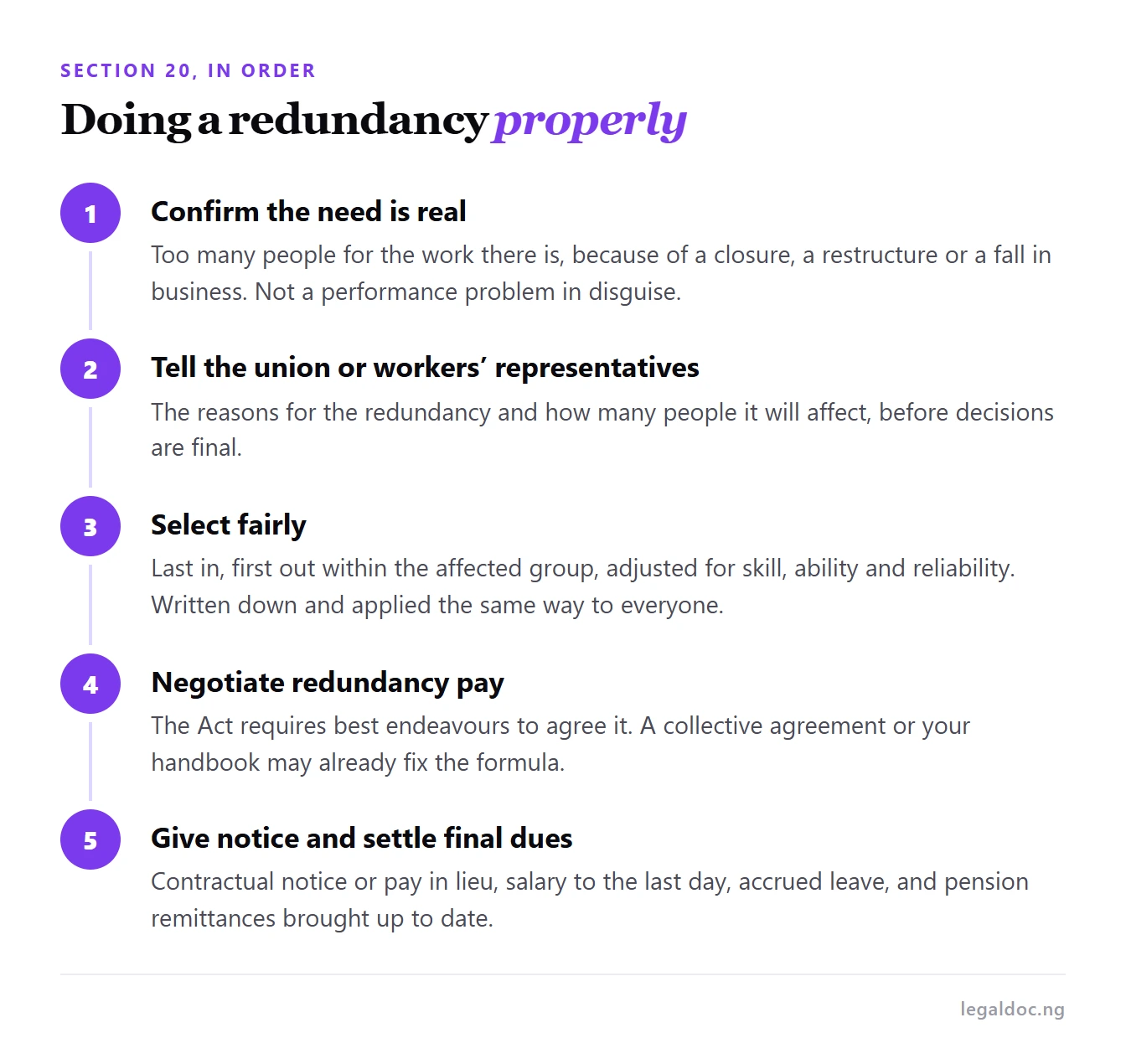
The order matters. Selection comes after consultation, not before it.
Tell the union or the workers' representatives
The Act requires the employer to inform the trade union or workers' representatives of the reasons for the redundancy and how far it will go. Where there is no union, tell the staff representatives or, in a small business, the staff directly.
Do it before decisions are final. Consultation is meant to give people a chance to respond, suggest alternatives such as reduced hours or redeployment, and understand why it is happening. Announcing a finished list and calling that consultation is precisely the thing a court looks for.
Select fairly
The Act's starting point is last in, first out within the category of workers affected: the most recently employed go first. But it is expressly subject to relative merit, including skill, ability and reliability. So an employer can keep a newer worker who is clearly more skilled, as long as the reasoning is genuine and applied consistently.
What protects you is writing the criteria down before you apply them, applying them the same way to everyone in the affected group, and keeping the scoring. Criteria invented after you have already decided who to let go are easy to spot and hard to defend.
Negotiate redundancy pay
The Labour Act does not fix a redundancy payment. It requires the employer to use its best endeavours to negotiate one with the workers affected. Where a collective agreement or your employee handbook already sets a formula, that formula applies.
Planning job cuts? Ask what the Labour Act requires first
Describe your situation and LegalDoc+ walks you through notice, selection and redundancy payments.
Ask LegalDoc+A common basis is a number of weeks' pay for each completed year of service. Whatever the basis, apply it evenly, put it in writing, and pay it on time. A redundancy package that is reasonable and promptly paid is the single best protection against a claim.
Notice and final dues
Redundancy still ends a contract, so notice applies. The employee is entitled to the notice in their contract, or the Labour Act minimum if that is longer, and notice can be replaced by pay in lieu.
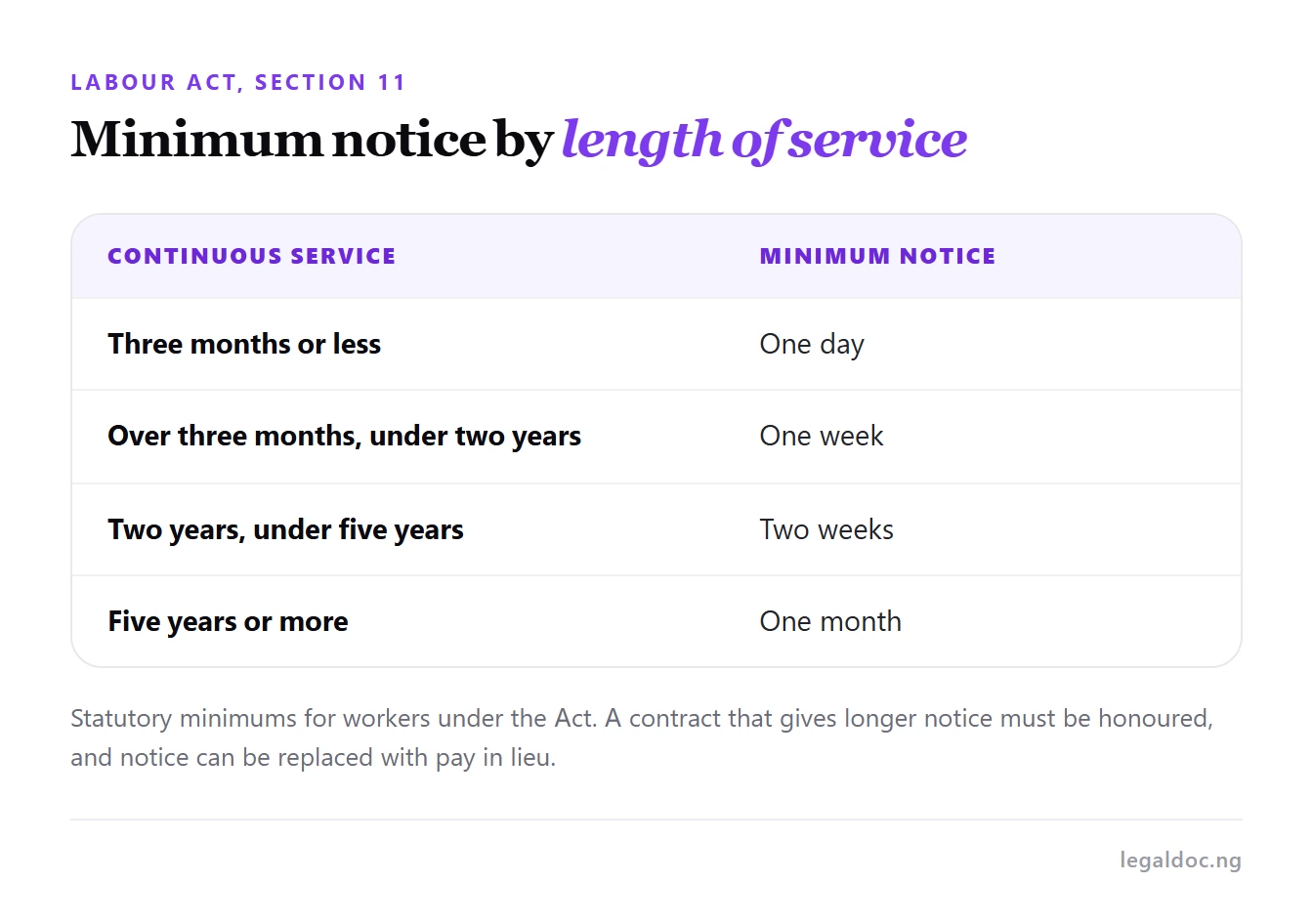
Minimums. A contract that promises more must be honoured.
On top of notice and the redundancy payment, settle everything else that is owed: salary up to the last day, any leave accrued but not taken, any gratuity the contract provides for, and pension contributions remitted right up to the end. Unremitted pension is an especially bad thing to leave behind, because it becomes a separate problem with PenCom, which we explain in pension, PAYE and NHF.
Is it a genuine redundancy?
This is the first thing a court will ask, and usually the place an employer's case falls apart.
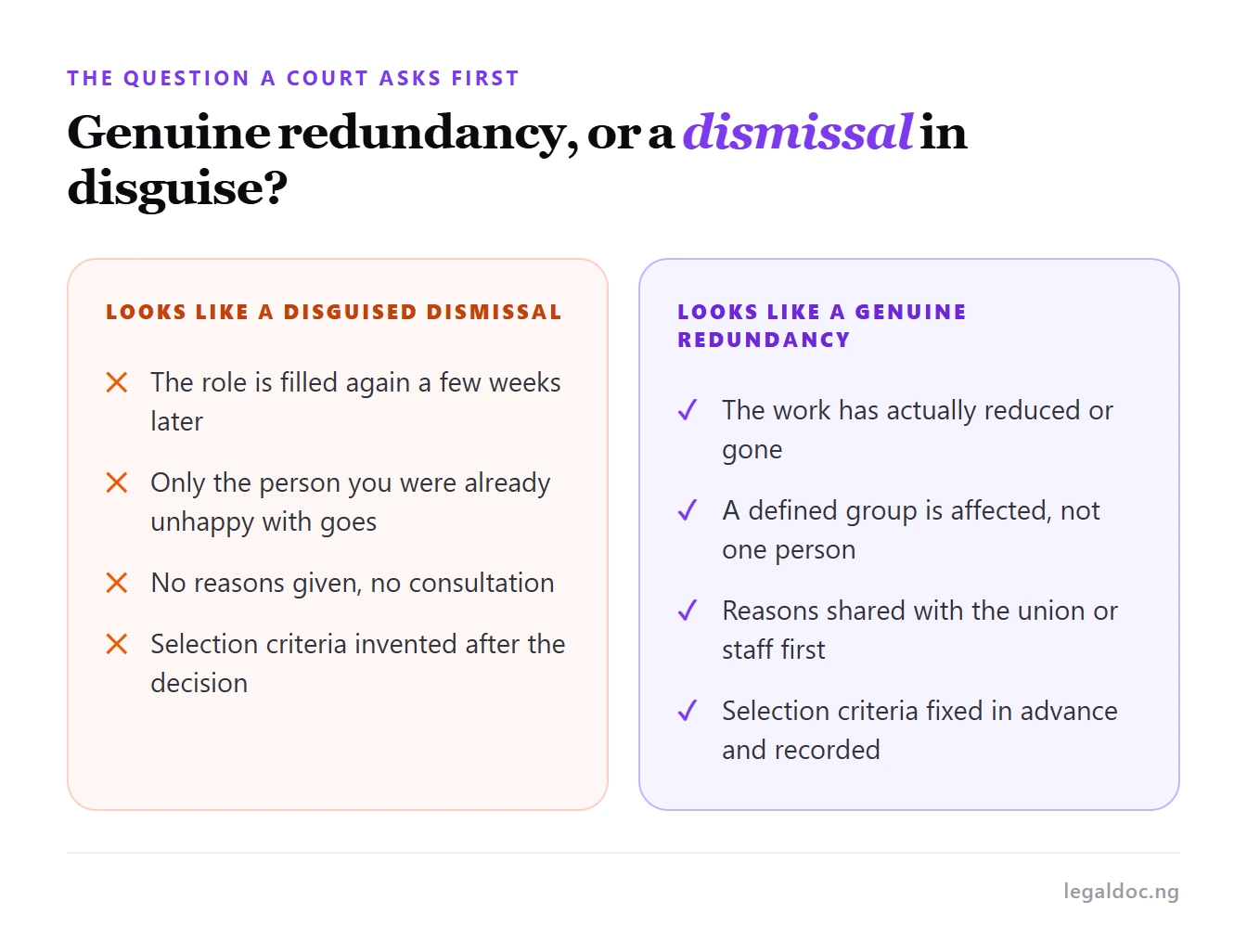
A redundancy that targets one person is rarely a redundancy.
The clearest warning sign is filling the role again. If the job was redundant, it should stay gone. Hiring somebody into the same position a few weeks later tells everybody that the redundancy was really a way to remove a particular person without going through a disciplinary process.
Paperwork that protects you
If a redundancy is challenged, the employer's case is only as good as its records. Keep:
- A short written explanation of why the redundancy is necessary: the contract lost, the branch closed, the work that no longer exists.
- Notes or minutes of the consultation with the union or staff, including any alternatives raised and why they were or were not adopted.
- The selection criteria, written before they were applied, and the scores for each person in the affected group.
- The redundancy letter to each employee, stating the reason, the notice, the payment and the date.
- Evidence of payment of everything owed.
Better still, set out your redundancy approach in your employee handbook before you ever need it. A policy that existed beforehand is far more convincing than one written in the week the decision was made.
The mistakes that end up in court
No consultation. Announcing the list on Friday afternoon is the commonest failure, and the most avoidable.
Selecting the people you wanted gone anyway. If the affected group happens to contain exactly the staff you had disciplinary concerns about, expect that to be raised.
Ignoring the contract. Notice periods, gratuity clauses and redundancy terms in the contract or a collective agreement apply whatever the Act says.
Holding back final dues. Withholding a final salary until an employee signs something, or paying weeks late, turns an orderly redundancy into a dispute.
Rehiring into the role. As above. It undoes everything.
Frequently Asked Questions About Redundancy in Nigeria
What does the Labour Act say about redundancy? Section 20 requires the employer to inform the union or workers' representatives of the reasons and extent of the redundancy, to apply last in, first out subject to skill, ability and reliability, and to use its best endeavours to negotiate redundancy pay for the workers affected.
Is redundancy pay compulsory in Nigeria? The Act requires the employer to try in good faith to negotiate redundancy pay, and a collective agreement, contract or handbook may make a particular amount compulsory. In practice, a fair payment is expected, and leaving it out invites a claim.
Does the Labour Act cover managers made redundant? Section 20 is aimed at workers as the Act defines them, which excludes administrative, executive, technical and professional staff. But their contracts still apply, and the NICN expects fair treatment for everyone, so run the same fair process across the board.
How much notice must I give a redundant employee? Whatever the contract says, or the Labour Act minimum if that is longer: from one day for very short service up to one month for five years or more. Notice can be replaced by pay in lieu.
Can I make one person redundant? You can, if their role genuinely disappears. But a redundancy that affects only one person, especially one you were already unhappy with, will be examined closely, and filling the role again afterwards will usually show it was not genuine.
Where this leaves you
A redundancy done properly is not complicated: a real reason, an honest conversation, fair selection, a reasonable payment and everything owed paid on time. It is skipping those steps that turns a hard business decision into a court case.
If you do not yet have a written policy, put one in your handbook now, while it is a policy and not a decision.