

Pension is calculated on the salary structure in the contract
Basic, housing and transport set out clearly in each employment contract, so the deductions are never guesswork.
Draft an employment contractIt usually starts with a bad month. Sales are slow, a client pays late, and payroll is due. The salaries go out, the deductions are taken, and the deductions just sit in the account a little longer than they should. It will be sorted next month.
Next month is a little tight too. Six months later there is a gap nobody wants to look at, and the person who eventually finds it might be an employee checking their pension statement, a PenCom examiner, or the state tax authority.
Unremitted payroll deductions are one of the most common compliance failures in Nigerian businesses, and one of the most dangerous, because the law treats that money as never having been the employer's to spend.
The short answer
Employers with three or more staff must remit pension contributions, at least 10% from the employer and 8% from the employee on basic, housing and transport, within seven working days of paying salaries. PAYE goes monthly to the state tax authority, NHF at 2.5% of basic salary to the Federal Mortgage Bank, and the employer also pays 1% of payroll to NSITF and, if it qualifies, 1% to the ITF. Late pension attracts a penalty of at least 2% a month, and directors can be personally liable for deductions taken and not paid over.
The deductions at a glance
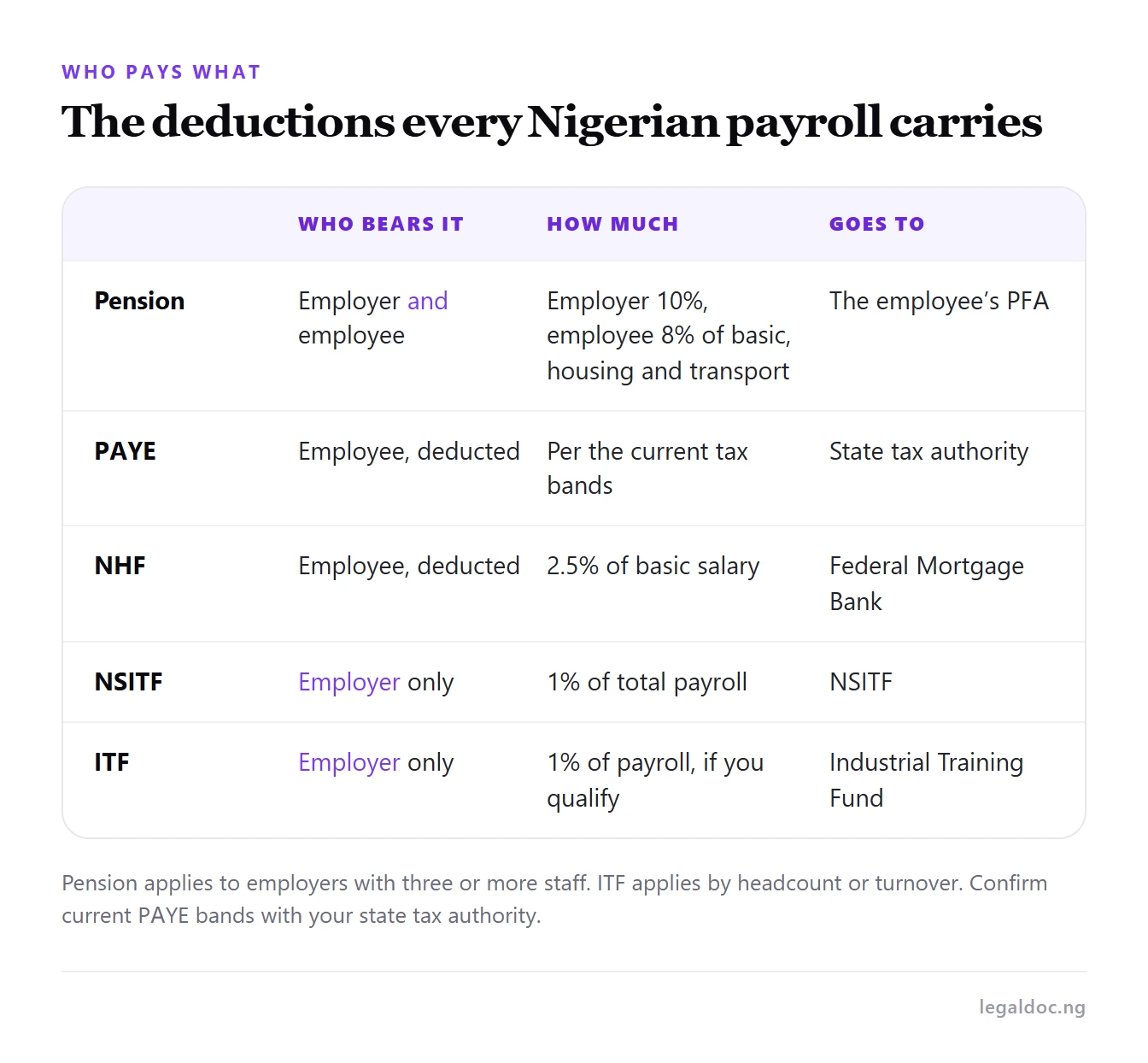
Two of these come out of the employee's salary. Two come purely from the employer. Pension is both.
Pension
The Pension Reform Act 2014 requires every employer with three or more employees to run the contributory pension scheme. The minimum contribution is 18% of monthly emoluments: at least 10% from the employer and at least 8% deducted from the employee. An employer can choose to bear the whole contribution, in which case it must be at least 20%.
"Monthly emoluments" for this purpose means basic salary, housing allowance and transport allowance together. This is where salary structures matter. An employer that pays a small basic and loads everything else into unnamed allowances is not reducing its pension obligations so much as building an argument with PenCom.
The contributions go to each employee's chosen pension fund administrator, and they must be remitted within seven working days of the day the employee is paid.
If they are not, the Act sets a penalty of at least 2% of the unpaid contributions for every month, or part of a month, that the default continues, on top of the contributions themselves. The penalty is credited to the employee's retirement savings account, so it is the employee who is compensated for the delay.
The Act also requires employers to keep a group life insurance policy for each employee, worth at least three times their annual total emolument. It is the obligation employers most often forget exists.
PAYE
Pay As You Earn is the employee's personal income tax, which the employer deducts from salary and pays over to the tax authority of the state where the employee lives. It is remitted monthly, usually by the 10th of the following month, together with a schedule showing who it was deducted from.
The bands and reliefs that decide how much PAYE each employee pays were reworked under the tax reforms that took effect in January 2026. We have deliberately not quoted figures here. Use the current bands from your state tax authority or your payroll provider, and check that your payroll system was updated when the new rules came in.
An employer that fails to deduct PAYE becomes liable for the tax it should have deducted. An employer that deducts it and then does not remit it is in a worse position again, because it has taken money on the government's behalf and kept it.
National Housing Fund
Under the National Housing Fund Act, employees contribute 2.5% of their basic monthly salary to the Fund. The employer deducts it and remits it to the Federal Mortgage Bank of Nigeria.
The money is the employee's. It is refundable to them later, with interest, and a contributor can use their record to apply for a mortgage through the scheme. Treating NHF as an optional extra, as some employers do, deprives staff of something that is theirs.
NSITF and ITF: the ones the employer pays
These two are not deducted from anybody's salary. They come from the employer.
Fallen behind on remittances? Ask how to put it right
LegalDoc+ explains what is owed, the penalties that apply, and how to approach your PFAs and the tax authority.
Ask LegalDoc+NSITF. Under the Employees' Compensation Act, employers contribute 1% of their total monthly payroll to the Nigeria Social Insurance Trust Fund, which compensates employees injured at work or their families.
ITF. Employers with five or more employees, or a turnover above the threshold in the Industrial Training Fund Act, contribute 1% of their annual payroll to the Industrial Training Fund, which funds training. Employers who train their staff can apply for a partial refund.
A worked example
Here is how it looks for one invented employee in one month.
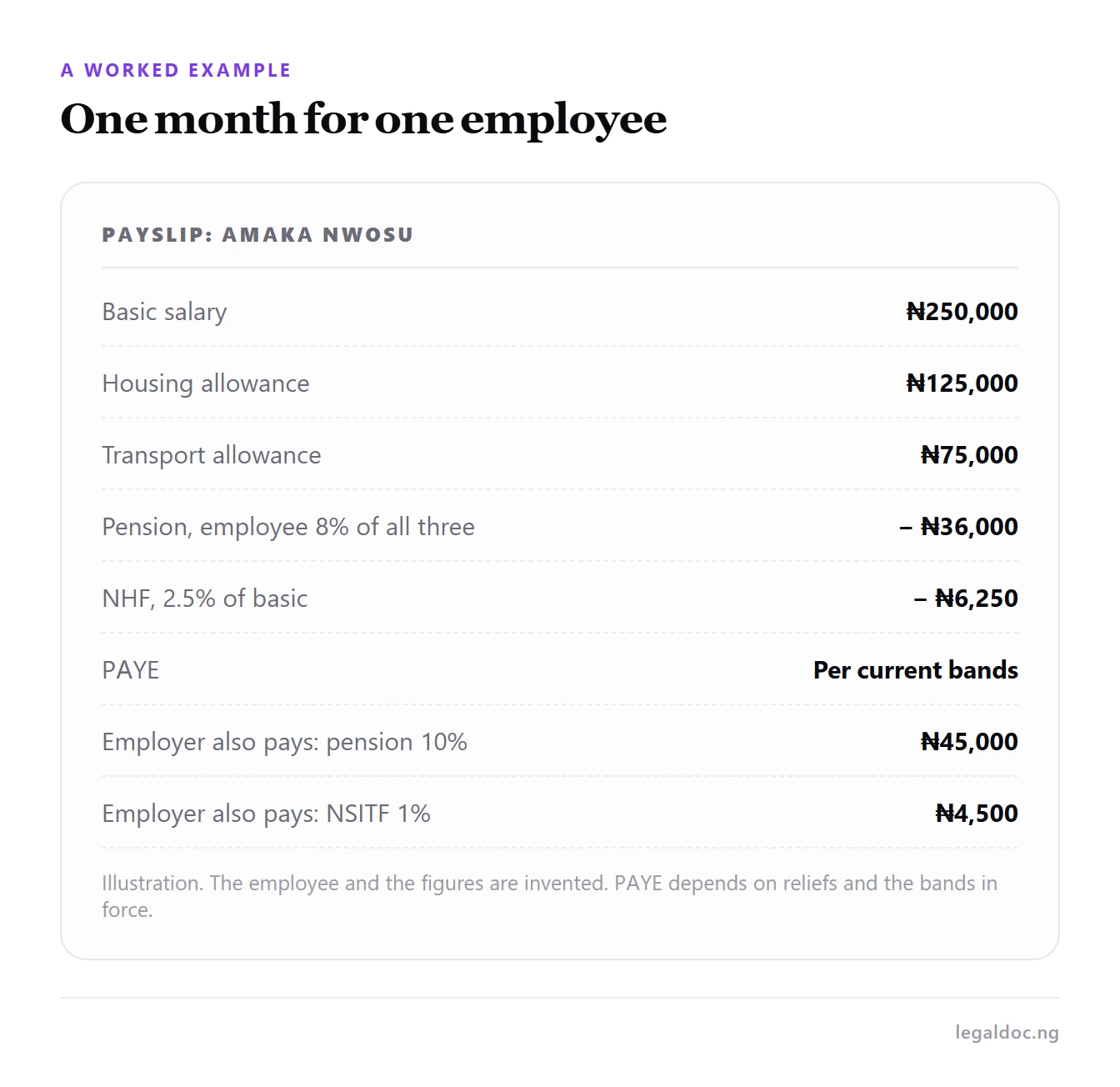
An illustration. The employee and the figures are invented.
Notice that the employer's real cost is higher than the gross salary. On top of the ₦450,000 the employee earns, the employer pays another ₦45,000 in pension and ₦4,500 to NSITF that month. Budgeting for salaries without budgeting for these is how the gap opens in the first place.
The monthly rhythm
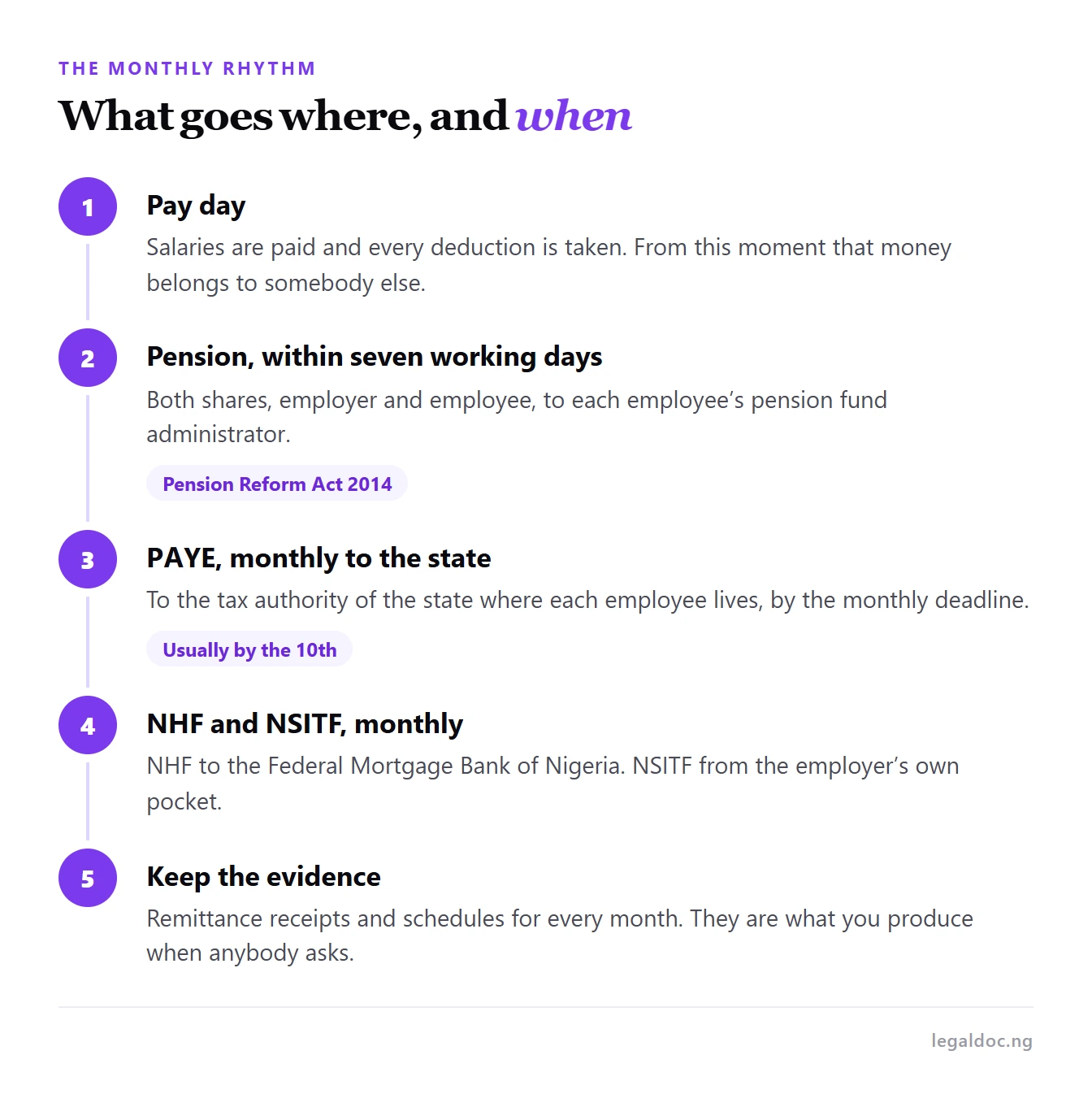
Pension is the tightest deadline: seven working days from pay day.
Why this becomes personal
A limited company normally protects its directors from the company's debts. Payroll deductions are where that protection is weakest, for a simple reason: the money was never the company's. It was deducted from employees for the benefit of their pension funds, the tax authority and the housing fund, and the company was only holding it on their behalf.
The pension and tax laws both provide for the officers responsible to answer personally where a company commits an offence. In practice that means directors who knew deductions were being taken and not paid over can find themselves personally exposed, alongside the company, to the arrears, the penalties and, in serious cases, prosecution.
It also has a way of surfacing at the worst moment. Unremitted pension shows up in due diligence when you try to raise money or sell the business. It shows up when an employee leaves and checks their account. And it shows up in a redundancy, when every outstanding remittance has to be settled before staff go, as we explain in redundancy in Nigeria.
If you have fallen behind
Stop the gap growing first. From next month, remit everything on time, whatever happens to the arrears.
Then work out exactly what is owed: for each employee and each month, the pension, PAYE and NHF deducted and not remitted. Contact the PFAs, the state tax authority and the relevant bodies, and agree how the arrears will be cleared. Coming forward with a plan is treated very differently from being found.
And fix the structure that caused it. Hold deductions in a separate account on pay day, so they are never available as working capital.
Staff, contractors and the line between them
All of this applies to employees. A genuine independent contractor is not on your payroll: they invoice you, you deduct withholding tax where it applies, and they handle their own pension and income tax.
The danger is calling somebody a contractor when they are really an employee. If the court decides they were employed all along, the unpaid pension and PAYE come back with them. We explain the test in employee misclassification in Nigeria. For genuine staff, set the salary structure out properly in the employment contract, because pension is calculated on it.
Frequently Asked Questions About Payroll Deductions in Nigeria
How much pension must a Nigerian employer contribute? At least 10% of the employee's monthly emoluments, meaning basic, housing and transport together, with at least 8% deducted from the employee. An employer that bears the whole contribution must pay at least 20%.
When must pension contributions be remitted? Within seven working days of the day the employee is paid, to the employee's pension fund administrator.
What is the penalty for late pension remittance? Under the Pension Reform Act 2014, at least 2% of the unpaid contributions for each month or part of a month the default continues, in addition to the contributions themselves.
Does pension apply to small businesses? The Pension Reform Act applies to employers with three or more employees. Below that, it is not compulsory, though an employer can still choose to provide it.
How much is NHF in Nigeria? Employees contribute 2.5% of their basic monthly salary, which the employer deducts and remits to the Federal Mortgage Bank of Nigeria.
Can a director be personally liable for unremitted deductions? Yes. The pension and tax laws provide for officers to answer where a company commits an offence, and deductions taken from staff and not paid over are treated seriously because the money was never the company's.
Where this leaves you
None of these deductions is complicated on its own. The trouble comes from treating them as money the business can borrow for a month. It cannot. Remit on time, keep the receipts, and if there is a gap already, deal with it before somebody else finds it.