

Settle how the rent can be reviewed before anybody signs
A tenancy agreement with a clear rent review clause, notice periods and renewal terms, written for Nigerian tenancies.
Draft a tenancy agreementIt usually arrives as a WhatsApp message, or a letter pushed under the door. "Please be informed that with effect from your next renewal, the rent for your flat will be..." and then a number that makes you sit down.
Rents in many Nigerian cities have climbed fast, and plenty of landlords are passing on their own rising costs. Some increases are fair. Some are not. Either way, most tenants have no idea whether the landlord is allowed to do it, or what they can do about it.
The answer depends on two things: where your tenancy is in its term, and what your tenancy agreement says. In Lagos, there is also a court route that very few tenants know exists.
The short answer
During a fixed term, a landlord cannot increase the rent unless your tenancy agreement has a rent review clause allowing it. When the term ends, the landlord can propose a new rent, and you can accept, negotiate or leave. In Lagos, outside the areas the Tenancy Law excludes, an existing tenant can also ask the court to declare an increase unreasonable and fix a different amount, and the landlord cannot evict you while that case is pending. A rent increase notice is not a quit notice, and refusing an increase never allows a landlord to throw you out without a court order.
Can they do it right now?
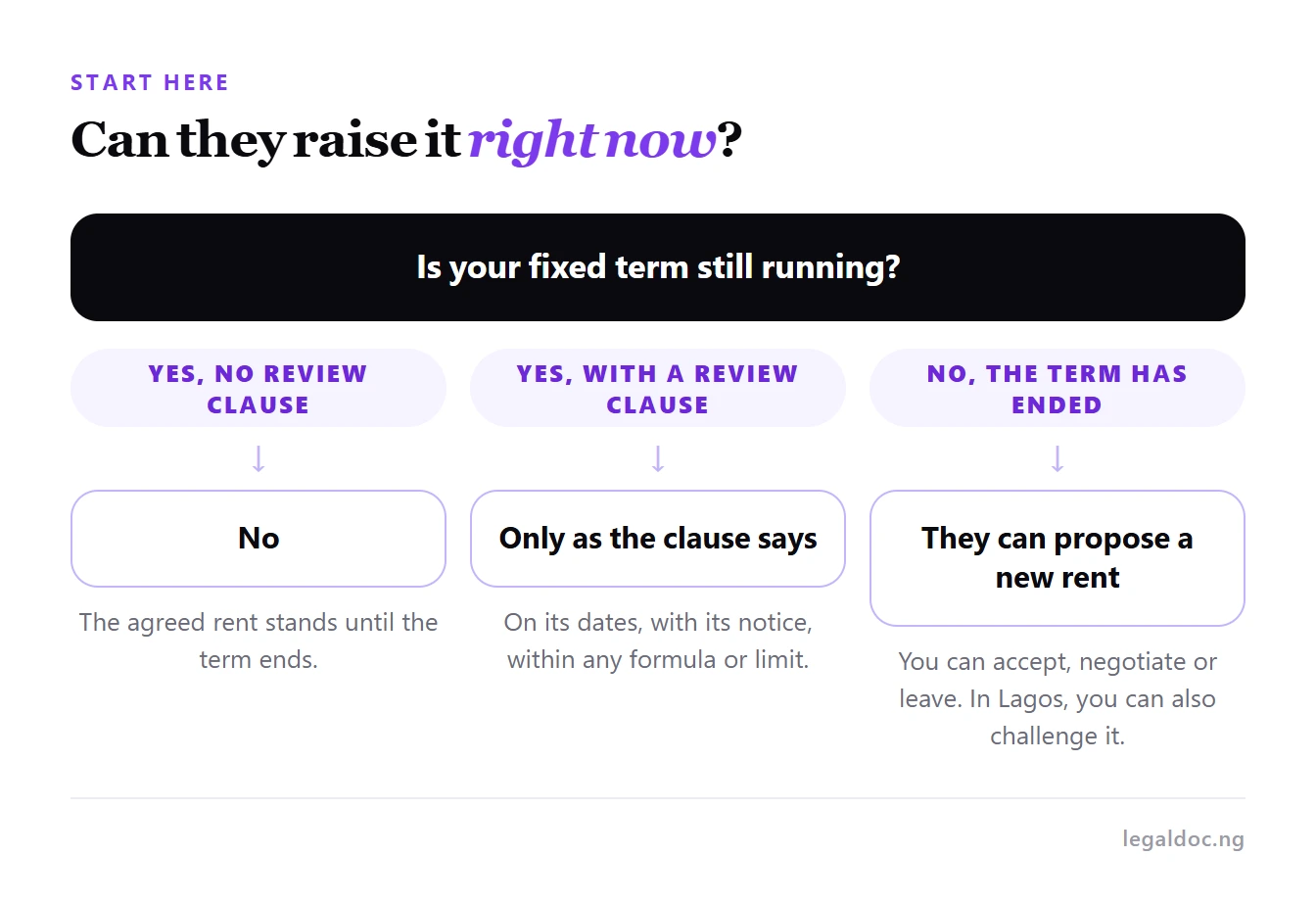
Start with where you are in your term. Then read your agreement.
During the term: only if the agreement allows it
Rent is a term of your contract. If you agreed to rent a flat for two years at a stated rent, the landlord cannot change that figure halfway through any more than you could decide to pay less. A notice in the middle of the term saying the rent has gone up has no effect on the rent you agreed for that term.
The exception is a rent review clause. Many tenancy agreements, especially for longer terms and commercial premises, allow the rent to be reviewed at set points, say every year of a three-year lease. If yours has one, the landlord can increase the rent, but only in the way the clause says: on the dates it gives, with the notice it requires, and within any limit or formula it sets.
So the first thing to do with any rent increase is find your tenancy agreement and read it. We list the clauses worth checking in the essential clauses in a Nigerian tenancy agreement.
When the term ends: yes, they can ask for more
When a fixed term comes to an end, nobody is bound to renew on the old terms. The landlord can offer a new tenancy at a higher rent, and you can decide whether to take it. That is ordinary negotiation, and in most of Nigeria there is no fixed limit on how much the new rent can be.
The same applies to a yearly or monthly tenancy that simply rolls on. The landlord can propose a new rent for the coming period, but if you do not agree, their remedy is to end the tenancy properly, not to bill you for a rent you never accepted.
The Lagos route most tenants never hear about
Section 37 of the Tenancy Law of Lagos State 2011 gives an existing tenant the right to apply to the court for an order declaring that an increase in rent is unreasonable.
The court gives the landlord notice, hears both sides, and if it is satisfied the increase is unreasonable, it can order that the increase be changed to a specific amount. While the case is going on, the law says it is unlawful for the landlord to eject the tenant.
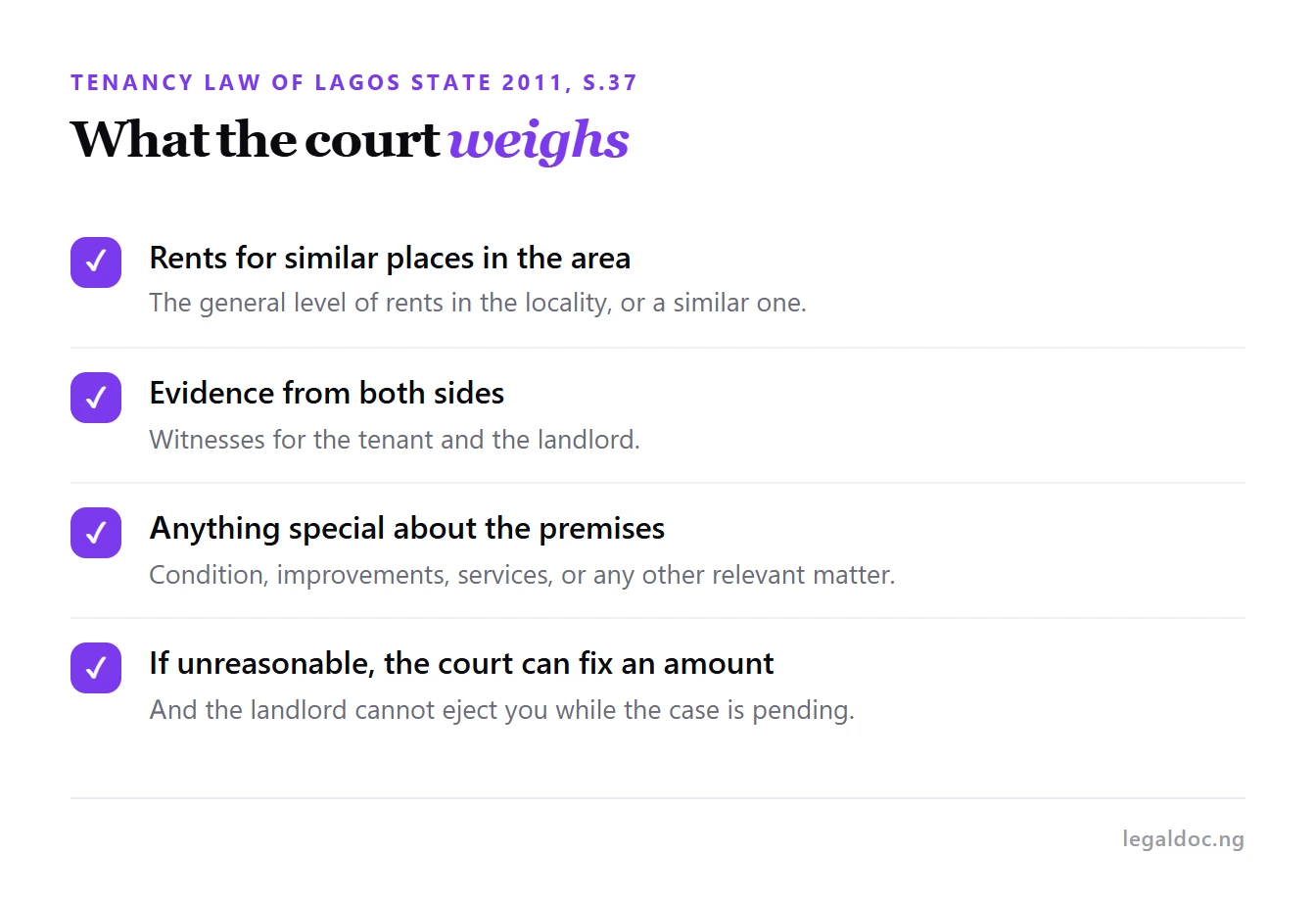
Evidence of what similar places nearby actually rent for is usually decisive.
Three limits are worth knowing before you rely on it:
- It is subject to your agreement. The section applies "subject to any agreement to the contrary". If your tenancy agreement already sets out how the rent will be reviewed, that agreement is likely to govern.
- It is for existing tenants. It protects a tenant facing an increase on premises they already occupy, not somebody negotiating to move in.
- It does not cover all of Lagos. The 2011 Law does not apply to residential premises in Apapa, Ikeja GRA, Ikoyi and Victoria Island, where the older rent control law is generally taken to apply instead.
Lagos has also been considering a new tenancy bill that would change parts of this picture. Until it becomes law, the 2011 Law is what applies. We explain what the bill proposes in the Lagos State Tenancy and Recovery of Premises Bill.
Rent increase notice in hand? Ask whether it holds
Share your tenancy agreement and the notice, and LegalDoc+ tells you where you stand and how to respond.
Ask about my rentOutside Lagos
Most other states, and the FCT, do not have an equivalent court procedure for challenging a rent increase. A few have older rent control laws on their books, but they are rarely used, so check the law of your state if the increase is extreme.
In practice, that means the agreement and negotiation decide. Which makes what you sign at the start of a tenancy far more important than most people treat it.
A rent increase notice is not a quit notice
This is the point to hold onto. A letter saying the rent is going up does not end your tenancy, and refusing to pay a new rent does not make you a trespasser overnight.
If a landlord wants you out because you will not accept the new rent, they have to end the tenancy the lawful way: a valid notice to quit of the right length for your type of tenancy, then a notice of their intention to recover possession, then a court order. We set out the notice periods in how many days your landlord must give you.
Changing the locks, removing the roof, cutting off water or throwing your things out is not a shortcut. It is unlawful self-help, and if it happens, read what to do if your landlord locks you out.
One caution the other way. If your term ends, you do not agree a new rent, and you simply stay on, your position becomes uncertain. Paying the old rent, and having it accepted, can support an argument that the tenancy carried on as before. But a landlord who refuses it can start the process to recover possession and claim for your use of the property in the meantime. Do not leave it hanging. Settle the rent in writing, one way or the other.
How to respond to an increase
Take a typical case. Here is the kind of notice tenants are receiving.
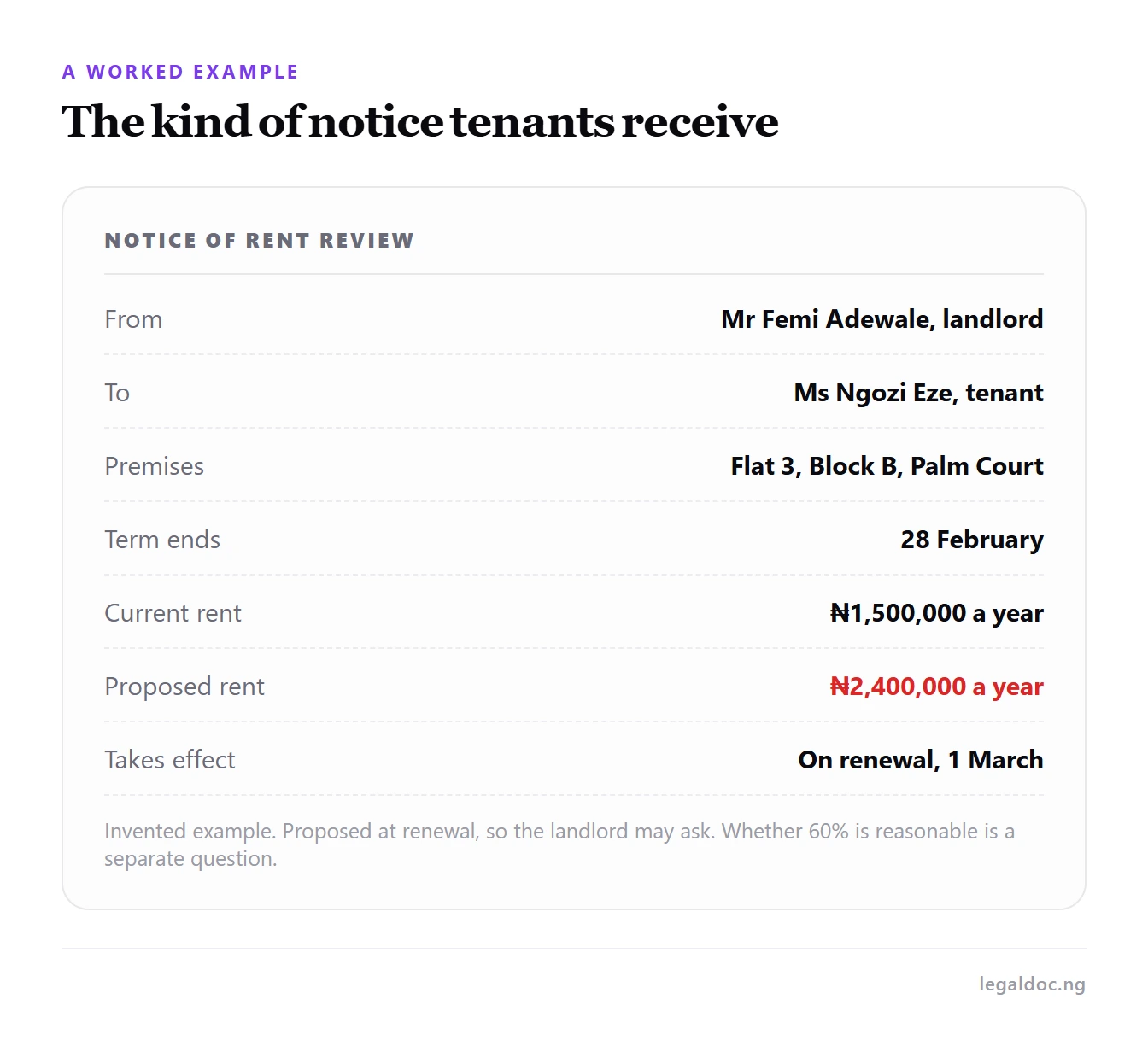
An invented example. The names, address and figures are not real.
Ngozi's two-year term ends on the last day of February. The increase is proposed for the renewal, not mid-term, so the landlord is entitled to ask. A 60% increase is steep, though. Her best first move is to find out what comparable flats on nearby streets actually rent for, ask the landlord in writing what the figure is based on, and make a counter-offer. If the landlord will not move and the flat is covered by the Lagos Tenancy Law, the section 37 route is there.
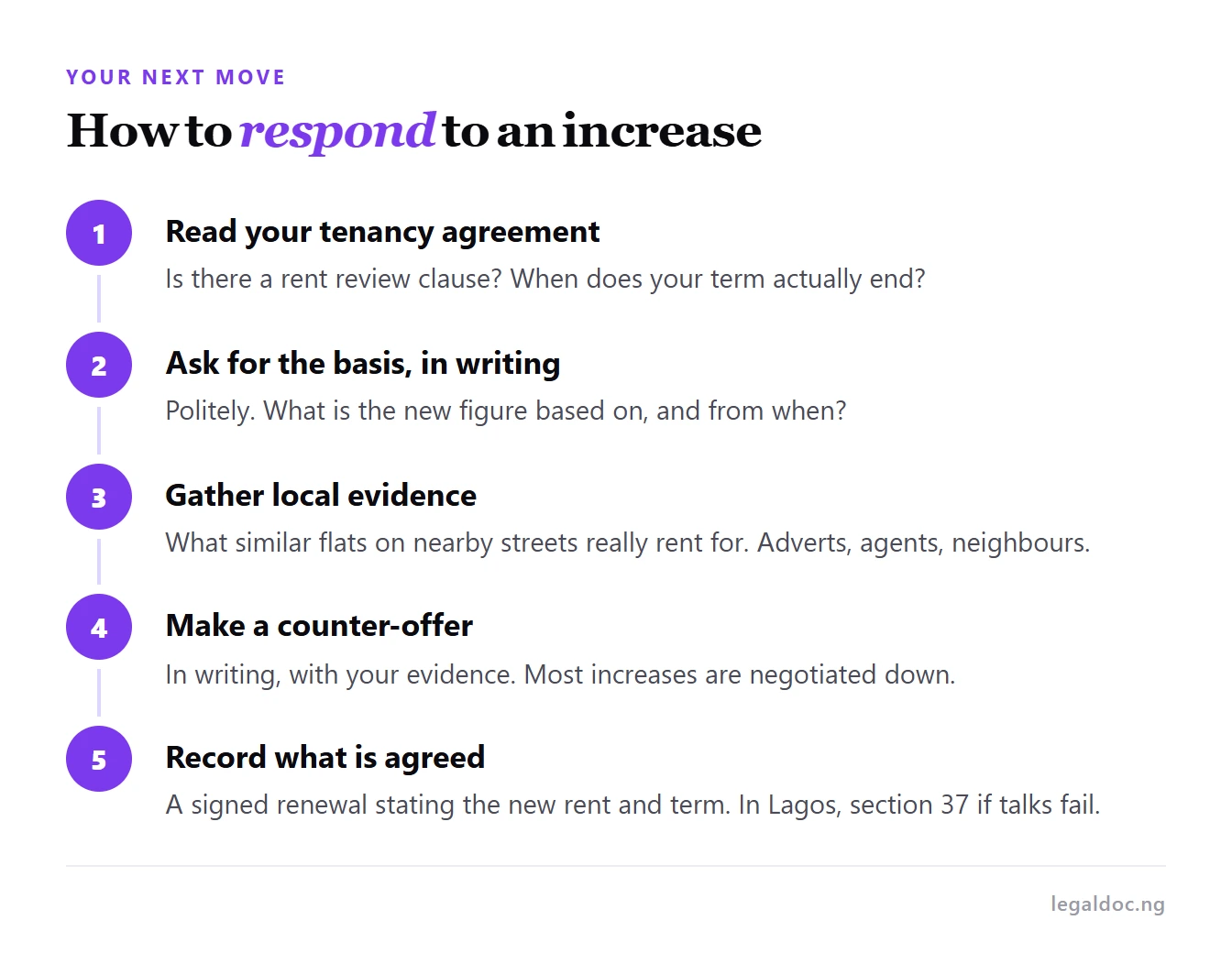
Calm, written and backed by evidence beats angry and verbal every time.
For landlords: raising the rent the right way
None of this means landlords cannot raise the rent. It means doing it in a way that holds up.
Build it into the agreement. A rent review clause stating when the rent can be reviewed, with how much notice, and on what basis, avoids most arguments before they start. Our tenancy agreement lets you set this out from the beginning.
Give real notice. Most tenancy laws do not set a specific notice period for a rent increase, but proposing it well before the term ends, three months or more, gives the tenant time to decide and makes you look reasonable if it ever reaches court.
Explain the number. Comparable rents nearby, improvements you have made, rising service costs. An increase that comes with reasons is far more likely to be accepted, and far easier to defend.
Put the renewal in writing. A short renewal agreement or letter, signed by both of you, stating the new rent and the new term. And issue a receipt for every payment.
Frequently Asked Questions About Rent Increases in Nigeria
Can a landlord increase rent at any time in Nigeria? No. During a fixed term, the rent you agreed stands unless your tenancy agreement has a rent review clause. When the term ends, the landlord can propose a new rent for the next period.
Is there a limit on rent increases in Lagos? There is no fixed percentage cap. But under section 37 of the Tenancy Law of Lagos State 2011, an existing tenant can ask the court to declare an increase unreasonable and set a specific amount instead, except in the areas the Law excludes.
How much notice must a landlord give before increasing rent? Most tenancy laws do not set a specific notice period for an increase. Your tenancy agreement may. In practice, it should come well before your term ends so you have time to decide.
Can my landlord evict me for refusing a rent increase? Not without due process. They must serve a valid notice to quit, a notice of their intention to recover possession, and obtain a court order. In Lagos, they cannot eject you while a section 37 application is pending.
Does the Lagos Tenancy Law apply everywhere in Lagos? No. It does not apply to residential premises in Apapa, Ikeja GRA, Ikoyi and Victoria Island.
Where this leaves you
Read your agreement, check where you are in your term, and answer in writing with evidence. A landlord is entitled to seek a fair market rent at renewal. A tenant is entitled to the rent they agreed until then, to negotiate, and in most of Lagos, to ask a court whether the new number is reasonable. Neither side gets to skip the process.