

Start with a privacy policy that fits Nigerian law
Written for the Nigeria Data Protection Act 2023: what you collect, why, how long you keep it and how people can reach you.
Create my privacy policyFor years, data protection in Nigeria felt like paperwork that nobody checked. That has changed. The Nigeria Data Protection Commission fined Fidelity Bank ₦555.8 million in August 2024 and MultiChoice Nigeria ₦766.2 million in July 2025, wrote to more than 1,300 organisations in August 2025, and brought its new General Application and Implementation Directive into force in September 2025.
At the centre of that directive sits an annual obligation many businesses have never heard of: filing compliance audit returns. This guide explains who has to file, by when, what the audit looks at, and how to get your organisation ready well before the next deadline of 31 March 2027.
The short answer
If your organisation processes the personal data of more than 200 people in six months, it is likely a data controller or processor "of major importance" and must register with the NDPC. Organisations in the two higher tiers, broadly those handling the data of more than 1,000 people in six months or working in sectors such as banking, telecoms, insurance, fintech, health and education, must also file a compliance audit return every year by 31 March, through a licensed Data Protection Compliance Organisation. Filing late adds up to half again to the fee, and not filing can attract a fine of up to 2% of annual gross revenue or ₦10 million, whichever is greater.
Are you a data controller of major importance?
The Nigeria Data Protection Act 2023 applies to everybody who handles personal data in Nigeria. But the registration and audit duties apply only to organisations "of major importance", and the directive sorts those into three tiers by how much personal data they process and what sector they work in.
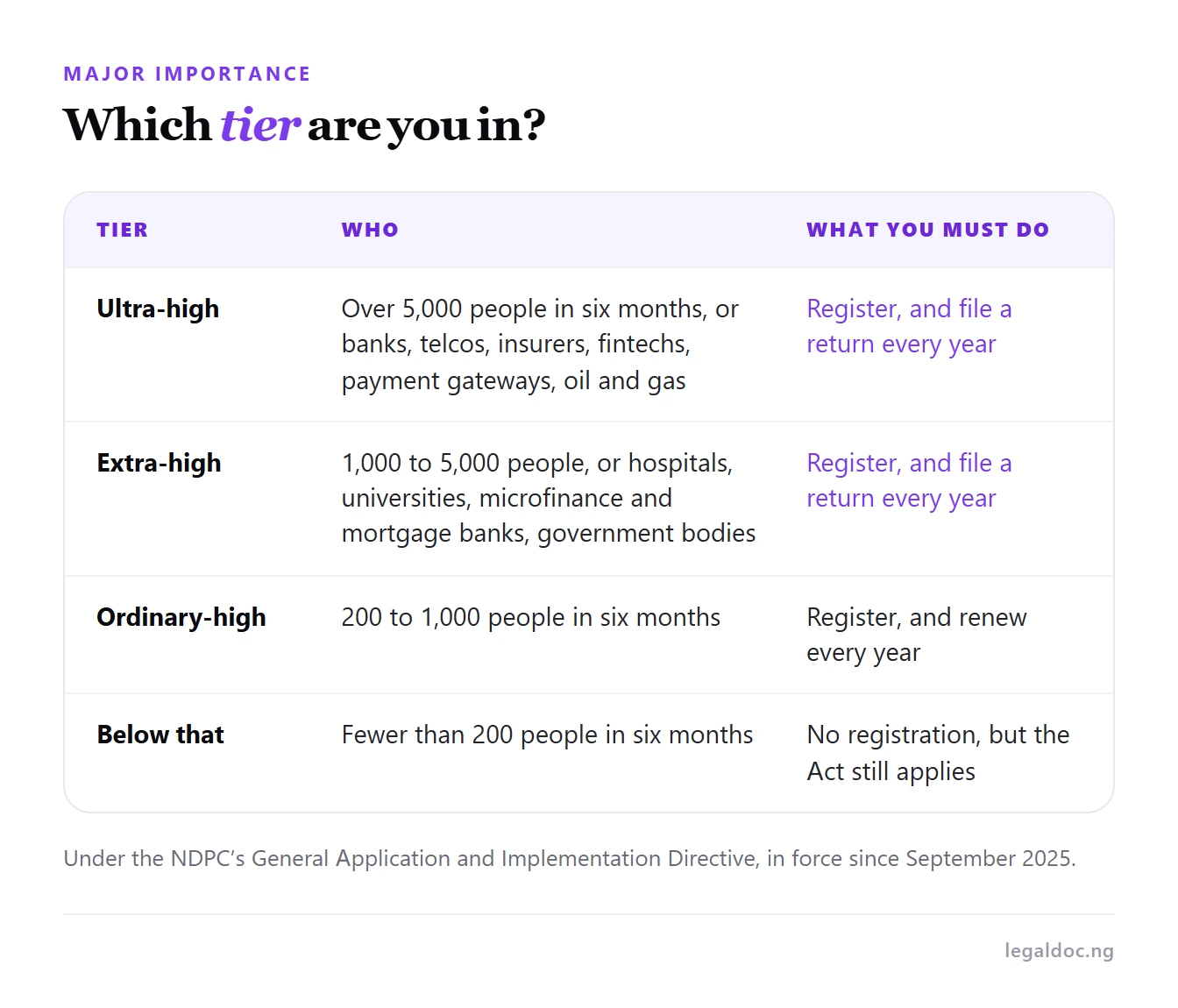
A sector can put you in a tier regardless of numbers. A fintech with a few hundred customers is still in the top tier.
"Data subjects" means people, not records: customers, employees, patients, students, website visitors whose details you collect. Count everybody whose personal data passed through your hands in any six months. A school with 600 pupils and their parents, a clinic, a property agency with a busy website or an online shop can cross 1,000 faster than its owners expect.
What compliance audit returns cover
A compliance audit return is not a form you fill in about yourself. It is the report of an audit carried out by a licensed Data Protection Compliance Organisation, known as a DPCO, using the template in the directive, and filed on the NDPC's portal on your behalf.
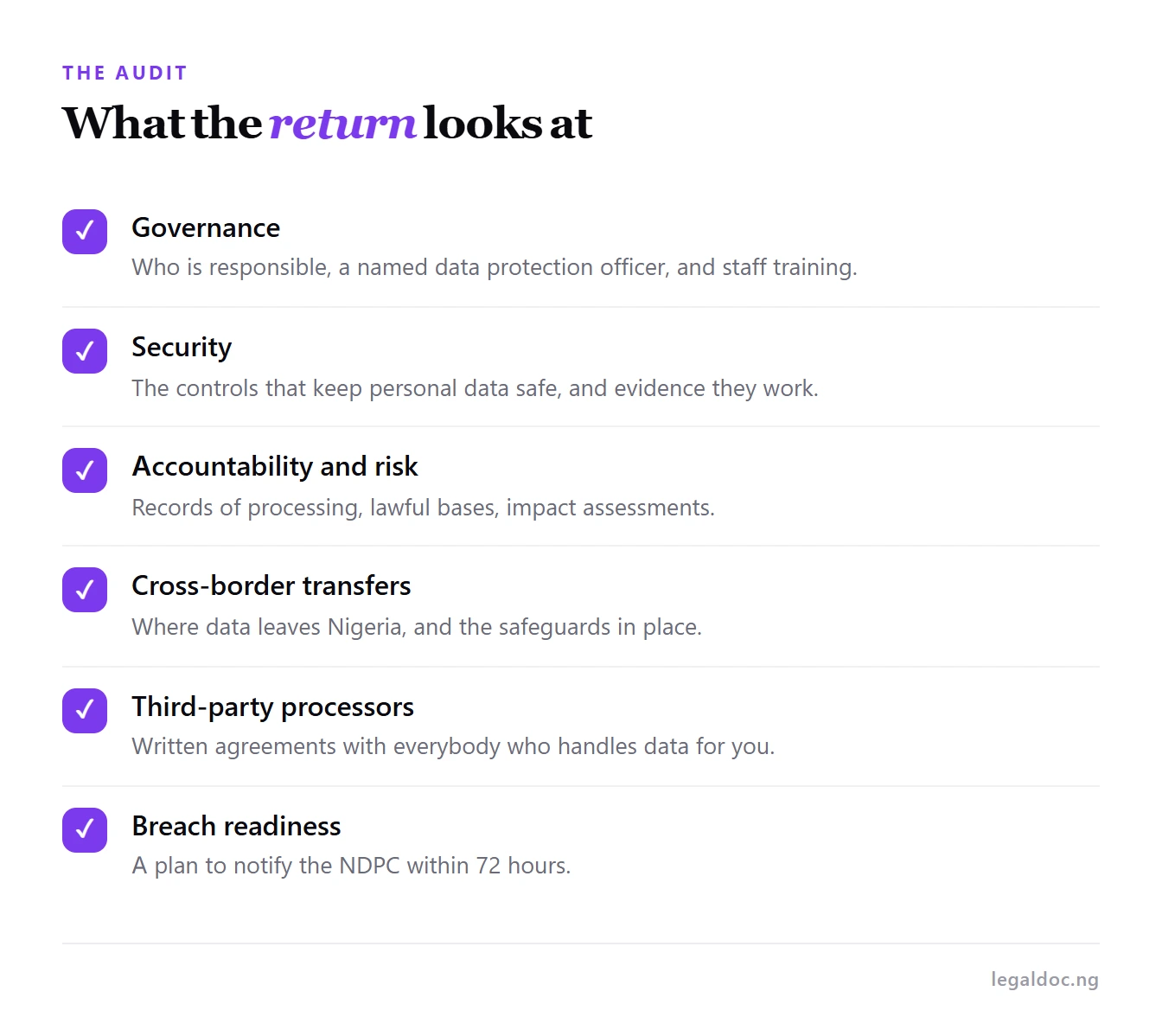
The audit asks for evidence, not intentions. A policy nobody follows counts for little.
Two duties from the Act itself come up in almost every audit. An organisation of major importance must appoint a Data Protection Officer. And every organisation must notify the NDPC of a personal data breach likely to put people at risk within 72 hours of becoming aware of it, which is very hard to do without a plan written in advance.
How to file compliance audit returns, step by step
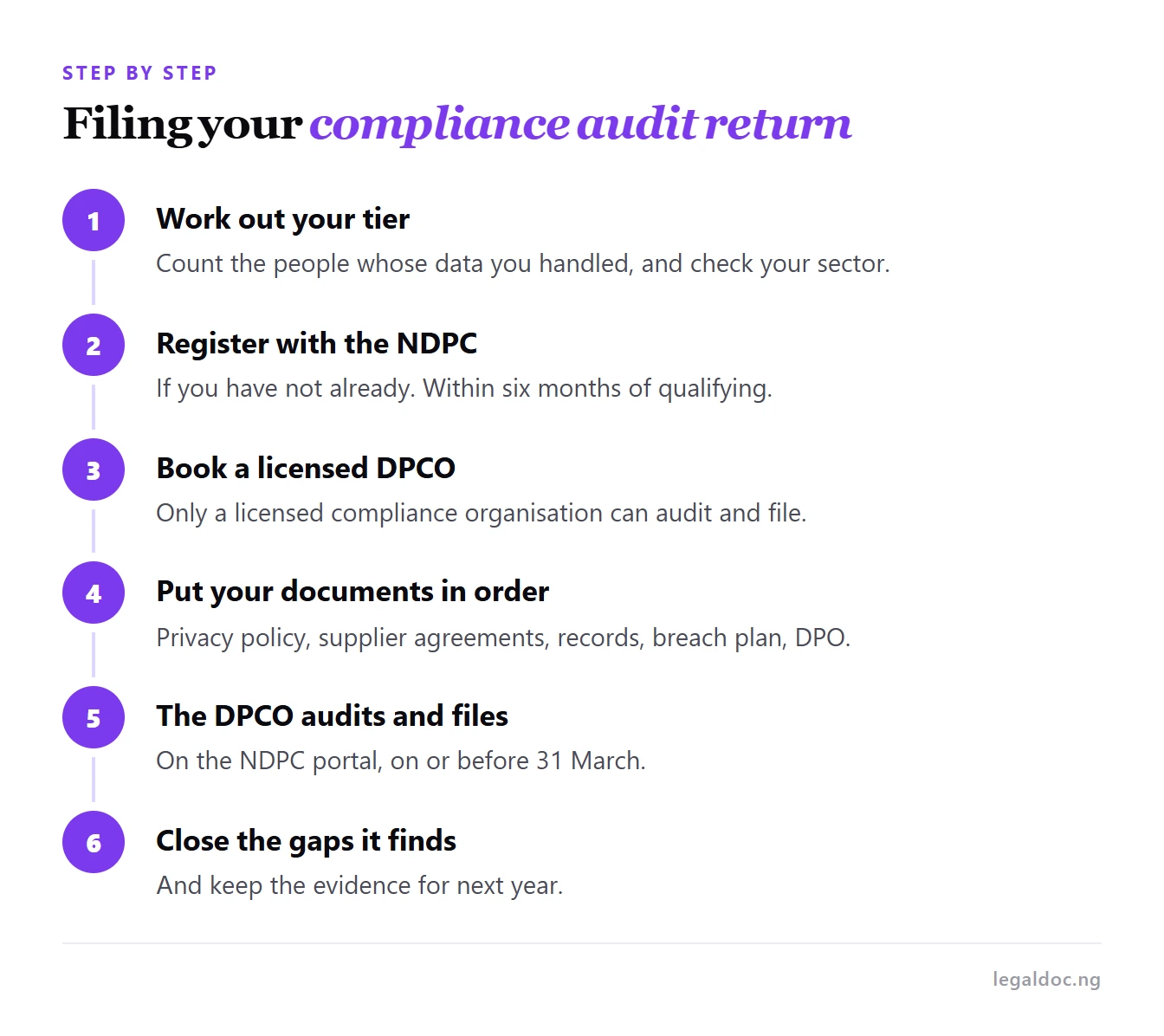
Start in the fourth quarter. DPCOs are busiest in March.
Which NDPC tier are you in? Ask LegalDoc+
Describe your business and LegalDoc+ tells you what you must register and file, and reviews your privacy policy against the Act.
Ask LegalDoc+The step that takes longest is the fourth. A DPCO cannot audit documents that do not exist, and most of the gaps auditors find are basic: no privacy policy, or one copied from a foreign website; no record of what data is held and why; no written agreement with the companies that process data for you, such as your payroll provider, cloud host or marketing agency; and no plan for a breach.
Deadlines, fees and what happens if you miss them
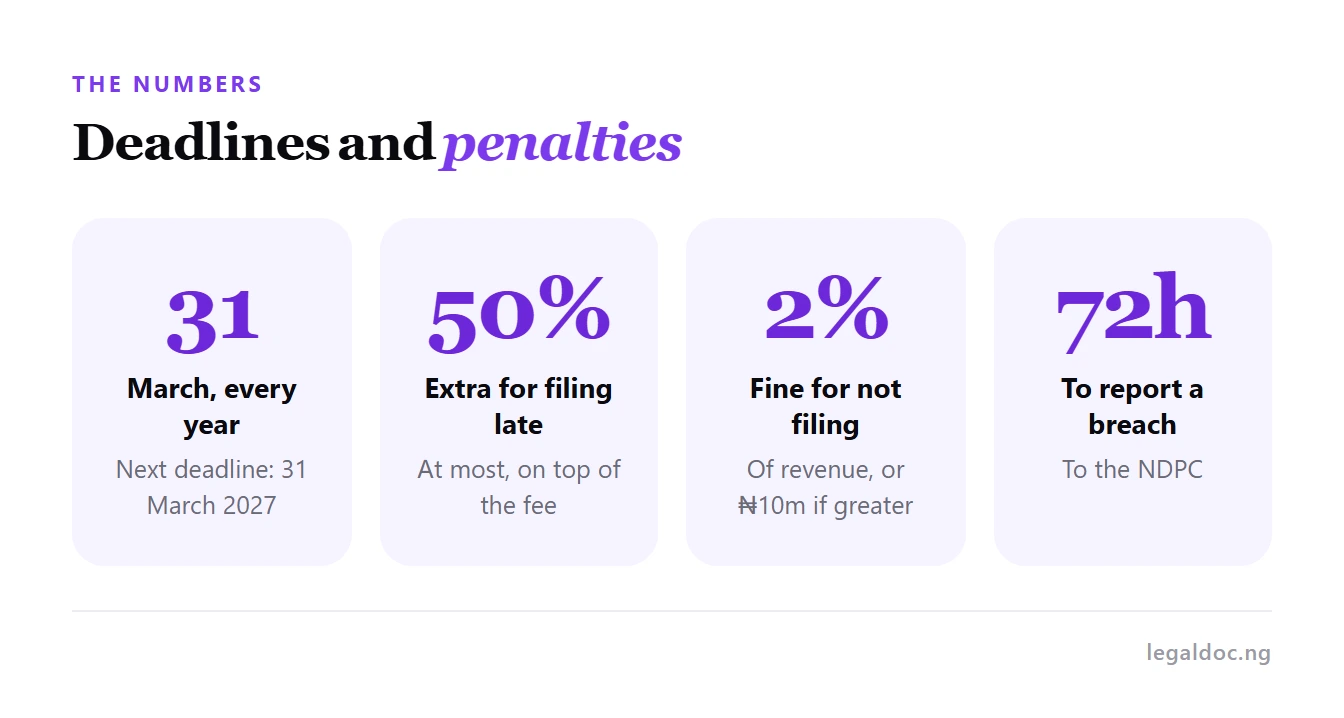
The penalty for not filing is set against revenue, so it scales with the business.
Returns are due on or before 31 March each year and cover the previous year's processing. The NDPC extended the deadline for the 2025 returns to 30 May 2026, but extensions are not guaranteed, so plan for 31 March 2027 for your 2026 return. Filing fees rise with your tier, and filing late adds an administrative charge of up to 50% of the fee.
The larger risk is attention. Organisations that do not file are the ones the Commission writes to, and an investigation looks at everything, not only the missing return. The fines above came from investigations into how data was actually handled.
Below the thresholds? The law still applies
If you handle the data of fewer than 200 people in six months, you do not register or file. But the Act still applies to you in full. You still need a lawful reason for collecting personal data, you must tell people what you do with it, keep it secure, and report breaches. In practice, that starts with a proper privacy policy on your website. We explain why in why every Nigerian website now needs a privacy policy.
Get your documents audit-ready with LegalDoc
The audit itself must be carried out and filed by a licensed DPCO. What LegalDoc does is make sure that when the auditor arrives, the documents are already there.
The essentials are ready to complete in minutes, written for Nigerian law: a privacy policy that reflects the Nigeria Data Protection Act, a cookie policy for your website, terms and conditions, an employee handbook setting out how staff must handle personal data, and a non-disclosure agreement for the people and companies who see it.
For everything else, use LegalDoc+. Describe your business and it will tell you which tier you are likely to fall into and what that requires. Upload your current privacy policy and it will review it against the Act and the directive, ranking what is missing by how serious it is. And it drafts the documents auditors most often find missing, such as data processing agreements with your suppliers, a data retention policy and a breach response plan.
Frequently Asked Questions About NDPC Compliance Audit Returns
Who must file compliance audit returns in Nigeria? Data controllers and processors of major importance in the two higher tiers: broadly, those processing the data of more than 1,000 people in six months, or working in sectors such as banking, telecoms, insurance, fintech, health and higher education.
When are NDPC compliance audit returns due? On or before 31 March each year, covering the previous year. The next deadline is 31 March 2027 unless the NDPC announces an extension.
Can I file a compliance audit return myself? No. The audit must be carried out and filed by a Data Protection Compliance Organisation licensed by the NDPC, on the Commission's portal.
What is the penalty for not filing? Late filing adds up to 50% of the filing fee. Not filing at all can attract a fine of up to 2% of annual gross revenue for the previous year or ₦10 million, whichever is greater, and invites closer scrutiny.
Do small businesses need to file? Not if they process the data of fewer than 200 people in six months, and those in the lowest tier only renew their registration. But every business must still comply with the Nigeria Data Protection Act, starting with a proper privacy policy.
Where this leaves you
Work out your tier now, register if you need to, and book a DPCO in good time. Then spend the months before 31 March putting the documents in place: a real privacy policy, written agreements with your suppliers, a breach plan and a named data protection officer. Filing compliance audit returns is far easier when the audit only has to confirm what you have already done.