
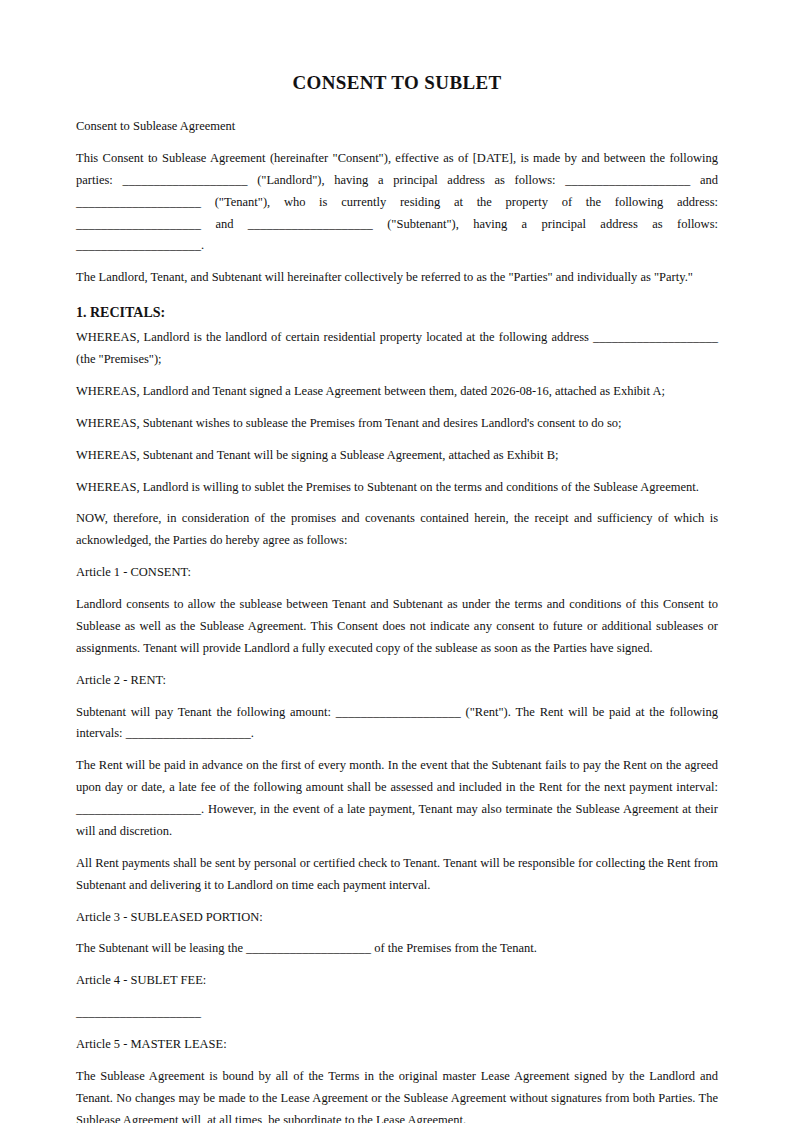
If you're in need of a Consent to Sublet document, you'll find everything required in the form above.
A sublet (or sublease) agreement is a legal contract that allows an existing tenant (the sublessor) to rent out their leased property to another party (the sublessee) for a specified period. This arrangement can be beneficial in various situations, such as when the original tenant needs to vacate the premises temporarily but intends to return before the lease term ends.
Key Elements of a Sublease Agreement:
-
Consent from the Landlord: Before initiating a sublease, it's imperative to obtain written permission from the landlord. Some primary lease agreements explicitly prohibit subleasing, while others may allow it with the landlord's consent. Utilizing a standardized consent form, like the one available at Legaldoc, can streamline this process.
-
Terms and Conditions: The sublease should clearly outline the duration of the sublease, rent amount, payment schedule, and any other pertinent terms. It's essential that these terms do not conflict with the original lease agreement.
-
Responsibilities and Obligations: The agreement should specify the responsibilities of both the sublessor and sublessee, including maintenance duties, utility payments, and adherence to property rules.
-
Incorporation of Original Lease Terms: To ensure consistency, the sublease should incorporate relevant terms from the original lease, making the sublessee aware of all existing obligations.
-
Termination Clauses: Clearly defined conditions under which the sublease can be terminated help prevent future disputes.
Frequently Asked Questions about Sublease Agreements:
-
What is a sublease agreement?
- A sublease agreement is a contract where the original tenant rents out the leased property to another individual for a portion of the remaining lease term.
-
Is subleasing legal?
- Subleasing is legal in many jurisdictions; however, it's crucial to review the original lease and obtain the landlord's consent before proceeding.
-
Do I need my landlord's permission to sublease?
- Yes, most lease agreements require tenants to obtain written consent from the landlord prior to subleasing.
-
What should be included in a sublease agreement?
- A comprehensive sublease agreement should include:
- Names of the original tenant and subtenant
- Property address
- Sublease term (start and end dates)
- Rent amount and payment details
- Responsibilities for utilities and maintenance
- Any specific rules or restrictions
- A comprehensive sublease agreement should include:
-
Who is responsible if the subtenant doesn't pay rent?
- The original tenant remains responsible to the landlord for rent payments. If the subtenant defaults, the original tenant must cover the rent and may seek reimbursement from the subtenant.
-
Can a subtenant further sublease the property?
- Unless explicitly allowed in both the original lease and the sublease agreement, subtenants typically cannot sublease the property to another party.
-
What happens if the original lease is terminated?
- If the original lease ends, the sublease usually terminates simultaneously, as the sublessor cannot grant rights they no longer possess.
-
Are there any risks associated with subleasing?
- Yes, potential risks include:
- The subtenant failing to pay rent
- Damage to the property
- Legal disputes if the sublease violates the original lease terms
- Yes, potential risks include:
-
How can I find a suitable subtenant?
- Consider advertising through reputable rental platforms, conducting background checks, and verifying references to ensure the subtenant is reliable.
-
Is a verbal sublease agreement valid?
- While verbal agreements can be legally binding in some jurisdictions, it's advisable to have a written sublease to clearly outline terms and protect all parties involved.
-
Can the landlord increase rent during the sublease term?
- The landlord cannot increase the rent during the sublease term unless such provisions are included in the original lease or agreed upon by all parties.
-
What should I do if I want to end the sublease early?
- Review the sublease agreement for any early termination clauses. Communicate with both the landlord and subtenant to negotiate a mutually agreeable solution.
-
Does the subtenant have to pay a security deposit?
- It's common for sublessors to require a security deposit from the subtenant to cover potential damages or unpaid rent.
-
How does subleasing affect my security deposit with the landlord?
- The original tenant remains responsible for the property. Any damages caused by the subtenant could jeopardize the original tenant's security deposit.
-
Where can I find a template for a consent to sublease?
- A standardized consent to sublease template is available at Legaldoc, which can be customized to fit specific needs.