
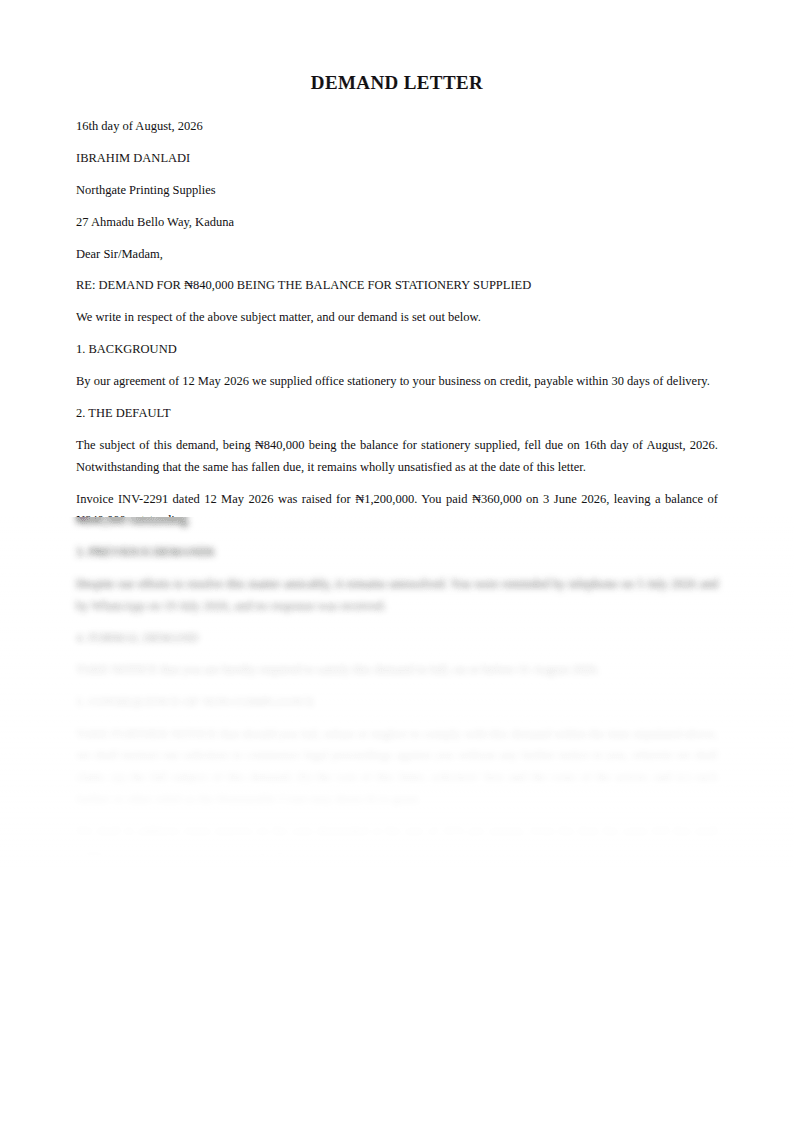
Demand Letter in Nigeria: How to Ask for Your Money and Be Taken Seriously
Most debts in Nigeria are not lost in court. They are lost long before that, in the months of phone calls, WhatsApp messages and promises to pay next week. A demand letter is the point where that stops being a conversation and starts being a record.
It is a formal written notice telling somebody exactly what they owe, why they owe it, and what happens if they do not pay by a stated date. It costs almost nothing to send, and it changes the tone of the whole matter.
What a Demand Letter Actually Does
Three things, and the first one is the one people underrate.
It creates a paper trail. If this ends up in front of a judge, the first question is what you did to resolve it. A dated letter setting out the debt and a reasonable deadline answers that question in your favour. Months of voice notes do not.
It removes the excuse. A surprising number of debtors genuinely have not understood what is being claimed, or are hoping you have lost track of the figure. A letter that sets out the invoice numbers, the dates and the total removes any room for confusion.
It moves people. A formal letter signals that you have stopped waiting. A large share of demand letters are paid without anybody going near a court, which is the entire point.
When You Should Send One
Send it once informal requests have stopped working, and before you spend money on a lawyer or a claim.
Typical situations in Nigeria: an invoice unpaid past its terms, a loan to a friend or business associate that has gone quiet, a landlord withholding a refundable deposit, a contractor who took a deposit and never returned, goods paid for and never delivered, or a client who has taken the work and gone silent.
One timing point that matters more than most people realise. The Limitation Law of most Nigerian states gives you six years from the date the debt became due to bring a simple contract claim. Sending a demand letter does not pause that clock. If your debt is approaching that age, the letter is urgent rather than optional.
What Goes Into a Demand Letter That Works
Your details and theirs. Full names, and the correct legal name if a company is involved. Writing to "Musa" when the contract is with "Musa Ventures Limited" gives them something to argue about later.
What the debt is for. Reference the agreement, the invoice number, the date of the transaction. Be specific enough that nobody reading it has to ask a follow-up question.
The exact amount. One figure, in naira. If it is made up of several invoices, list them and show the total. If interest has accrued under the agreement, say so and show the calculation.
A deadline. Seven to fourteen days is normal and defensible. Too short reads as unreasonable, too long reads as if you are not serious.
How to pay. Account name, number and bank. Make paying you the easiest thing they can do.
What happens if they do not. State that you will pursue recovery, including court proceedings and the costs that come with them. Say it plainly, once.
The Tone That Gets Paid
Firm, factual, unemotional. The letter that works reads like a statement of account with a deadline attached, not like an argument.
Leave out the history of how disappointed you are. Leave out threats that go beyond legal recovery: telling somebody you will report them to the police over a civil debt is not only wrong, it can amount to an offence in itself. Nigerian courts take a dim view of parties who use criminal threats to recover a commercial debt, and the police are not a debt collection service.
What you want is a document you would be comfortable having a judge read aloud.
How to Send It So It Counts
Service is where people get careless, and it matters because you may need to prove the letter arrived.
Send it by more than one route. Email gives you a timestamp. A courier with a signed receipt gives you proof of delivery. Hand delivery with somebody signing an acknowledgement copy is the strongest of all. Keep every receipt and every copy.
If the debtor is a registered company, send it to the registered office as filed at the Corporate Affairs Commission, not just to whichever address you have been using. Section 862 of the Companies and Allied Matters Act 2020 treats a document served at the registered office as properly served.
What to Do When the Deadline Passes
Do what the letter said you would do. A deadline you ignore teaches the debtor that the next one is also negotiable.
Your realistic options: a claim in the Magistrate Court, which handles smaller sums quickly and cheaply and is where most of these belong, the Small Claims Court in states that have one, or the High Court for larger amounts. In Lagos the Small Claims Court handles claims up to a set limit with no lawyer required, which is often the fastest route for a straightforward debt.
Before you file, consider one more thing. If the other side responds with a payment plan and you accept it, put that in writing too. An agreed plan that is then broken is much easier to enforce than the original debt.
Mistakes That Weaken a Demand Letter
Getting the amount wrong. Even slightly. It hands the other side a reason to dispute everything rather than pay.
No deadline, or a vague one. "As soon as possible" is not a deadline. A date is.
Sending it from an emotional place. Every insult in the letter becomes a paragraph in their defence.
Not keeping a copy. The letter is only useful later if you can produce it, with proof it was sent and received.
Threatening criminal action. Covered above, and worth repeating because it is the single most common way Nigerians undermine an otherwise strong civil claim.
Do You Need a Lawyer to Send One?
No. A demand letter is a letter, and you are entitled to write your own. Most debts recovered in Nigeria are recovered on a letter the creditor wrote.
A letter on a law firm's letterhead does carry extra weight with some debtors, and if the sum is large or the relationship is complicated, it is worth the fee. For an unpaid invoice or a loan to somebody who has gone quiet, a properly drafted letter from you does the same job for a fraction of the cost.
Frequently Asked Questions About Demand Letters in Nigeria
How long should I give them to pay? Seven to fourteen days from the date of the letter is standard and will look reasonable to a court. Shorter can be justified where the debt is long overdue and previous deadlines have passed.
Is a demand letter legally binding? The letter itself does not create an obligation. What it does is record the demand, fix a date, and evidence that you tried to resolve matters before going to court, which is what a judge will want to see.
Can I charge interest on the money owed? Only if your agreement provides for it, or where a court awards it. If the contract sets a rate, state it in the letter and show the calculation. Inventing a rate that was never agreed weakens the whole letter.
What if they ignore it completely? Follow through. File in the Magistrate Court or, for a straightforward sum in states that have one, the Small Claims Court. The unanswered letter becomes part of your evidence.
Should I send it by email or by post? Both, and by hand if you can. Email gives you a timestamp, a courier gives you a signature. For a company, serve the registered office as filed at the Corporate Affairs Commission.
Getting Your Demand Letter Right
Read next: how to write a demand letter. If the money is owed under a loan, the loan agreement page explains what makes one enforceable in the first place.
The difference between a letter that gets paid and one that gets ignored is rarely the legal language. It is whether the amount is exact, the deadline is real, and the tone says you have moved past asking.
Answer a few plain questions and you will have a demand letter written for Nigerian use, with the right structure and a clear deadline, ready to download in Word and PDF and send today.