
How to Write a 24 Hour Notice to Enter
A landlord who needs access tomorrow still has to ask properly. This notice is the short form version, and a day is about the least warning that counts as reasonable.
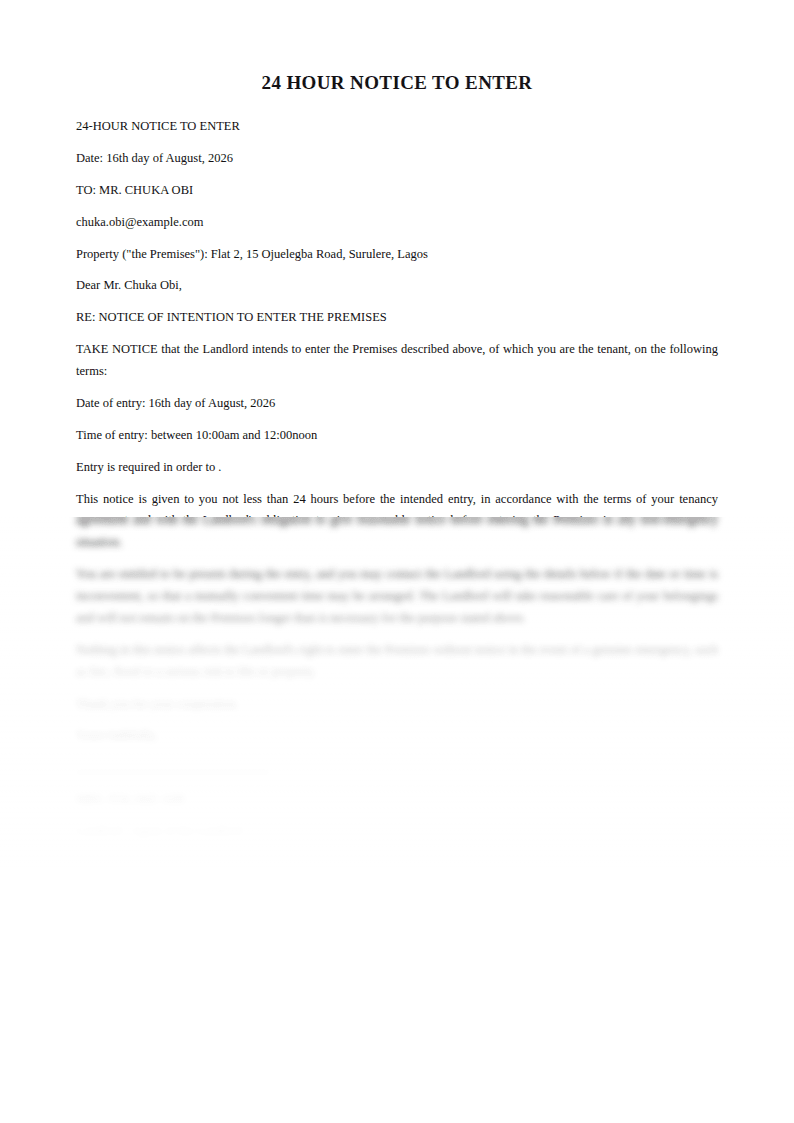
What a 24 hour notice to enter is
A notice to enter is a landlord's written request for access to a property somebody else is living in.
The underlying principle is simple and frequently forgotten. Once a tenancy is granted, the tenant has possession. The landlord owns the building; the tenant controls who comes through the door. That right, quiet enjoyment, is one of the few things a tenant gets automatically.
So a landlord who turns up unannounced is not exercising ownership, they are interfering with the tenancy. A notice fixes that by asking, in writing, with enough warning for the tenant to plan around it.
Twenty four hours is the shorter of the two standard forms. It suits an inspection or a repair that cannot wait a week.
Who needs one
Landlords needing access at short notice for an inspection, a repair, or to show the property to somebody.
Property managers and agents attending on an owner's behalf, who need the same permission the owner would.
Any landlord who has previously let themselves in and been told, correctly, that they should not have.
Where the work can wait, the 48 hour version is the better choice and reads as more considerate. Use this one when a day is genuinely all the warning the situation allows.
Before you start
Have four things ready.
The date, and the window of time you actually need rather than the whole day.
The real reason, described specifically enough that the tenant knows who is coming and why.
The tenant's current contact details, since a notice they never received has not been served.
And a check of the tenancy agreement, because many specify their own notice period and method, and where they do, that clause governs rather than this default.
The walkthrough
Filling in the form, step by step
Every question you will be asked, what it means, and an example of a good answer.
Step 1 of 3
24 Hour Notice to Enter
When you are coming, and what for
This step sets the appointment and justifies it, and the two work together.
Give a window rather than a day. Between ten and noon is an appointment a tenant can arrange their morning around. Sometime on Tuesday asks them to give up a day, and it is the difference between a tenant who cooperates and one who starts objecting on principle.
On the reason, be specific. Access to inspect the plumbing and replace the kitchen tap tells the tenant who is arriving, roughly how long it takes, and whether they need to move anything. To carry out inspection tells them nothing and invites suspicion about what is really happening.
Only complete the description box matching the reason you ticked. Where you ticked more than one, complete each of those, since the notice sets out everything you intend to do while you are there.
- Date you intend to enter
- The date you intend to attend. Count the notice from when the tenant actually receives this, not from when you write it. A notice sent late on Monday for a Tuesday morning visit has not given a full day.
- Time and how long you will be there
- The window and how long you expect to be there, for example between 10:00am and 12:00noon. A defined window is what makes short notice reasonable, because the tenant can plan around two hours far more easily than a whole day.
- Why do you need to enter? (choose all that apply)
- Tick every reason that applies. You may have more than one, such as inspecting and carrying out a repair in the same visit. The tenant is entitled to know everything you intend to do while inside.
- What will you inspect?
- If you ticked inspection, say what is being inspected, for example the plumbing and electrical fittings. Naming it tells the tenant which rooms are involved and how long it is likely to take.
- What repairs or improvements will you carry out?
- If you ticked repairs or improvements, describe the work, for example replacing the kitchen sink and repairing the leaking roof. Where contractors are attending, say so, since the tenant is entitled to know who is coming into their home.
- Who will you be showing the property to?
- If you ticked showing the property, say who is being shown round, for example a prospective tenant or a valuer. Tenants are most sensitive about this reason, so give the detail rather than withholding it.
- State your reason for entry
- If you ticked Others, describe the reason plainly, for example carrying out the annual fumigation. Any reason that is genuine and specific is acceptable; a vague one is what makes tenants refuse.
Step 2 of 3
24 Hour Notice to Enter
The property and the tenant
This step identifies where you are going and who you are telling.
Everybody on the tenancy agreement should be named here. Telling one of a couple is not telling both, and the one who was not told has a fair complaint if they arrive home to find contractors in the flat.
The contact details are how the notice gets delivered and how the tenant replies. That reply matters more than landlords expect. A tenant who cannot make Tuesday morning will often offer Wednesday, and a landlord who has given them a route to say so gets access without a dispute.
- Address of the rented property
- The full address of the rented property, including flat or house number. Where you own several units in one building, being specific avoids arriving at the wrong door with a notice for another tenant.
- Tenant's name
- The tenant, named as on the tenancy agreement. Name every tenant where the tenancy is held jointly, since notice to one is not notice to all and the others may reasonably object.
- Tenant's email or phone number
- An email address or phone number the tenant actually uses. This is how the notice reaches them and how they reply, and a tenant offering an alternative time is usually the fastest route to getting in.
Step 3 of 3
24 Hour Notice to Enter
Your details and the date
The final step says who is asking and when the notice was given.
Give contact details that work during the day. Short notice arrangements change, and a tenant who cannot reach you to say the time does not suit will simply not be there, which wastes the visit and the contractor.
The date on the notice should match when it was actually sent. It is the reference point for whether twenty four hours was given, and a notice dated earlier than it was delivered helps nobody if the tenant later disputes that they were told at all.
Keep a copy and a record of how you sent it. The evidence matters far more in the rare case where a tenant refuses access entirely and the question becomes whether they were properly asked.
- Landlord's name
- Your full name as landlord, matching the tenancy agreement. Where a manager or agent is issuing this on your behalf, the landlord named here is still you.
- Landlord's address
- Your address for correspondence. It confirms to the tenant that the notice comes from their actual landlord rather than somebody claiming to be.
- Landlord's phone number
- A number answered during the day. With a day's notice, arrangements frequently need adjusting, and a tenant who cannot reach you will simply be out when you arrive.
- Landlord's email
- An email address you monitor. It gives the tenant a written route to confirm or propose an alternative, which is useful evidence if access is later refused.
- Date of this notice
- The date the notice is given, which should match the date you actually send it. This is the point from which the twenty four hours runs, so accuracy matters here more than anywhere else in the document.
Ready to make yours?
Answer those questions in the builder and download a finished 24 hour notice to enter in Word and PDF.
Start now, ₦5,000After you download it
Send it by a route you can prove
Email, message or hand delivery with a witness. The notice period runs from receipt, so you need to be able to show when the tenant got it.
Check the tenancy agreement first
Many agreements set their own notice period and method for access. Where yours does, that clause governs and this notice should follow it.
Turn up in the window you gave
Arriving outside the stated hours undoes the notice. It also makes the next request harder, because the tenant has learned the window means nothing.
If access is refused, do not force it
Repeated written requests build a record. Letting yourself in against the tenant's wishes is a breach of quiet enjoyment and hands them the stronger position.
Questions people ask
Can a landlord enter without permission in Nigeria?
Not once a tenancy is granted. The tenant has possession and the right to quiet enjoyment, so a landlord needs the tenant's agreement or proper written notice to enter.
Is 24 hours enough notice?
It is generally treated as the minimum reasonable warning for an inspection or a repair that cannot wait. Where the work can be planned, 48 hours is better and reads as more considerate.
What if the tenancy agreement says something different?
The agreement governs. Many set their own notice period and method for access, and where yours does, follow that clause rather than the general default.
Can a landlord show the property to new tenants?
Yes, with proper notice. It is the reason tenants object to most, so say who is being shown round and keep the visits to the window you stated.
What if the tenant refuses to let me in?
Repeat the request in writing and keep the record. Forcing entry breaches quiet enjoyment and turns your access problem into the tenant's claim against you.
Does the notice have to be in writing?
It should be. A written notice proves what was asked, when, and for what reason, which is exactly what is in dispute if access is later refused.
Documents that go with this
Terms used on this page
Quiet Enjoyment
Quiet enjoyment is the tenant's right to use the property without the landlord interfering. Cutting power, entering without notice or harassing a tenant breaches it, whatever the rent situation.
Landlord
A landlord is the person who grants somebody else the right to occupy their property in exchange for rent. The role carries rights to rent and possession, and duties that Nigerian law enforces.
Tenant
A tenant is a person who occupies property belonging to somebody else in exchange for rent. Nigerian law gives tenants real protections, including proper notice and the right to a refund of the caution fee.
Possession
Possession is actual control of property. Nigerian law protects it separately from ownership, which is why the person on the land can sue a trespasser without first proving title.
Tenancy Agreement
A tenancy agreement is the contract between a landlord and a tenant setting out the rent, the term, and what each side must do. It is what decides most disputes, including how much notice you get.
Trespass
Trespass is entering or remaining on land in somebody else's possession without permission. It is actionable without proving any damage, and in Nigeria it is one of the most litigated claims there is.
Lease
A lease is a grant of exclusive possession of property for a fixed term, in exchange for rent. It creates an interest in the land itself, which is what separates it from a mere permission to occupy.
Dilapidation
Dilapidation is disrepair a tenant is responsible for under the lease. At the end of a commercial term a landlord can claim the cost of putting it right, and the bill surprises tenants.
Read more on this
Landlord Rights in Nigeria
Landlord Rights in Nigeria: What Every Property Owner Needs to Know Being a landlord in Nigeria is one of those ventures that looks straightforward from the outside and reveals its complexities only after you’re already…
8 Essential Clauses Every Tenancy Agreement Should Contain
8 Essential Clauses Every Tenancy Agreement Should Contain Renting property in Nigeria is often straightforward at the beginning. A landlord has a space to let, a tenant needs accommodation, and both parties are eager to…
Tenancy Relationships: The Different Types of Tenants
Tenancy Relationships: The Different Types of Tenants If you rent property in Nigeria—or you own one—you’ve probably used the word “tenant” casually. But in law, not all tenants are the same. The type of tenancy relation…
Step by step guides for every document on LegalDoc
Browse all guides