
How to Write a 48 Hour Notice to Enter
Two days notice suits planned work: contractors, viewings and anything a tenant needs to prepare for. It is the version that keeps tenancies pleasant.
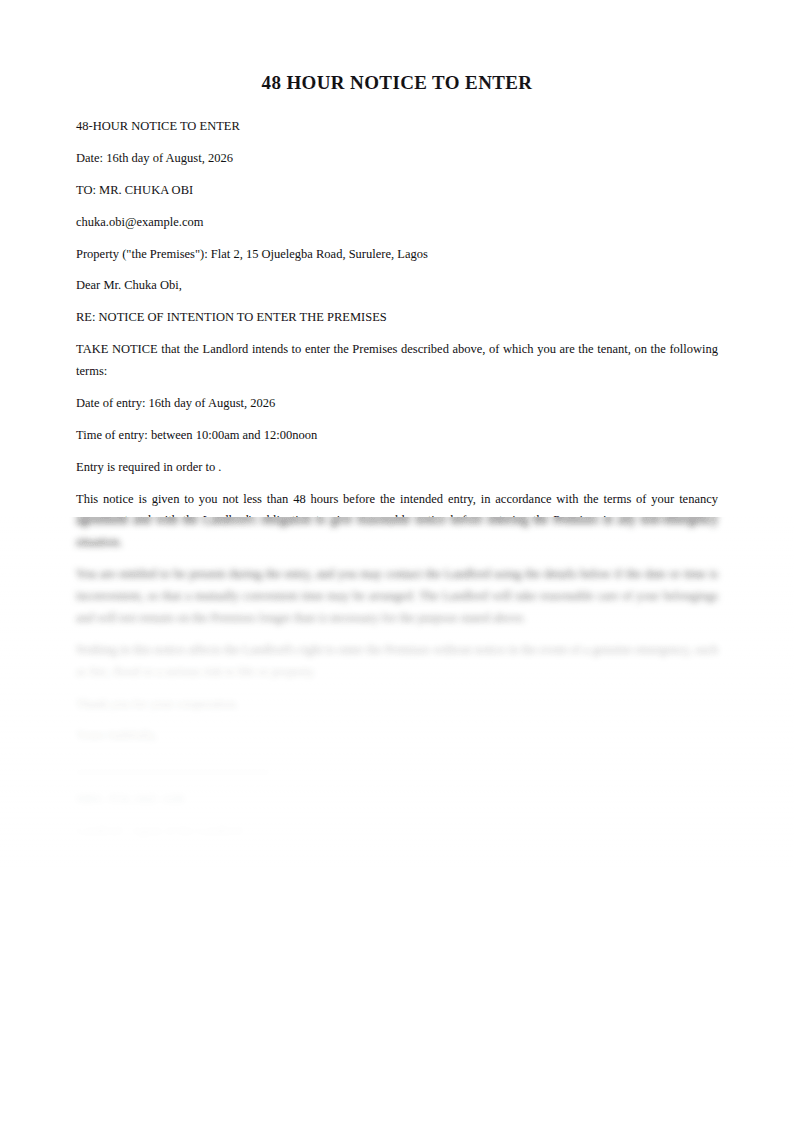
What a 48 hour notice to enter is
This notice asks a tenant for access in two days rather than one.
The legal position behind it is the same. A tenant in possession decides who enters, and a landlord who wants to come in has to ask. The difference is practical: forty eight hours gives the tenant a working day to rearrange things, secure valuables, arrange for somebody to be present, or simply tidy up.
That extra day changes the tone of the request. Landlords who use it for planned work find tenants far more cooperative than landlords who give the minimum every time.
It is the right form for anything you knew about more than a day in advance, which is most things.
Who needs one
Landlords arranging planned maintenance where contractors will be attending.
Owners preparing to sell or re let, who need to show the property to several people.
Anybody carrying out work that will be disruptive, noisy, or require the tenant to move belongings.
Managers coordinating a visit that involves more than one trade, where two days makes the difference between a tenant being ready and a wasted appointment.
Where something has genuinely gone wrong overnight and cannot wait, the 24 hour form exists for that.
Before you start
Get the practical details settled first, because the point of two days is that everything is arranged.
Confirm the contractor or visitor and the time they will actually arrive.
Work out how long the visit will take, honestly, including the tidying up afterwards.
Establish whether the tenant needs to do anything beforehand, such as clearing a cupboard or moving a car.
And re read the tenancy agreement, since a clause setting its own notice requirements takes precedence over the general position.
The walkthrough
Filling in the form, step by step
Every question you will be asked, what it means, and an example of a good answer.
Step 1 of 3
48 Hour Notice to Enter
The visit and the reason for it
With two days to work with, this step should read like a proper appointment rather than a demand.
Use the extra time to be precise. If a plumber is coming at nine and an electrician at eleven, the tenant would rather know that than be told somebody will attend during the morning. Precision here is what earns cooperation, and cooperation is what gets you access without a dispute.
Say what the tenant needs to do in advance. Clearing under the sink, moving a car off the driveway, keeping a pet secured: these are small requests that fail entirely when made on the doorstep and work perfectly when made two days out.
Complete the description box for each reason you ticked, and use it to describe the whole visit rather than a summary of it.
- Date you intend to enter
- The date of the visit. Count two clear days from when the tenant receives the notice rather than from when you write it, which usually means sending it three days ahead to be safe.
- Time and how long you will be there
- The arrival window and expected duration, for example between 10:00am and 12:00noon. Where several trades are attending, set out the sequence, since a tenant who knows the order can plan their day around it.
- Why do you need to enter? (choose all that apply)
- Tick each reason applying to this visit. Planned work often involves more than one, such as an inspection followed by a repair, and the tenant should see the full picture rather than the first item.
- What will you inspect?
- If inspecting, name what is being examined, for example the plumbing and electrical fittings. With two days notice you can also say which rooms are involved, which lets the tenant prepare those areas.
- What repairs or improvements will you carry out?
- If carrying out work, describe it and name the contractor where you can. Say whether water or power will be interrupted and for how long, since that is the detail that determines whether a tenant can work from home that day.
- Who will you be showing the property to?
- If showing the property, say who is attending and roughly how many people. Viewings are the most intrusive reason for entry, and two days notice with an honest description is what keeps a tenant onside.
- State your reason for entry
- If you ticked Others, set out the reason, for example the annual fumigation. Note anything the tenant must do beforehand, such as covering food or arranging to be out for a period.
Step 2 of 3
48 Hour Notice to Enter
Where you are going and who you are telling
This step records the property and the tenant being notified.
Every tenant on the agreement should be named. In a shared house or a family tenancy, one person receiving the notice does not put the rest on notice, and somebody arriving home to find strangers working in the kitchen has a legitimate grievance even where the landlord did everything else correctly.
Use contact details the tenant actually monitors. With two days in hand there is time for a reply, and the reply is often the useful part: a tenant proposing a slightly different time, or telling you the gate code, or mentioning that the dog will be in the yard.
- Address of the rented property
- The full address including flat or house number. Where a building contains several tenanted units, precision prevents the notice being served on the wrong household.
- Tenant's name
- Every tenant named on the agreement. In shared or family tenancies, notifying one occupier does not notify the others, and the person who was not told is the one who objects.
- Tenant's email or phone number
- An email or phone number the tenant checks. Two days allows a genuine exchange, and the tenant's reply often contains the practical detail that makes the visit work.
Step 3 of 3
48 Hour Notice to Enter
Your details and the date of the notice
The closing step identifies the landlord and dates the notice.
Contact details here should be for whoever can actually resolve a problem on the day. If a property manager is coordinating the visit, the tenant needs their number rather than an owner abroad who cannot help when a contractor fails to arrive.
Date the notice for the day it is sent. With a forty eight hour period the arithmetic is easy to get wrong: a notice sent on Wednesday evening for a Friday morning visit is closer to thirty six hours, and a tenant who feels short changed on the notice period is less likely to accommodate the next request.
Keep a copy. Where a tenancy sours, a file of properly served notices is what shows the landlord behaved reasonably throughout.
- Landlord's name
- Your full name as landlord, as it appears on the tenancy agreement, so the tenant can see the notice comes from the person they contracted with.
- Landlord's address
- Your correspondence address. It authenticates the notice and gives the tenant somewhere to write if they want to object or propose another time.
- Landlord's phone number
- A number reaching whoever can solve problems on the day. Where a manager is running the visit, give their number rather than one that will not be answered.
- Landlord's email
- A monitored email address. It gives the tenant a written route to confirm the appointment, which is worth having on file.
- Date of this notice
- The date the notice is sent. Check the arithmetic: two clear days means sending it well before the visit, and a notice that turns out to give thirty six hours undermines the goodwill the longer period is meant to buy.
Ready to make yours?
Answer those questions in the builder and download a finished 48 hour notice to enter in Word and PDF.
Start now, ₦5,000After you download it
Confirm the appointment the day before
A short reminder message the day before turns a notice into an arrangement, and it catches problems while there is still time to reschedule.
Brief your contractors
Tell them the window and that somebody lives there. Tradespeople arriving early or unannounced undo the notice you carefully served.
Leave the property as you found it
Access granted once sets the tone for every future request. A tenant who comes home to mess will make the next visit considerably harder.
Keep the notices on file
Where a tenancy later goes wrong, a record of properly served notices demonstrates that the landlord acted reasonably throughout.
Questions people ask
When should I use 48 hours rather than 24?
For anything planned: contractors, viewings, or work needing the tenant to prepare. Reserve the shorter notice for problems that genuinely arose overnight.
Does a landlord have an automatic right to enter?
No. The tenant has possession and the right to quiet enjoyment. Access requires the tenant's agreement or proper written notice, whatever the landlord owns.
How do I count the 48 hours?
From when the tenant receives the notice, not when you write it. Sending it three days before the visit is the safe way to be sure two clear days have passed.
Can I bring contractors with me?
Yes, provided the notice says so. Name who is attending and what they will do, since a tenant expecting the landlord alone may reasonably object to a team arriving.
What if the tenant asks for a different time?
Accommodate it where you can. The point of two days notice is that there is room to negotiate, and a rearranged visit is far cheaper than a refused one.
Do I need notice for emergency repairs?
A genuine emergency, such as a burst pipe or a gas leak, is different and immediate access may be justified. Anything that can wait until tomorrow is not an emergency.
Documents that go with this
Terms used on this page
Quiet Enjoyment
Quiet enjoyment is the tenant's right to use the property without the landlord interfering. Cutting power, entering without notice or harassing a tenant breaches it, whatever the rent situation.
Tenant
A tenant is a person who occupies property belonging to somebody else in exchange for rent. Nigerian law gives tenants real protections, including proper notice and the right to a refund of the caution fee.
Landlord
A landlord is the person who grants somebody else the right to occupy their property in exchange for rent. The role carries rights to rent and possession, and duties that Nigerian law enforces.
Possession
Possession is actual control of property. Nigerian law protects it separately from ownership, which is why the person on the land can sue a trespasser without first proving title.
Tenancy Agreement
A tenancy agreement is the contract between a landlord and a tenant setting out the rent, the term, and what each side must do. It is what decides most disputes, including how much notice you get.
Dilapidation
Dilapidation is disrepair a tenant is responsible for under the lease. At the end of a commercial term a landlord can claim the cost of putting it right, and the bill surprises tenants.
Lease
A lease is a grant of exclusive possession of property for a fixed term, in exchange for rent. It creates an interest in the land itself, which is what separates it from a mere permission to occupy.
Nuisance
Nuisance is unreasonable interference with somebody's use and enjoyment of their land. Generator noise, fumes, smoke and water running onto a neighbour's property are the everyday Nigerian versions.
Read more on this
8 Essential Clauses Every Tenancy Agreement Should Contain
8 Essential Clauses Every Tenancy Agreement Should Contain Renting property in Nigeria is often straightforward at the beginning. A landlord has a space to let, a tenant needs accommodation, and both parties are eager to…
Landlord Rights in Nigeria
Landlord Rights in Nigeria: What Every Property Owner Needs to Know Being a landlord in Nigeria is one of those ventures that looks straightforward from the outside and reveals its complexities only after you’re already…
Tenancy Relationships: The Different Types of Tenants
Tenancy Relationships: The Different Types of Tenants If you rent property in Nigeria—or you own one—you’ve probably used the word “tenant” casually. But in law, not all tenants are the same. The type of tenancy relation…
Step by step guides for every document on LegalDoc
Browse all guides