
How to Write a Billboard Lease Agreement
A landowner rents out space for advertising. Regulatory permits and who insures the structure are the two answers that decide the risk.
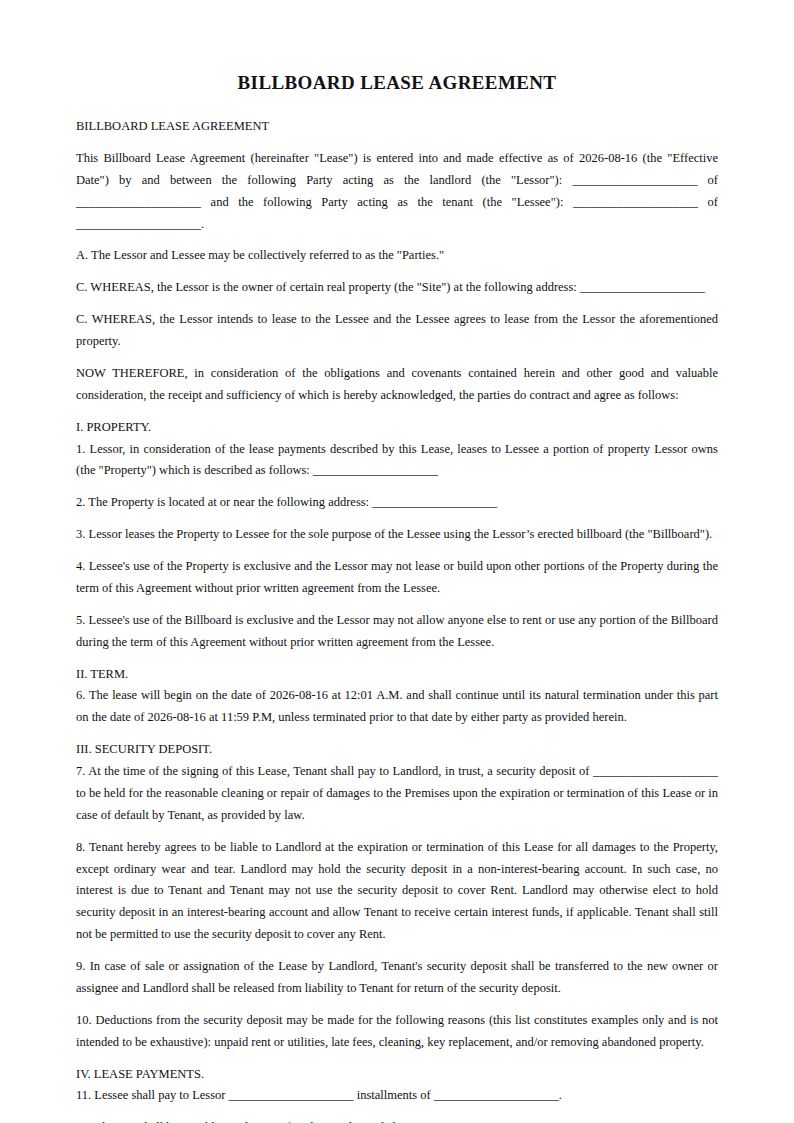
What a billboard lease agreement is
A billboard lease lets an advertiser use part of somebody's land or building to put up an advertising structure.
The landowner keeps the property and earns from a strip of it they were not otherwise using: a roof, a wall, a boundary, a roadside plot. The advertiser gets a site.
The arrangement carries a regulatory dimension that ordinary lettings do not. Outdoor advertising in Nigeria is regulated, and in Lagos the Lagos State Signage and Advertisement Agency controls signage, with permits required and enforcement action taken against structures put up without them. Other states operate their own regimes. A billboard erected without the necessary permit can be removed regardless of what the lease says.
So the agreement should be clear about who obtains the permits and who bears the consequence if they are refused or revoked. That is the question this document exists to settle.
Who needs one
Landowners with roadside land, a visible wall or a rooftop who want to earn from it.
Advertising companies and agencies acquiring sites for outdoor campaigns.
Businesses putting up their own signage on land they do not own.
Property owners approached by an advertiser and unsure what they are agreeing to.
The structure itself is worth thinking about: a billboard is a substantial object exposed to weather and traffic, and if it falls on somebody the question of who is responsible is answered by this agreement and by whoever holds the insurance.
Before you start
Settle these before signing.
Which permits are needed for outdoor advertising in that state, and who will obtain them.
Whether the landowner has the right to grant this, particularly on leased premises where the head lease may prohibit signage.
Who builds, maintains and eventually removes the structure.
Who insures it, since public liability is the real exposure.
And what the landowner will not allow to be advertised, which is easier to agree now than to object to later.
The walkthrough
Filling in the form, step by step
Every question you will be asked, what it means, and an example of a good answer.
Step 1 of 4
Billboard Lease Agreement
The parties
The lease names the site owner and the advertiser.
The lessor is the landowner. Confirm they can actually grant this. Where the lessor is themselves a tenant, the head lease frequently restricts alterations and signage, and a billboard erected in breach of it puts the lessor's own occupation at risk. Where the property is jointly owned, all owners should be party.
The lessee is the advertiser or agency taking the site. Name the entity that will actually erect and operate the structure, since that is who carries the obligations to maintain it and to take it down at the end.
Addresses matter here for a specific reason: outdoor advertising attracts regulatory correspondence, and the landowner may receive notices about a structure the advertiser installed. Both sides need to be reachable quickly when that happens.
- Date of the Agreement
- When the agreement takes effect. Where a structure is already in place under an informal arrangement, use the honest date and address the earlier period, including any permit position.
- Lessor's name
- The landowner granting the site. Where they are themselves a tenant of the property, check the head lease first, since most restrict signage and alterations and a breach puts their own occupation at risk.
- Lessor's Address
- The landowner's address. Regulatory notices about the structure frequently reach the landowner rather than the advertiser, so this needs to be somewhere post is read.
- Lessee's name
- The advertiser or agency taking the site, named as the entity that will erect and operate the structure and carry the obligation to remove it at the end.
- Lessee's Address
- The advertiser's address for notices, including anything urgent about the structure's condition or a regulatory demand.
Step 2 of 4
Billboard Lease Agreement
The site, the term and the deposit
This step defines what part of the property is being let and for how long.
Describe the site precisely. A billboard lease is not a letting of the whole property, it is a right to occupy a defined area: a stated section of wall, a marked plot at a boundary, a portion of roof. Say exactly where, with dimensions, and include the access the advertiser needs to install and maintain the structure, since a site nobody can reach is worthless.
The term should reflect the advertiser's investment. A structure costing several million naira to build needs a term long enough to justify it, and advertisers commonly want renewal rights. Landowners should be aware that a long term with an automatic renewal can tie up the site for years at a rent that stops looking attractive.
The security deposit covers damage to the property and, importantly, the cost of removing the structure and making good if the advertiser disappears. That second purpose is the one landowners forget, and dismantling an abandoned billboard is not cheap.
- Address of the property (Billboard)
- The address of the property where the structure will stand.
- The description of the property
- The specific area being let, with dimensions and location: a stated section of wall, a marked plot, a portion of roof. Include the access the advertiser needs to install and maintain the structure, since a site they cannot reach is of no use.
- Starting date of the lease
- When the advertiser may take the site. Where permits are still being obtained, consider whether the term should start on grant of the permit rather than on signature.
- End date of the lease
- When the term ends. It should be long enough to justify the advertiser's build cost. Landowners should note that a long term with automatic renewal can tie up the site for years at a rent that dates quickly.
- Security deposit
- The sum held against damage and, critically, against the cost of removing the structure and making good if the advertiser abandons it. Dismantling an abandoned billboard is expensive and landowners routinely forget to provide for it.
Step 3 of 4
Billboard Lease Agreement
Rent, timing and what may be advertised
This step covers the money and the content restrictions.
Set the payment frequency and the amount, and be clear which period the figure covers. Billboard rents in Nigeria are commonly annual and paid in advance, which suits a landowner and requires the advertiser to commit capital before earning from the site.
The restrictions field is the one landowners should take seriously. Once a structure is up, whatever appears on it is associated with the property and with the owner. A landowner with religious objections, a school next door, or a residential neighbourhood to consider should say now what may not be displayed: alcohol, gambling, political messaging, tobacco, or particular imagery.
This is far easier to agree at the outset than to object to once a campaign is running and the advertiser has committed to a client. A landowner who says nothing has effectively agreed to whatever arrives.
Advertisers should also note that outdoor advertising content is itself regulated, and some categories face restrictions independent of anything the landowner requires.
- The Lessee shall pay the Lessor Weekly, monthly or Yearly?
- The payment frequency. Annual payment in advance is common for billboard sites in Nigeria, which suits the landowner and requires the advertiser to commit before the site earns anything.
- How much is the rent?
- The rent, with the period it covers stated clearly. For a long term, consider whether it should increase periodically, since a fixed rent over five years loses value.
- Late fee
- The charge that applies once rent runs past its due date. Keep it a genuine reflection of what the delay costs rather than a penalty, since a punitive figure is open to challenge.
- The first rent shall be paid on?
- When the first payment falls due. Where permits are outstanding, consider tying it to permit approval rather than to signature, since an advertiser paying for a site they cannot legally use will want that addressed.
- Will the lessee's use of the billboard be restricted?
- What may not be advertised. Say it now: alcohol, gambling, political messaging, tobacco or particular imagery. Whatever appears on the structure is associated with your property, and objecting once a campaign is running is far harder than agreeing the limits today.
Step 4 of 4
Billboard Lease Agreement
Insurance and governing law
The final step allocates the risk that actually matters.
A billboard is a large structure exposed to wind, rain and traffic. If it collapses onto a vehicle or a person, somebody is liable, and the question of who is answered here. Public liability insurance is the real protection, and whichever party carries it should hold cover proportionate to the exposure rather than a nominal policy.
The better arrangement is usually for the advertiser to insure, since they own and maintain the structure. Landowners agreeing to insure should understand they are taking on the risk of an object they did not build and do not maintain.
Whichever way it goes, the party not insuring should be named on the policy or given evidence of cover, and should ask to see renewal confirmation each year. Cover that lapsed eighteen months ago protects nobody.
Name the state where the property sits, which also determines the signage regulator whose permits apply.
- Who is to insure the property?
- Who carries insurance on the structure. The advertiser is the more logical choice since they own and maintain it, and a landowner agreeing to insure is taking on the risk of an object they neither built nor look after.
- Lessee to insure
- If the advertiser insures, state the cover required, particularly public liability, and the amount. Require evidence of cover at the outset and on each renewal, since a policy that lapsed a year ago protects nobody.
- Lessor to insure
- If the landowner insures, state what the advertiser contributes and confirm the policy actually extends to the advertising structure, since standard property cover may exclude it.
- This agreement is to be governed by which state?
- The state where the property is located. It governs the agreement and determines which signage regulator applies, which in Lagos means the state signage agency and its permit regime.
Ready to make yours?
Answer those questions in the builder and download a finished billboard lease agreement in Word and PDF.
Start now, ₦10,000After you download it
Obtain the signage permits
Outdoor advertising is regulated at state level, and in Lagos through the state signage agency. A structure without a permit can be removed whatever the lease says.
Check the head lease if you are a tenant
Most leases restrict signage and alterations. Granting a billboard site in breach of your own lease puts your occupation at risk, not just the structure.
Verify the insurance annually
Ask for the renewal certificate each year. Public liability is the real exposure on a large structure beside a road, and lapsed cover is discovered after an incident.
Agree removal and reinstatement
Who takes the structure down at the end and who makes good the wall or ground. The deposit should be sized against that cost.
Questions people ask
Do I need a permit for a billboard in Nigeria?
Outdoor advertising is regulated at state level, and in Lagos the state signage agency controls it. A structure erected without the necessary permit can be removed regardless of what the lease provides.
Who should insure a billboard?
Usually the advertiser, since they own and maintain the structure. A landowner who agrees to insure is accepting the risk of an object they neither built nor look after.
Can a landowner restrict what is advertised?
Yes, and they should say so at the outset. Whatever appears on the structure is associated with the property, and objecting once a campaign is running is far harder than setting the limits now.
Can I grant a billboard site if I am a tenant?
Check the head lease first. Most restrict signage and alterations, and granting a site in breach puts your own occupation at risk as well as the structure.
How long should a billboard lease run?
Long enough for the advertiser to justify the build cost. Landowners should be careful with automatic renewals, since a long term at a fixed rent dates quickly.
What happens to the structure at the end?
Whatever the agreement says, which is why it should say. Removal and making good are real costs, and the deposit should be sized against them.
Documents that go with this
Terms used on this page
Lease
A lease is a grant of exclusive possession of property for a fixed term, in exchange for rent. It creates an interest in the land itself, which is what separates it from a mere permission to occupy.
Landlord
A landlord is the person who grants somebody else the right to occupy their property in exchange for rent. The role carries rights to rent and possession, and duties that Nigerian law enforces.
Rent
Rent is what a tenant pays for the right to occupy a property. In Nigeria it is normally paid in advance, and how far in advance a landlord may demand is limited by law in some states.
Deposit
A deposit is money paid to secure a transaction. Whether you get it back if the deal falls through depends on whether it was a true deposit or a part payment, and most people never ask.
Insurance
Insurance is paying a premium so somebody else carries a risk you cannot afford to carry yourself. It is a contract of utmost good faith, which means what you did not disclose matters as much as what you did.
Occupiers Liability
Occupiers liability is the duty of whoever controls premises to keep visitors reasonably safe. Malls, hotels, event venues and construction sites all carry it.
Negligence
Negligence is carelessness that the law will make you pay for. Somebody owed a duty of care, fell below the standard expected, and caused loss or injury as a result.
Quiet Enjoyment
Quiet enjoyment is the tenant's right to use the property without the landlord interfering. Cutting power, entering without notice or harassing a tenant breaches it, whatever the rent situation.
Read more on this
Tenancy Agreement vs Commercial Lease Agreement
Tenancy Agreement vs Commercial Lease Agreement Choosing the right agreement for occupying property in Nigeria is more than just a paperwork exercise. Whether you are renting a flat, opening a shop, or taking a warehouse…
8 Essential Clauses Every Tenancy Agreement Should Contain
8 Essential Clauses Every Tenancy Agreement Should Contain Renting property in Nigeria is often straightforward at the beginning. A landlord has a space to let, a tenant needs accommodation, and both parties are eager to…
Landlord Rights in Nigeria
Landlord Rights in Nigeria: What Every Property Owner Needs to Know Being a landlord in Nigeria is one of those ventures that looks straightforward from the outside and reveals its complexities only after you’re already…
Step by step guides for every document on LegalDoc
Browse all guides