
How to Write a Brand Influencer Agreement
This agreement sets what an influencer will post, when, and for how much. The deliverables answer is what stops the argument after the first post.
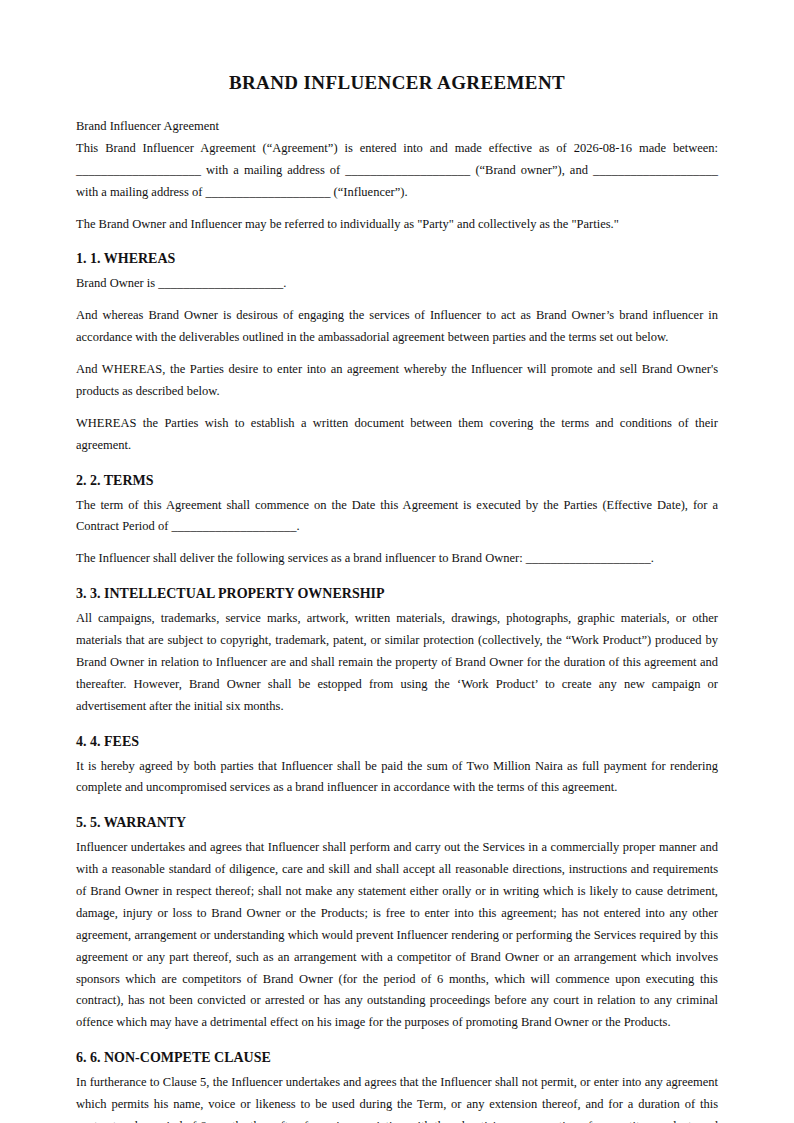
What a brand influencer agreement is
A brand influencer agreement records what a creator will produce and post for a brand, and what they are paid for it.
It is a services contract with a content licence attached. The influencer provides a service, producing and publishing content, and the brand usually wants some right to reuse that content in its own channels.
Influencer arrangements go wrong in predictable ways. The brand expected four posts and got two. The influencer expected payment on posting and was paid ninety days later. Nobody agreed whether the brand could run the content as a paid advertisement, and it did. Each of those is settled by one clear sentence written beforehand.
There is also a disclosure dimension. Paid promotion presented as genuine opinion is misleading, and consumer protection regulators take an interest. Both sides benefit from the agreement requiring clear disclosure.
Who needs one
Brands engaging creators for paid promotion, whether one post or a long campaign.
Influencers who want the deliverables and the payment terms fixed before they start producing.
Agencies contracting creators on a client's behalf, where the agreement should be clear about who the influencer's contract is actually with.
Anybody whose last collaboration ended in a disagreement about scope or payment, which is most people who have done more than a few.
Where the arrangement involves the creator producing content the brand will own outright rather than licence, that is closer to a work for hire and should be documented accordingly.
Before you start
Settle these before drafting.
Exactly what is being produced: how many posts, on which platforms, in what format.
When each piece goes live.
Whether the brand may reuse the content, where, and for how long.
The fee, and when it is paid relative to posting.
Whether the influencer may work with competing brands during the term.
And who approves content before it goes out.
The walkthrough
Filling in the form, step by step
Every question you will be asked, what it means, and an example of a good answer.
Step 1 of 3
Brand Influencer Agreement
The brand and the influencer
The agreement names both parties.
Name the brand owner as the entity that will actually pay. Influencers are frequently engaged through an agency, and the question of who they are contracting with matters enormously when an invoice goes unpaid. If the agreement is with the agency, the agency owes the fee. If it is with the brand, the brand does.
Name the influencer as they invoice, which may be a personal name or a registered business. Consistency between the agreement, the invoice and the receiving account avoids payment queries.
Addresses matter for notices and, practically, for the brand to send products where the collaboration involves them.
- Date on the Agreement
- When the agreement takes effect. Where content has already been discussed or produced informally, use the honest date rather than backdating to cover earlier work.
- Brand Owner's Name
- The entity paying for the campaign, using its registered name. Where an agency engages the influencer on a client's behalf, be clear which of them is the contracting party, since that is who owes the fee.
- Brand Owner's Address
- The brand's business address, for notices and invoices.
- Influencer's Name
- The creator, named as they invoice: a personal name or a registered business. Keep it consistent with the invoice and the receiving account, since a mismatch delays payment.
- Influencer's Address
- The influencer's address, for notices and for sending any product the collaboration involves.
Step 2 of 3
Brand Influencer Agreement
The brand, the term and the deliverables
This step describes the campaign, and the deliverables field is where the whole agreement lives.
Be specific to the point of tedium. Three feed posts and six stories on Instagram, published between 1 and 30 September, each featuring the product in use, with the brand tagged and the campaign hashtag included. That is a deliverable both sides can measure. Content promoting the brand is not, and it is why so many collaborations end in disappointment.
Use this field for the things the form does not separately ask, because they all matter.
Who approves content before it goes live, and how long the brand has to respond. An approval right with no deadline can stall a campaign entirely.
How long posts must remain up. Brands assume permanently, influencers assume until the next campaign, and neither says so.
Whether the brand may reuse the content in its own channels or as paid advertising, in what territory, and for how long. Reusing a creator's content as an advertisement without agreeing it is one of the most common disputes in this area.
And whether the influencer may work with competing brands during the term.
- Details of the Brand
- The brand and what is being promoted: the product or service, the campaign, and any messaging or claims the influencer must or must not make. Where the product carries regulatory constraints, such as health or financial claims, say so here.
- This agreement shall be valid for how long?
- The term of the agreement. Distinguish it from how long content must stay published, which is a separate and frequently unstated obligation. State both.
- Deliverables by the Influencer
- Exactly what is produced and published: how many posts, on which platforms, in what format, by when, with what tagging and hashtags. Also cover here who approves content and within what time, how long posts must remain live, whether the brand may reuse the content in its own channels or as paid advertising and for how long, and whether the influencer may work with competing brands during the term. Each of those is a common dispute and each is settled by one sentence.
Step 3 of 3
Brand Influencer Agreement
The fee and the governing law
The final step sets the money and the law.
State the fee and, just as importantly, when it is paid. Payment on posting, within thirty days of invoice, or split between signature and completion are all workable; leaving it unstated is not, and influencers routinely wait months because nobody wrote a payment date. Where products or gifted items form part of the consideration, record their value, since that is what the arrangement is worth and it may be taxable.
A point neither side should skip: disclosure. Paid promotion presented as genuine opinion is misleading, and the Federal Competition and Consumer Protection Act addresses misleading commercial practices. The agreement should require the influencer to disclose the commercial relationship clearly, and the brand should want that too, since an undisclosed paid endorsement damages the brand as much as the creator.
Name a Nigerian state connected to the parties for the governing law, since that is where an unpaid invoice or an unperformed campaign would be pursued.
- Fees
- What the influencer is paid, and when. State the payment trigger explicitly: on posting, within thirty days of invoice, or split between signature and completion. Where gifted product forms part of the consideration, record its value, since that is part of what the arrangement is worth and may be taxable.
- Governing law of what state?
- The Nigerian state whose law governs, for example Lagos State. Choose somewhere connected to the parties, since that is where an unpaid invoice or an unperformed campaign would realistically be pursued.
Ready to make yours?
Answer those questions in the builder and download a finished brand influencer agreement in Word and PDF.
Start now, ₦10,000After you download it
Require clear disclosure
Paid promotion presented as genuine opinion is a misleading commercial practice. Both sides benefit from the agreement requiring visible disclosure on every post.
Agree content reuse explicitly
Running a creator's content as a paid advertisement without agreeing it is among the most common disputes in influencer work. Settle territory and duration in writing.
Set an approval deadline
A brand approval right with no time limit can stall a campaign entirely. Give the brand a stated window to respond or the content goes live as submitted.
Keep the analytics
Screenshots of reach and engagement after posting. Brands ask for them, and they are the influencer's evidence that the deliverables were met.
Questions people ask
What should a brand influencer agreement include?
The exact deliverables with platforms and dates, who approves content and by when, how long posts stay live, whether the brand may reuse the content, the fee and when it is paid.
Do influencers have to disclose paid partnerships in Nigeria?
Presenting paid promotion as genuine opinion is a misleading commercial practice, and the Federal Competition and Consumer Protection Act addresses that. Clear disclosure protects both the creator and the brand.
Can the brand reuse my content in adverts?
Only if the agreement says so. Running a creator's content as paid advertising without agreeing it is one of the most common disputes, so settle territory and duration up front.
When should an influencer be paid?
Whenever the agreement says, so it must say. On posting, within thirty days of invoice, or split between signature and completion are all workable. Silence is what causes months of waiting.
Does gifted product count as payment?
It is part of the consideration and its value should be recorded. That is what the arrangement is actually worth, and it may carry tax consequences.
Can I work with a competing brand during the campaign?
Only if the agreement permits it. Exclusivity is worth agreeing explicitly, since brands frequently assume it and creators frequently assume the opposite.
Documents that go with this
Terms used on this page
Intellectual Property
Intellectual property is the legal ownership of things you create rather than things you can touch, including trademarks, copyright, patents and designs. In Nigeria each type has its own registry and its own rules.
Copyright
Copyright is the automatic right you get over original work you create, such as writing, music, film, photographs and software. It protects the expression, not the underlying idea.
Licensing
Licensing is permission to use something you own without giving it away. The owner keeps the asset, the licensee gets defined rights for a defined period, and money usually flows as a royalty or a fee.
Consumer Protection
Consumer protection law gives buyers rights against sellers: honest information, safe goods, and redress when something is wrong. In Nigeria it is enforced by the FCCPC.
Exclusivity
Exclusivity gives one party sole rights: to distribute in a territory, to supply a customer, or to negotiate a deal without the other side talking to anybody else. It is valuable, and it should be earned.
Work for Hire
Work for hire is the question of who owns something created by somebody you paid. For employees the answer usually favours the employer. For freelancers it usually does not.
Invoice
An invoice is a document requesting payment for goods or services already delivered. It records what was supplied, what is owed, and when payment falls due.
Termination for Convenience
Termination for convenience is a right to end a contract without anybody being in breach, simply on notice. Where a contract has one, it is usually the safest way out.
Read more on this
10 Legal Documents Every Startup in Nigeria Needs
10 Legal Documents Every Startup in Nigeria Needs Starting a business in Nigeria is exciting. Entrepreneurs launch new ventures every day—technology startups, creative agencies, e-commerce platforms, consulting firms, an…
The Unpopular but Essential Document Called a Consulting Agreement in Nigeria
The Unpopular but Essential Document Called a Consulting Agreement Most business relationships don’t fall apart at the beginning—they unravel somewhere in the middle. At the start, everything feels clear. The consultant…
Service Level Agreements: What Small Businesses Need to Avoid Disputes
Service Level Agreements: What Small Businesses Need to Avoid Disputes Running a small business in Nigeria often involves working with other businesses, vendors, consultants, freelancers, and service providers. A graphic…
Step by step guides for every document on LegalDoc
Browse all guides