
How to Write a Company Resolution
A resolution is the written record of a decision the company formally made. Banks, registries and buyers all ask for one, usually at short notice.
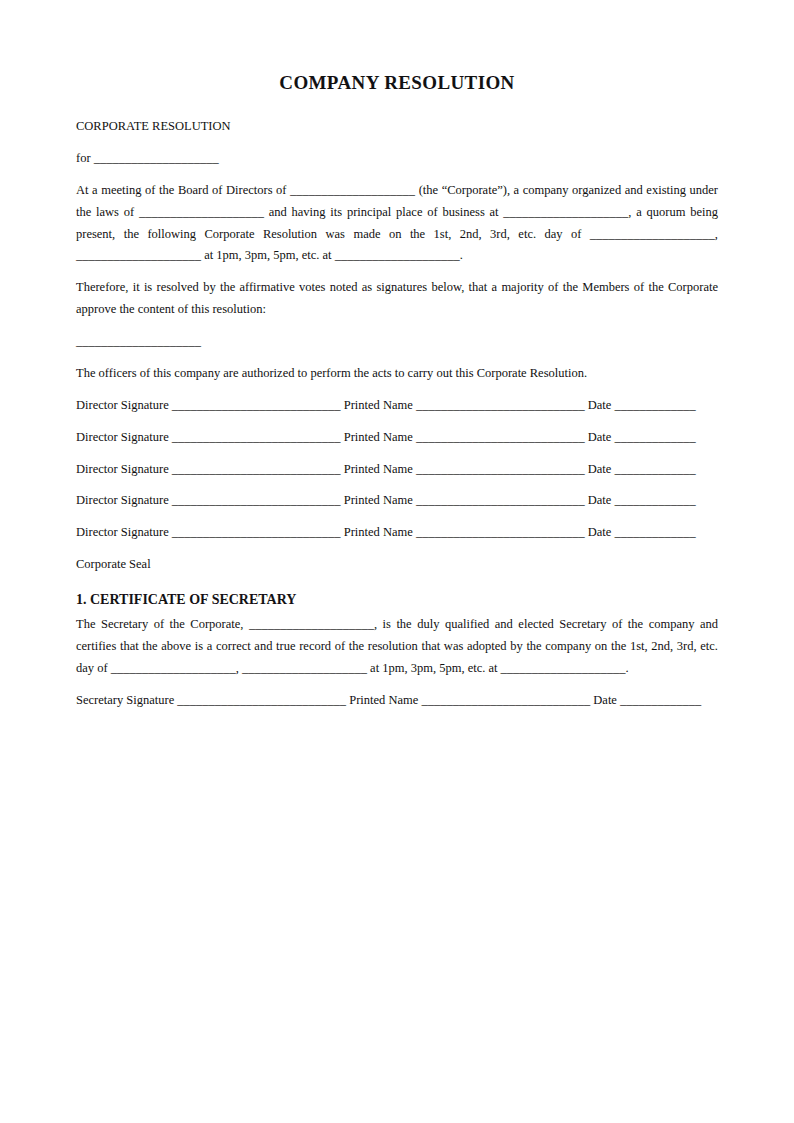
What a company resolution is
A company resolution records a decision taken by the shareholders or the board, in a form that can be shown to somebody outside the company.
That external purpose is the point. A company is a legal person that cannot speak for itself, so when a bank, a registry, a buyer or a regulator needs to know that the company decided something, the resolution is the evidence.
It is requested constantly and usually urgently: opening a bank account, changing signatories, appointing a director, approving a loan, authorising somebody to sign a contract, selling an asset.
CAMA distinguishes between ordinary resolutions, passed by a simple majority, and special resolutions, which require a greater majority and are needed for more significant matters such as changing the company name or altering the articles. Knowing which one your decision requires is worth checking before the meeting rather than after.
Who needs one
Companies opening or changing bank accounts, which is the most common trigger by a wide margin.
Businesses appointing or removing directors, changing the registered office, or authorising somebody to act for the company.
Any company entering a significant transaction where the other side wants proof the decision was properly taken.
Sole director companies still need them. The requirement is not about the number of people but about creating a record of the company deciding rather than an individual acting.
Before you start
Have the details of the meeting before you draft.
The exact date, time and place it was held.
What was actually decided, in the words the decision needs to carry.
Whether the matter requires an ordinary or a special resolution under CAMA.
Who was present, and whether the meeting was quorate under your articles.
And who will sign: typically the chairman and the company secretary.
The walkthrough
Filling in the form, step by step
Every question you will be asked, what it means, and an example of a good answer.
Step 1 of 3
Company Resolution
The company
The resolution opens by identifying the company that made the decision.
Use the registered name exactly as it appears on the certificate of incorporation, including the Limited or Plc suffix. Banks and registries check this against their records, and a resolution naming a slightly different entity is rejected, usually after the person needing it has already left the office.
The address should be the registered office. That is the address on the CAC record, and it is the one an institution will compare against.
The country question matters where a group has entities in more than one jurisdiction, since the resolution needs to make clear which company decided.
- Name of the Company
- The registered name exactly as it appears on the certificate of incorporation, including the Limited or Plc suffix. Banks compare this against their records, and any variation gets the resolution rejected.
- Address of the Company
- The registered office address as shown on the CAC record. Where the company operates from somewhere else, this should still be the registered address, since that is what an institution checks.
- Country
- Where the company is incorporated, for example Nigeria. It matters most in a group with entities in several jurisdictions, where the resolution must make clear which company acted.
Step 2 of 3
Company Resolution
When the meeting was held
This step records the timing of the meeting, and the detail exists because it is evidence.
A resolution asserts that a meeting happened and a decision was taken at it. The date, month, year and time are what make that assertion specific enough to be tested. A vague resolution invites the question of whether the meeting occurred at all, which is precisely the question a bank or a court would be asking.
Record the meeting that actually took place. Where the decision was taken by written resolution without a meeting, which CAMA permits in defined circumstances, that is a different instrument and the details should reflect what genuinely happened rather than describing a meeting that did not.
The time matters more than it looks in disputed situations, where the sequence of two decisions on the same day can be the whole issue.
- Meeting day
- The day of the month the meeting was held. Use the actual date. A resolution is evidence that a decision was properly taken, and inventing the particulars undermines the only thing it is for.
- Meeting month
- The month of the meeting, written out, for example September.
- Meeting year
- The year of the meeting. Together with the day and month it fixes the date the decision took effect, which institutions cross reference against other filings.
- Time when the resolution was passed
- The time the resolution was passed, for example 3pm. It seems excessive until two decisions are taken on the same day and the order matters, which is exactly when the record is examined.
Step 3 of 3
Company Resolution
The venue, the decision and the secretary
The final step contains the substance: what was actually resolved.
Write the resolution in operative language. The wording should be capable of being acted on by somebody who was not in the room. Resolved that the company opens an account with the named bank and that the persons named are authorised to operate it, with the mandate stated, is something a bank can act on. A note that the account was discussed is not.
Be specific about names, amounts and limits. Where signatories are being appointed, name them and state whether they sign jointly or severally. Where a transaction is being approved, state the amount or the ceiling. Institutions read these literally and will refuse anything that requires them to interpret.
The company secretary signs. CAMA requires public companies to have a secretary, while small companies may operate without one, in which case a director signs instead. Whoever signs should be somebody whose authority is verifiable from the company's filings.
- The location where the meeting held
- Where the meeting took place, for example the registered office or a stated address. Where it was held virtually, say so, since CAMA permits companies to hold meetings electronically in defined circumstances.
- Content of the resolution that was decided
- The decision itself, written so somebody who was not present can act on it. Name the people, state the amounts and set out any limits. Institutions read resolutions literally and reject anything that requires interpretation.
- Name of the Secretary of the Company.
- The company secretary, who signs the resolution. Public companies must have one under CAMA; small companies may not, in which case a director signs. Whoever signs should be verifiable from the company's filings.
Ready to make yours?
Answer those questions in the builder and download a finished company resolution in Word and PDF.
Start now, ₦5,000After you download it
Enter it in the minute book
A resolution belongs in the company's records alongside the minutes of the meeting. CAMA requires those records, and a resolution issued but never filed internally is only half the job.
Check whether it needs filing
Some resolutions must be filed with the CAC, including special resolutions and those changing registered details. Doing it late attracts penalties.
Certify copies for third parties
Banks and registries usually want a copy certified as a true copy by a director or the secretary. Prepare that at the same time rather than being asked for it later.
Confirm the meeting was quorate
A resolution passed at a meeting that did not meet the quorum in your articles is open to challenge. Check the articles before relying on it for anything significant.
Questions people ask
What is a company resolution?
The written record of a decision taken by the shareholders or the board, in a form that can be shown to a bank, a registry or a counterparty as evidence the company decided something.
What is the difference between an ordinary and a special resolution?
An ordinary resolution passes by simple majority. A special resolution requires a greater majority under CAMA and is needed for more significant matters such as changing the company name or altering the articles.
Does a sole director company need resolutions?
Yes. The requirement is not about how many people are involved but about creating a record that the company decided, rather than an individual acting on its behalf.
Who signs a company resolution?
Typically the chairman and the company secretary. Public companies must have a secretary under CAMA; small companies may operate without one, in which case a director signs.
Does a resolution need to be filed with the CAC?
Some do, including special resolutions and those changing registered details. Filing late attracts penalties, so check the requirement rather than assuming.
Can a resolution be passed without a meeting?
CAMA permits written resolutions in defined circumstances. Where that is what happened, the document should record it honestly rather than describing a meeting that never took place.
Documents that go with this
Terms used on this page
Board Resolution
A board resolution is a written record of a decision taken by a company's directors. Banks, the CAC and counterparties ask for one whenever they need proof that the company, and not just one person, agreed to something.
Board of Directors
The board is the body that manages the company. It acts collectively through meetings and resolutions, and a decision that was never minuted is difficult to prove was ever taken.
Company Secretary
A company secretary is the officer responsible for a company's statutory records and filings. They keep the registers, prepare the board papers, and make sure the company stays current at the CAC.
Quorum
A quorum is the minimum number of people who must be present for a meeting to make valid decisions. Without it, whatever the meeting decides can be challenged and set aside.
Annual General Meeting
An annual general meeting is the yearly meeting where shareholders receive the accounts, appoint directors and auditors and ask questions. CAMA 2020 exempted small and single shareholder companies from holding one.
Director
A director is a person appointed to manage a company and make decisions on its behalf. The role comes with legal duties owed to the company, and with personal exposure when those duties are ignored.
Company
A company is a business registered at the CAC as its own legal person, separate from the people who own it. It signs contracts, owns property and owes debts in its own name, which is what keeps those debts away from your personal bank account.
Corporate Governance
Corporate governance is how a company is directed and controlled: who decides what, who checks them, and what gets recorded. Investors look at it before they look at the numbers.
Read more on this
11 Essential and Protective Documents Needed by a Startup Company
Business Plan Certificate of Incorporation, Memart, Art. of association, Status Report Founders’ Agreement Service Level Agreements Non-Disclosure Agreement Employee Contracts Intellectual Property Agreements Shareholder…
Business Name vs Limited Liability Company (Ltd) vs Public Company (Plc)
Business Name vs Limited Liability Company (Ltd) vs Public Company (Plc) — A Practical Guide In Nigeria the Corporate Affairs Commission (CAC) and the Companies and Allied Matters Act (CAMA) provide the legal framework f…
Founders Vs. Shareholders
When building a company, it’s important to understand the distinct roles of founders and shareholders and the legal documents that formalize their relationships. Founders: Globally, roughly 40 million startup companies a…
Step by step guides for every document on LegalDoc
Browse all guides