
How to Write a Disclaimer
A disclaimer limits what people can hold you to for the information, reviews and links you publish. Here is what the form is really asking at each step.
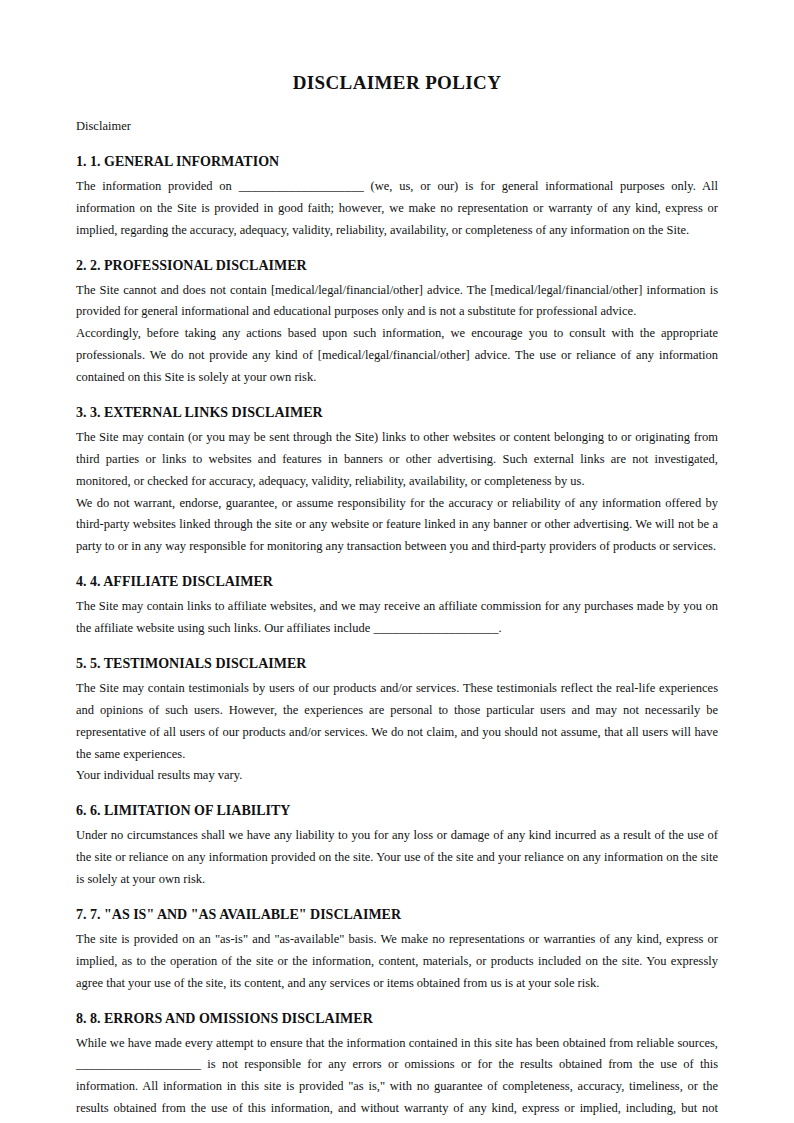
What a disclaimer policy is
A disclaimer limits what a reader can hold you responsible for.
It is the page that says your articles are general information rather than professional advice, that some links earn you a commission, that reviews reflect your own opinion, and that you do not control the advertising shown beside your content.
It does not make you immune. A disclaimer cannot excuse dishonesty, and it will not protect somebody who published something they knew to be wrong.
What it does is set expectations honestly, so a reader knows what they are getting and cannot fairly claim they were led to believe otherwise.
Who needs one
Publishers of any kind: blogs, review sites, newsletters, YouTube channels with a website behind them.
Anybody writing about health, law, money or any other field where a reader might act on what they read and come to harm.
Anybody earning through affiliate links, where disclosure is expected and in several markets required.
And any site carrying third party advertising, where the content beside yours is not yours and should not be treated as an endorsement.
Before you start
Look at what you publish and be honest about how it earns.
Do any of your links pay you a commission, including Amazon, Jumia or a course you promote.
Does your content touch fields where a reader might act on it: medical, legal, financial, or safety related.
Do you publish reviews, and were any of the products supplied to you free.
Do you run ads whose content you do not choose.
The disclaimer follows from those answers. Guessing at them produces a page that does not match your site.
The walkthrough
Filling in the form, step by step
Every question you will be asked, what it means, and an example of a good answer.
Step 1 of 4
Disclaimer Policy
Website or app
The first question sets where the disclaimer will be published and how it is worded.
For a website the disclaimer usually sits as its own page linked from the footer, and it refers to articles, pages and links. For an app it refers to content shown in the app and often appears within a settings or about screen, since app store reviewers expect policy links reachable inside the app itself.
The distinction is small here compared with the other policies, but it changes the language enough to be worth answering accurately.
- Disclaimer Policy for?
- Choose Website if this will be a page on a browser based site. Choose App if it will be shown inside a mobile application, where reviewers expect the link to be reachable in the app rather than only on a website.
Step 2 of 4
Disclaimer Policy
The property and the country
These answers say which publication the disclaimer covers and under which law it is read.
Scope is worth being precise about. If you publish across several sites or a separate newsletter, the disclaimer covers what it names. Assuming one page protects everything you publish is how a gap appears.
The country matters for the disclosure expectations that apply. Advertising and consumer protection rules on endorsements and paid promotion differ by market, and if you have a significant audience abroad it is prudent to meet the stricter standard rather than the minimum.
- What is your website URL?
- The site this disclaimer covers, for example www.yourblog.com. Name the property precisely. A disclaimer does not automatically extend to other sites, newsletters or channels you also run.
- Enter the Country
- Where you publish from, which sets the consumer protection and advertising standards you are read against. Enter Nigeria for a Nigerian publisher. Where much of your audience is elsewhere, meeting the stricter disclosure standard is the safer course.
Step 3 of 4
Disclaimer Policy
Who publishes the content
This step names the publisher standing behind what is said.
A disclaimer is a statement about your own content, so it needs an author. For a business, the registered entity. For an individual writer, your own name is a perfectly good answer and is often more credible on a personal blog than a company that does not really exist.
The address gives a reader somewhere to raise a complaint or a correction request, which is worth having: most disputes about published content are resolved quietly by correcting it.
- Pick One
- Choose I am a Business or Startup where a registered business name or company publishes the site. Choose I am an Individual for a personal blog or channel. Both are legitimate, and claiming a company you have not registered is not.
- Name of Business/ Startup
- The name the site publishes under, using the registered name where you have one, for example Lumen Digital Limited. On a personal site, your own name is appropriate and reads more honestly than an invented company.
- Address of Business
- A contactable address with street, city and state. It is where a reader sends a correction request or complaint, and having somewhere for that to land usually stops small problems becoming larger ones.
Step 4 of 4
Disclaimer Policy
What you publish and how it earns
These answers decide which disclaimers the page actually contains, and honesty here is the whole point of the document.
Affiliate links come first because disclosure is expected wherever you publish and required in several markets. Readers should be told before they click, not in a footnote afterwards. Burying it defeats the purpose and is exactly what regulators look for.
The professional information question is the one carrying real risk. Publishing on health, law or money invites readers to act, and the disclaimer makes clear the content is general information rather than advice for their situation. It is not a licence to be careless; it sets the reader's expectation correctly.
Reviews carry their own duty. If a product was supplied free, or you were paid, say so. An undisclosed paid review is a misleading commercial practice regardless of how positive you genuinely felt.
Advertising is the mildest of the four: it separates content you chose from content an ad network placed.
- Do you offer affiliate links
- Describe the affiliate arrangements you have, for example Amazon Associates or a Jumia affiliate account. If you earn commission on any link, say so here. Readers should learn this before clicking, and in several markets that disclosure is required rather than merely good manners.
- Do you share[medical/legal/financial/other] information?
- Answer Yes if your content touches health, law, money or any field where a reader might act and come to harm. The disclaimer then makes clear it is general information rather than advice for their circumstances, and encourages them to consult a professional.
- Do you post product or service reviews?
- Answer Yes if you publish reviews or recommendations. The disclaimer then frames them as your opinion. Where a product was supplied free or you were paid, disclose that on the review itself as well, since an undisclosed paid review is misleading whatever you thought of the product.
- Do you show ads?
- Answer Yes if third party advertising appears on the site, including through an ad network. The disclaimer then separates advertising from your own content and makes clear that an ad is not an endorsement.
- How can visitors/users contact you as regards your disclaimer policy
- Pick whichever routes reach an actual person. Readers use these to request corrections, and most complaints about published content settle quietly when somebody replies.
- Phone No.
- A line somebody answers, if you ticked phone. Add the country code when your readership extends beyond Nigeria, for example +234 801 234 5678.
- The address for content queries and corrections, if you ticked email. Something like editor@yourblog.com works well and can be handed to somebody else later.
- Link
- A contact page, if you ticked that option, for example www.yourblog.com/contact. Confirm it works, because a correction request that cannot reach you tends to become a public complaint instead.
Ready to make yours?
Answer those questions in the builder and download a finished disclaimer policy in Word and PDF.
Start now, ₦5,000After you download it
Link it from the footer
Put it beside your privacy policy and terms so it is reachable from every page rather than only from the article that needed it.
Disclose affiliate links in place
A line at the top of the article carries far more weight than a disclaimer page a reader never opens. Disclose before the click, not after it.
Say when a review was gifted or paid
Note it on the review itself. An undisclosed paid review is a misleading commercial practice however genuine your opinion of the product was.
Do not treat it as a shield
A disclaimer sets expectations. It will not protect you from publishing something you knew to be untrue, and it is no substitute for checking what you write.
Questions people ask
What is a disclaimer on a website?
A page limiting what readers can hold you responsible for, covering things like general information rather than professional advice, affiliate commissions, review opinions and third party advertising.
Do I need a disclaimer for affiliate links?
Yes. Wherever you publish, readers are expected to be told that a link earns you a commission, and in several markets that disclosure is a legal requirement rather than a courtesy.
Does a disclaimer protect me legally?
Partly. It sets expectations honestly, which helps. It will not excuse publishing something you knew to be false, and it is not a substitute for reasonable care.
What should a medical or legal disclaimer say?
That the content is general information, not advice for the reader's own circumstances, and that they should consult a qualified professional before acting on it.
Do I need one if I only publish reviews?
Yes. It frames reviews as your opinion, and you should also disclose on the review itself where a product was supplied free or the coverage was paid for.
Where should the disclaimer go?
Its own page linked from the footer, next to your privacy policy and terms. Affiliate and sponsorship disclosures should additionally appear on the article itself.
Documents that go with this
Terms used on this page
Limitation of Liability
A limitation of liability clause caps what a party can be made to pay and excludes defined categories of loss. Between businesses it is enforceable, and it is the clause that decides the real risk in a contract.
Consumer Protection
Consumer protection law gives buyers rights against sellers: honest information, safe goods, and redress when something is wrong. In Nigeria it is enforced by the FCCPC.
Intellectual Property
Intellectual property is the legal ownership of things you create rather than things you can touch, including trademarks, copyright, patents and designs. In Nigeria each type has its own registry and its own rules.
Negligence
Negligence is carelessness that the law will make you pay for. Somebody owed a duty of care, fell below the standard expected, and caused loss or injury as a result.
Misrepresentation
Misrepresentation is a false statement of fact that persuades somebody to enter a contract. Depending on how it was made, the wronged party may rescind the contract, claim damages, or both.
Read more on this
What Should I Write in My Terms and Conditions? Guide and Template
What Should I Write in My Terms and Conditions Most people see terms and conditions as a long legal document sitting at the bottom of a website. Many users click “agree” without reading it. Yet behind that simple checkbo…
What Is a Privacy Policy? Guide and Template
What Is a Privacy Policy? What It Does and the Legal Requirement for One In today’s digital economy, businesses collect more personal information than ever before. Every time a customer fills out a form, signs up for a n…
Where to Get Legal Documents Online in Nigeria
Where to Get Legal Documents Online in Nigeria Running a business or managing personal affairs often requires legal documentation. Whether you are starting a company, hiring a freelancer, creating a partnership agreement…
Step by step guides for every document on LegalDoc
Browse all guides