
How to Write a Farm Lease Agreement
Farmland is leased on longer terms because crops take seasons. Who holds title to the land is the question to answer before anything else.
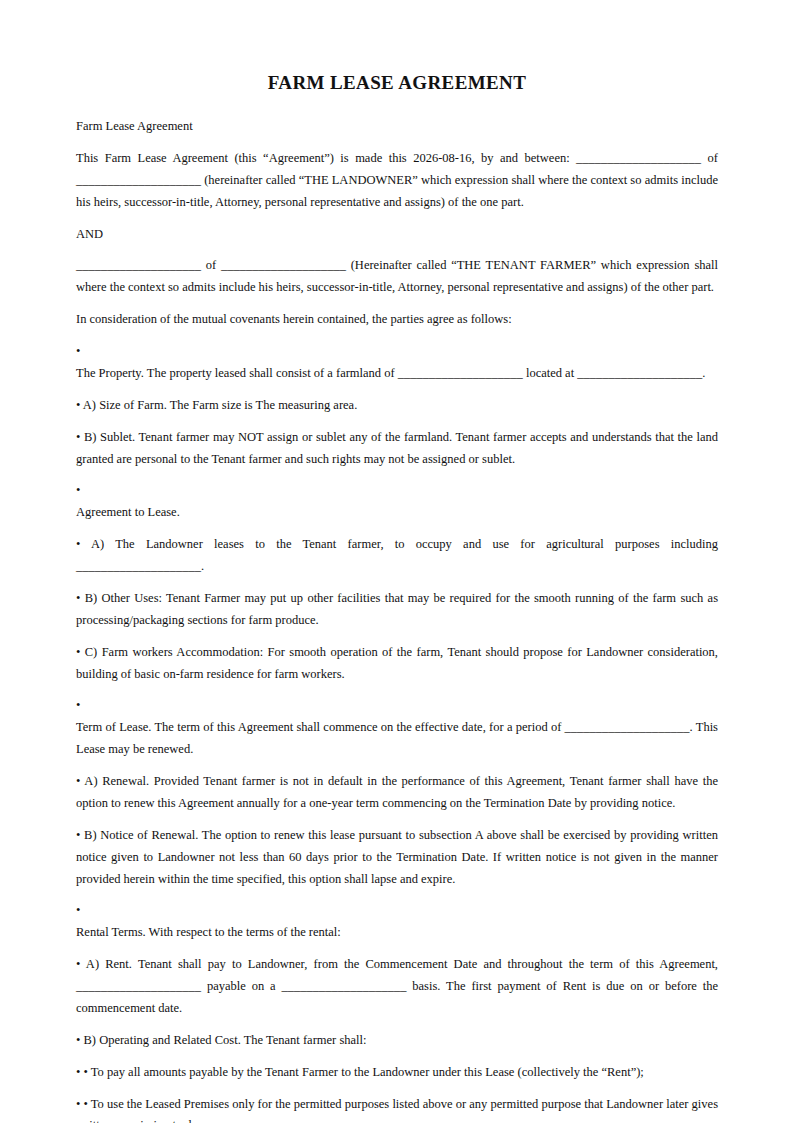
What a farm lease agreement is
A farm lease lets somebody use agricultural land they do not own, for a period, in exchange for rent.
It differs from other lettings in one important respect: the timescale. A farmer clearing land, improving soil, planting perennials or building irrigation is investing in something that pays back over seasons and years. A one year term does not justify that investment, which is why farm leases run longer than most.
The Nigerian complication is title. Under the Land Use Act all land in a state is vested in the Governor, held in trust, with occupiers holding rights of occupancy. Rural agricultural land frequently sits under customary arrangements, held by families or communities, where the person offering it may hold real authority without holding a certificate of occupancy.
That is not necessarily a problem, and it is something to understand before committing money and a planting season to a piece of land. Establishing who actually has authority to grant this lease is the first job, before any of the questions on this form.
Who needs one
Farmers taking land to cultivate rather than buying it.
Landowners with unused agricultural land wanting income from it.
Agribusinesses acquiring land for commercial production.
Families and communities formalising arrangements that have run informally for years.
Anybody planning to invest in clearing, irrigation or perennial crops, where the term needs to be long enough to recover the investment.
Before you start
Establish these before signing anything.
Who actually holds the right to grant this lease, and on what basis. Ask for the certificate of occupancy or, where the land is family held, understand who must consent.
Whether any consent is needed for the grant, since a lease of a right of occupancy may require the Governor's consent.
The boundaries, ideally with a survey plan rather than a description of trees and paths.
What you may grow, and what the land will actually support.
And access, water and whether anybody else claims rights over the land.
The walkthrough
Filling in the form, step by step
Every question you will be asked, what it means, and an example of a good answer.
Step 1 of 3
Farm Lease Agreement
The landowner and the farmer
The lease names the party granting the land and the party farming it.
The landowner question is the one to spend time on. Ask what they hold: a certificate of occupancy, a registered deed, or a customary entitlement recognised by the family or community. Each is a real basis for granting a lease and each carries different risks. A person granting land they do not control is the most common cause of loss in Nigerian rural land dealing, and a farmer who discovers this after a season of planting has lost the crop as well as the rent.
Where the land is family held, one member cannot usually grant a lease of family land alone. The consent of the head of the family and principal members is generally required, and a lease granted without it can be challenged by those who did not consent.
Name the tenant farmer as the entity that will actually farm, whether an individual or a business.
- Date on the agreement
- When the lease takes effect. Consider aligning it with a planting season rather than an arbitrary date, since a farm term that starts mid season wastes months of it.
- Landowner's name
- The person or entity granting the land. Establish what they actually hold: a certificate of occupancy, a registered deed, or a customary entitlement. Where the land is family held, one member cannot usually grant a lease alone, and the consent of the head of family and principal members is generally required.
- Landowner's address
- The landowner's address for rent and notices. For rural land held by a family, record who specifically is authorised to receive payment and correspondence.
- Tenant farmer's name
- The farmer taking the land, whether an individual or an agribusiness. Name the entity that will actually farm and be responsible for the rent.
- Tenant farmer's address
- The farmer's address, which is frequently not the farm itself, so give somewhere correspondence reliably reaches them.
Step 2 of 3
Farm Lease Agreement
The land, its size, use and the term
This step describes the land and what may be done with it.
Boundaries are the recurring source of farm land disputes in Nigeria, and a description referring to natural features is what makes them possible. Trees fall, paths move, streams shift. Where a survey plan exists, refer to it by number. Where it does not, consider commissioning one, since the cost is small against the risk of clearing and planting land that turns out to belong to a neighbour.
State the size from the survey rather than by estimate, and be clear about the unit: hectares and acres differ substantially and both are used in Nigeria.
The usage answer defines what the farmer may do. It matters more than it appears: a lease for seasonal crops is a different proposition from one permitting tree crops, since planting cocoa or oil palm is a decades long commitment on somebody else's land. Livestock brings different considerations again, including fencing and water.
On the term, match it to what is being grown. A short term for perennial crops leaves the farmer unable to recover their investment and the landowner receiving improved land they did not pay for. Also consider what happens to crops still in the ground when the term ends.
- Address of the farm property
- Where the land is, with as much locational detail as possible: the community, the local government area and the state, along with any landmarks that identify the approach.
- Description of the farm
- The boundaries, referring to a survey plan by number where one exists. Descriptions relying on trees, paths and streams are how farmland disputes start, since natural features move and fall. If no plan exists, commissioning one costs little against the risk.
- Farm size
- The area, taken from the survey rather than estimated, and state the unit clearly. Hectares and acres are both used in Nigeria and differ substantially, so an unqualified number invites confusion.
- Usage
- What the farmer may do with the land: seasonal crops, tree crops, livestock, or a combination. It matters commercially, since planting perennials such as oil palm or cocoa is a decades long commitment on land somebody else owns.
- This farm lease shall be for an original period of how many years?
- The term in years. Match it to what is being grown, since a short term for perennial crops leaves the farmer unable to recover their investment. Also agree what happens to crops still in the ground when the term ends.
Step 3 of 3
Farm Lease Agreement
Rent and governing law
The final step sets the rent and the applicable law.
Farm rent is commonly annual, which fits an income that arrives at harvest rather than monthly. Consider aligning the payment date with the harvest rather than the calendar, since rent due in the planting season, when a farmer has spent on inputs and earned nothing, is rent that gets paid late.
Where the arrangement is a share of the crop rather than a cash rent, which remains common in Nigerian agriculture, that should be recorded here: what share, measured how, and delivered when. A share cropping arrangement described loosely produces disagreement at exactly the moment the crop is being weighed.
Name the state where the land sits. Land is governed by the law of its state, and this is also where any dispute would be heard.
One further point worth adding beyond the form: a lease of a right of occupancy may require the Governor's consent under the Land Use Act, and a long agricultural lease should be checked against that requirement rather than assumed exempt.
- Rent
- The amount payable. Where the arrangement is a share of the crop rather than cash, which remains common in Nigerian farming, record it here: what share, measured how, and delivered when. A loosely described share arrangement produces disagreement exactly when the crop is being weighed.
- Rent is to be received (Yearly, Monthly, Weekly...)?
- How often rent is paid. Annual suits farming, and aligning the date with harvest rather than the calendar matters, since rent falling due mid planting season is rent that gets paid late.
- The agreement is to be governed by which State?
- The state where the land is located, which governs the lease and is where any dispute is heard. Note that a lease of a right of occupancy may require the Governor's consent under the Land Use Act, which is worth checking for a long term.
Ready to make yours?
Answer those questions in the builder and download a finished farm lease agreement in Word and PDF.
Start now, ₦10,000After you download it
Verify who can actually grant the lease
A certificate of occupancy, a registered deed, or family authority with the consent of the head of family and principal members. This is the step that prevents the whole loss.
Get a survey plan
Boundaries described by trees and paths are how farmland disputes begin. A plan costs little against clearing and planting land a neighbour claims.
Agree what happens to standing crops
A term ending mid season leaves crops in the ground. Say whether the farmer may harvest them and how long they have to do it.
Check whether consent is required
A lease of a right of occupancy may need the Governor's consent under the Land Use Act. Long agricultural leases should be checked rather than assumed exempt.
Questions people ask
Who can grant a farm lease in Nigeria?
Whoever holds the right to the land: a holder of a certificate of occupancy, a registered owner, or a family with customary entitlement. Where land is family held, one member generally cannot grant a lease alone.
How long should a farm lease run?
Long enough to recover the farmer's investment. Seasonal crops suit shorter terms; tree crops such as oil palm or cocoa are a decades long commitment and need a term to match.
Do I need a survey plan?
It is strongly advisable. Boundaries described by trees, paths and streams are how farmland disputes begin, since natural features move, and a plan costs little against the risk.
Can rent be a share of the crop?
Yes, and share cropping remains common in Nigerian farming. Record what share, how it is measured and when it is delivered, since a loose description produces disagreement at harvest.
Does a farm lease need the Governor's consent?
A lease of a right of occupancy may require it under the Land Use Act. It is worth checking for a long agricultural term rather than assuming the arrangement is exempt.
What happens to crops when the lease ends?
Whatever the agreement provides. A term ending mid season leaves crops in the ground, so say whether the farmer may harvest them and by when.
Documents that go with this
Terms used on this page
Lease
A lease is a grant of exclusive possession of property for a fixed term, in exchange for rent. It creates an interest in the land itself, which is what separates it from a mere permission to occupy.
Right of Occupancy
A right of occupancy is the interest Nigerians actually hold in land, granted under the Land Use Act. It is a right to occupy for a term, not outright ownership of the land itself.
Certificate of Occupancy
A Certificate of Occupancy, usually called a C of O, is the document a state governor issues confirming your right to occupy a piece of land for a fixed term, normally 99 years. It is the strongest ordinary title most Nigerians can hold.
Governor's Consent
Governor's consent is the state governor's approval of a transfer of land held under a statutory title. Under Section 22 of the Land Use Act, a transfer made without it risks being void.
Survey Plan
A survey plan is the drawing that fixes exactly where a piece of land is, produced by a licensed surveyor and lodged with the state. Without one, nobody can say with certainty which land your deed is talking about.
Omonile
Omonile is the Yoruba term for the indigenous landowning families whose consent is needed to buy family land in south western Nigeria. Dealing with the wrong ones is how buyers lose everything.
Rent
Rent is what a tenant pays for the right to occupy a property. In Nigeria it is normally paid in advance, and how far in advance a landlord may demand is limited by law in some states.
Title Search
A title search is the check you run at the lands registry before buying land, to find out who actually owns it and what is registered against it. It is the cheapest part of any Nigerian property purchase.
Read more on this
REAL ESTATE: Buyer’s Guide
Introduction: Real estate is one of the biggest investments most people make in their lifetime. Therefore, it is important to make an informed decision when buying a property. This guide will help you understand the key…
Title Perfection in Nigeria: From Search to Deed of Assignment to Registered Title
Title Perfection in Nigeria: From Search to Deed of Assignment to Registered Title and Consent There is a phrase that comes up often in Nigerian property circles: “the title is not perfected.” Sellers say it casually. Bu…
Farming as a Business: Turn Soil into Sustainable Profit
Farming is no longer just about surviving; it’s about thriving. With the right blend of strategy, innovation, and determination, farming as a business can be one of the most fulfilling
Step by step guides for every document on LegalDoc
Browse all guides