
How to Write a Franchise Agreement
A franchise licenses a whole business system, not just a brand. The franchisor controls how it is run, and the fees are how they earn from it.
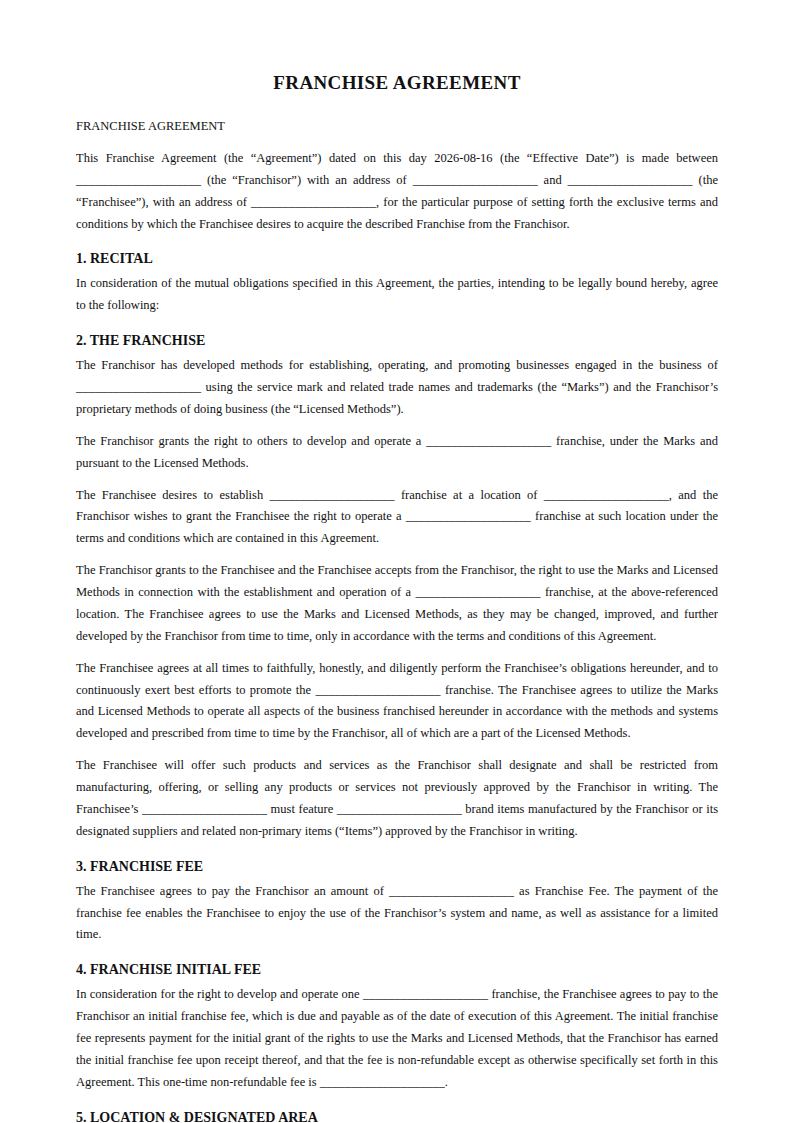
What a franchise agreement is
A franchise agreement lets somebody operate a business under an established brand and system, in exchange for fees and adherence to the franchisor's rules.
It is a much more controlled relationship than a licence. The franchisee does not merely use the brand; they run the business the franchisor's way, using their methods, their suppliers, their standards and their look. That consistency is what the customer is buying and what the franchisee is paying for.
The money usually comes in three layers: an upfront franchise fee for the right to join, fees for setup and design, and an ongoing royalty on turnover. The upfront fee buys entry, and the royalty is where the franchisor earns over time.
Nigeria has no dedicated franchise statute the way some countries do, so the relationship is governed by the contract, by intellectual property law protecting the brand, and by competition law where terms restrain trade. That makes the agreement itself carry more weight than it would in a regulated market.
Who needs one
Businesses expanding by franchising an established and repeatable model.
Entrepreneurs buying into a franchise who need to understand what they are committing to before paying an entry fee.
Owners of restaurant, retail, education, fitness and service businesses, which are the categories that franchise most readily in Nigeria.
Anybody who has been letting somebody operate under their brand informally and needs it structured properly.
If all you want is for somebody to use your brand on their own products, a licensing agreement is narrower and simpler.
Before you start
Franchisors should have these before offering anything.
A registered trademark, since the brand is what you are actually selling.
A documented operating system: manuals, standards, supplier arrangements.
A training programme you can actually deliver.
A proven unit that makes money, because franchising an unprofitable model just multiplies the problem.
Franchisees should get audited figures from existing units, speak to current franchisees without the franchisor present, and take advice before paying anything.
The walkthrough
Filling in the form, step by step
Every question you will be asked, what it means, and an example of a good answer.
Step 1 of 3
Franchise Agreement
The franchisor and the franchisee
The agreement names both sides of the relationship.
The franchisor is the brand owner granting the rights. A franchisee should verify that this entity actually owns the trademark, by checking the registration rather than accepting an assurance. A franchise built on a brand the franchisor does not own is a serious problem, and it surfaces when somebody else asserts the mark.
The franchisee is the operator. Where they will trade through a company, name the company, and expect the franchisor to want personal guarantees from the individuals behind it. That is normal in franchising and it is worth understanding before signing: the limited company operates the outlet, and the guarantee means the individual carries the obligations personally if it fails.
Addresses matter for notices, which in a franchise include the breach notices that precede termination.
- Agreement Date
- When the franchise agreement takes effect. Where a franchisee has already been trading under the brand informally, use the honest date and address the earlier period expressly.
- Franchisor's Name
- The brand owner granting the franchise, using the registered company name. A franchisee should verify this entity actually owns the trademark by checking the registration rather than taking an assurance.
- Franchisor's Address
- The franchisor's business address for notices, reports and royalty payments.
- Franchisee's Name
- The operator taking the franchise. Where they trade through a company, name the company, and expect the franchisor to seek personal guarantees from the individuals behind it, which is normal in franchising.
- Franchisee's Address
- The franchisee's address for notices, which in a franchise include the breach notices that precede termination.
Step 2 of 3
Franchise Agreement
The business, the location and the entry costs
This step describes what is being franchised and what it costs to start.
The location question deserves more attention than it usually receives, because it raises the issue the form does not ask about directly: territory. Does this franchisee have exclusive rights to an area, or can the franchisor open another outlet down the road? Franchisees frequently assume protection they were never granted, and it is the single most common cause of resentment in franchise relationships. Whatever is agreed, record it here.
The franchise fee is the entry price. The design fee covers fitting out the premises to the brand standard, and franchisees should establish whether it is a fee paid to the franchisor or an estimate of what they will spend with approved contractors, since those are very different commitments.
The training and assistance periods are what the franchisee is buying beyond the brand. A specified number of days is a real obligation. Ongoing support with no stated commitment is a promise that tends to fade after the first year, so a franchisee should ask what happens after the initial period.
- Type of Business
- What the franchised business does, for example a quick service restaurant or a tutoring centre. It defines the scope of the rights granted and what the franchisee may operate under the brand.
- Name of the Franchise
- The brand name the franchisee will trade under. It should match the registered trademark exactly, since that registration is what the franchisor is actually licensing.
- Location of the Franchise
- Where the outlet operates. Use this to record the territory position as well: whether the franchisee has exclusive rights to an area or the franchisor may open nearby. Assumed but ungranted territorial protection is the most common source of franchise resentment.
- Franchise Fee
- The upfront fee for the right to operate the franchise. Franchisees should establish exactly what it buys and whether any part is refundable if the outlet never opens.
- Design Fee
- What is paid for fitting out the premises to brand standard. Establish whether this is a fee to the franchisor or an estimate of spend with approved contractors, since those are very different commitments.
- Number of days for Training
- How many days of initial training the franchisor provides. A specified number is a real obligation, and this is a significant part of what the entry fee buys.
- Number of days in which the Franchisor will render assist to the Franchisee
- The period of launch assistance. Ask what support continues after it ends, since ongoing help with no stated commitment tends to fade once the outlet is running.
Step 3 of 3
Franchise Agreement
Royalties, duration, notice and abandonment
The final step covers the ongoing relationship and how it ends.
The royalty is the franchisor's continuing income and the franchisee's largest recurring cost after rent and staff. State the percentage and, importantly, what it is calculated on. A percentage of gross turnover is very different from a percentage of profit: the first is payable whether the outlet makes money or not, and it is the more common arrangement. A franchisee should model it against realistic revenue before committing.
Duration matters because it interacts with the franchisee's investment. Somebody spending heavily on a fit out needs a term long enough to recover it, and a five year term with a two year payback leaves them exposed at renewal. Ask what renewal costs and on what terms.
The notice period governs how the relationship ends by choice. The abandonment clause governs what happens if the franchisee simply stops operating, which in practice means the franchisor can terminate and recover the location and the brand. Franchisees should understand that closing for a period, even for good reason, can trigger it.
What the form does not ask, and what both sides should add: post termination obligations. Whether the franchisee must stop using the brand immediately, remove the signage, return the manuals, and whether they are restrained from operating a competing business afterwards.
- Royalties
- The ongoing percentage the franchisee pays. State what it is calculated on: a percentage of gross turnover is payable whether or not the outlet is profitable, which is the common arrangement and very different from a share of profit. Franchisees should model it against realistic revenue before signing.
- What day of every month shall the royalty be paid?
- The payment date each month. Align it with the franchisee's own cash cycle where possible, since royalties due before the month's takings have cleared cause avoidable defaults.
- Duration of this agreement
- How long the franchise runs. It should be long enough for the franchisee to recover their fit out investment, and both sides should know what renewal costs and on what terms.
- Period of Notice before Termination
- The notice required to end the agreement. Consider whether it runs both ways, since notice available only to the franchisor leaves the franchisee locked in.
- Abandonment
- What counts as abandoning the franchise and what follows. Typically a period of closure entitles the franchisor to terminate. Franchisees should understand that closing temporarily, even for a good reason, can trigger it.
- Laws of which State
- The Nigerian state whose law governs. Nigeria has no dedicated franchise statute, so the contract carries more weight here than in regulated markets, and the governing state is where disputes about it would be heard.
Ready to make yours?
Answer those questions in the builder and download a finished franchise agreement in Word and PDF.
Start now, ₦10,000After you download it
Register the trademark first
The brand is what a franchise actually sells. Franchising a mark you have not registered leaves both parties exposed, since Nigerian registration is first to file.
Franchisees should verify the numbers
Ask for audited figures from existing outlets and speak to current franchisees without the franchisor present. Projections are not performance.
Settle the territory in writing
Whether the franchisor may open nearby is the question franchisees most often assume in their favour and most often lose.
Add post termination obligations
The form does not ask. Stopping brand use, removing signage, returning manuals and any non compete after the franchise ends all need stating.
Questions people ask
What is the difference between a franchise and a licence?
A licence permits use of a specific asset such as a trademark. A franchise licenses a whole business system, including methods, training, suppliers and standards, with the franchisor controlling how it is run.
How are franchise royalties calculated?
Usually as a percentage of gross turnover, which means they are payable whether or not the outlet is profitable. That is very different from a share of profit and should be modelled before signing.
Is franchising regulated in Nigeria?
There is no dedicated franchise statute. The relationship is governed by the contract, by intellectual property law protecting the brand, and by competition law where terms restrain trade, which makes the agreement itself carry more weight.
Do I get an exclusive territory?
Only where the agreement grants one expressly. Franchisees frequently assume territorial protection nobody gave them, and it is the most common source of resentment in these relationships.
What is an abandonment clause?
A provision letting the franchisor terminate if the franchisee stops operating for a stated period. It can be triggered by a temporary closure even for a good reason, so understand the threshold.
What happens when the franchise ends?
Whatever the agreement provides, which is why post termination obligations should be stated: stopping brand use, removing signage, returning manuals, and any restriction on competing afterwards.
Documents that go with this
Terms used on this page
Franchise
A franchise is a licence to run a business using somebody else's brand, systems and know how, in exchange for fees. The franchisor keeps the brand, the franchisee runs the outlet.
Licensing
Licensing is permission to use something you own without giving it away. The owner keeps the asset, the licensee gets defined rights for a defined period, and money usually flows as a royalty or a fee.
Trademark
A trademark is a sign that identifies your goods or services and distinguishes them from everybody else's, such as a name or a logo. Registering it in Nigeria is what makes it enforceable.
Royalty
A royalty is a payment for using something somebody else owns, usually calculated as a share of the revenue it generates. Musicians, authors, franchisors and patent holders all earn this way.
Exclusivity
Exclusivity gives one party sole rights: to distribute in a territory, to supply a customer, or to negotiate a deal without the other side talking to anybody else. It is valuable, and it should be earned.
Restraint of Trade
A restraint of trade clause limits what somebody may do after a relationship ends, usually by stopping a former employee competing or poaching. It is void unless it is reasonable, and reasonable means narrow.
Goodwill
Goodwill is the value of a business beyond its physical assets: the reputation, the customer relationships and the name that make people keep coming back. It is real, it is saleable, and it is fragile.
Termination
Termination is the ending of a contract on its terms. In employment it means the relationship ends, normally with notice or payment in lieu, and it does not imply that anybody did anything wrong.
Read more on this
The Business of Franchising: A Practical Guide
The Business of Franchising: A Practical Guide What franchising is and how the model works Franchising is a commercial arrangement where a brand owner (the franchisor) licenses its trademark, operating model, supply chai…
Trademark Your Business Name in Nigeria Before Someone Else Does
What to Do When Someone Else Trademarks Your Brand
What to Do When Someone Else Trademarks Your Brand Few things are more frustrating for a business owner than discovering that someone else has registered a trademark that looks suspiciously similar to the brand you have…
Step by step guides for every document on LegalDoc
Browse all guides