
How to Write a Lease Agreement
This lease covers the detail a short tenancy agreement leaves out: late fees, bounced cheques, subletting and pets. Each answer settles an argument in advance.
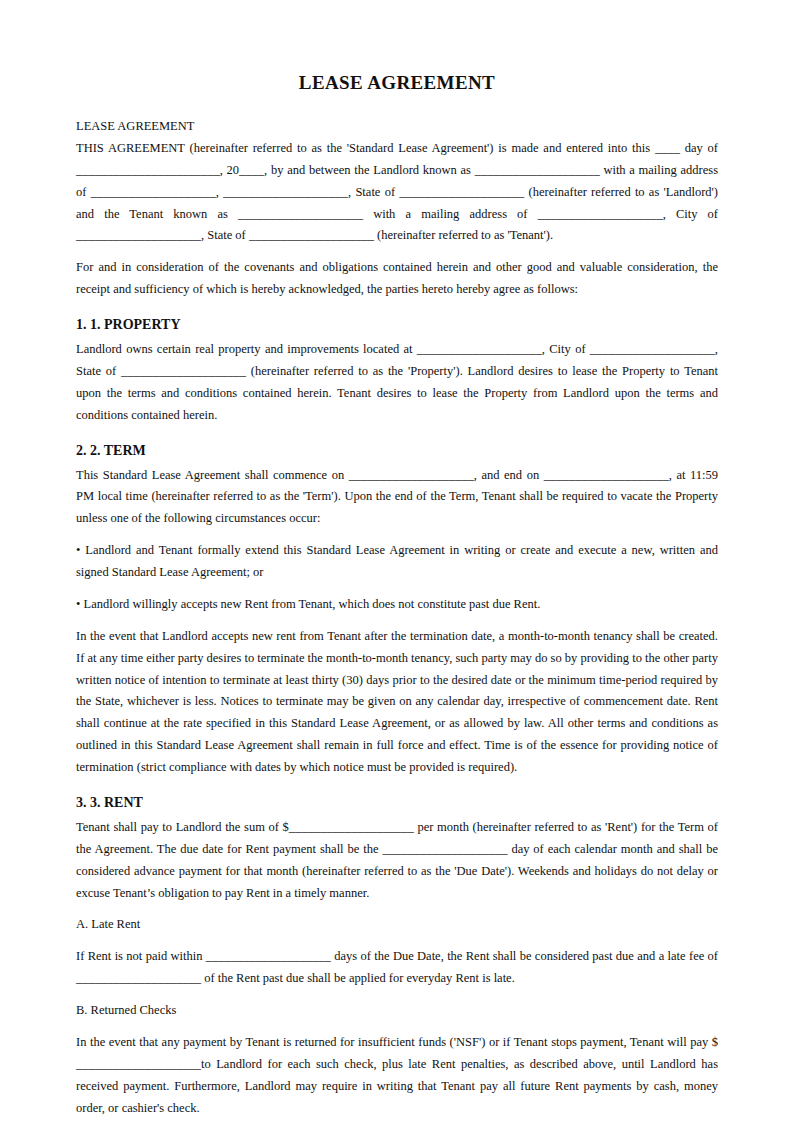
What a lease agreement is
A lease agreement is the full length version of a letting document.
Where a short tenancy agreement records the essentials and leaves the rest to law and goodwill, this one works through the details: exactly when rent is due, what happens when it is late, what a bounced cheque costs, whether the tenant may sublet, and whether pets are allowed.
None of those questions is exotic. They are simply the ones that come up during a tenancy, and the difference between a lease that answers them and one that does not is the difference between checking a document and having an argument.
Who needs one
Landlords who want the day to day rules written down rather than negotiated each time.
Tenants taking a property for a defined term who would rather know the position on late payment and subletting before signing than after.
Anybody who has had a tenancy go wrong over something small and does not intend to repeat the experience.
For a straightforward one year residential letting, the shorter tenancy agreement may be enough. For anything longer or more detailed, this is the better fit.
Before you start
Have the numbers and the rules decided before you begin.
The rent, the day of the month it falls due, and the grace period before it counts as late.
What you will charge for late payment and for a returned cheque.
The deposit and what it covers.
Whether subletting is permitted, and on what conditions.
And whether pets are allowed, which sounds trivial until a tenant arrives with two dogs and no agreement to point at.
The walkthrough
Filling in the form, step by step
Every question you will be asked, what it means, and an example of a good answer.
Step 1 of 4
Lease Agreement
The landlord
The lease opens by identifying the landlord and where they can be reached.
This is where formal notices go: rent demands, breach notices, and anything the tenant needs to serve. Use an address where post is actually collected rather than the property being let, since the landlord is not living there.
Joint ownership needs every owner on the document. A lease granted by one of several co owners is open to challenge from the others, and a tenant who discovers that mid term is in a difficult position through no fault of their own.
For a company landlord, use the registered name from the certificate of incorporation.
- Landlord's name
- The full legal name of the owner letting the property. For a company, the registered name. Every co owner must be named where the property is held jointly, since one of them alone cannot grant a lease that binds the others.
- Landlord's address
- The landlord's address for service of notices, which is not the property being let. Rent demands and formal correspondence arrive here, so it needs to be somewhere post is genuinely received.
- City
- The city or town of the landlord's address. Together with the state below it completes the address for service.
- State
- The state of the landlord's address. This is the landlord's own location and is not necessarily the same state as the property, which is asked separately later.
Step 2 of 4
Lease Agreement
The tenant
The second step names the other side of the agreement.
Name every adult who will be a tenant, not only the one paying the rent. A person not named on the lease is not bound by it: they cannot be pursued for arrears, and they are not entitled to the protections either. Landlords who name one of a couple regularly regret it.
The address here is where the tenant lives now, before moving in. It identifies them and gives the landlord a fallback if the tenancy ends badly and the tenant disappears.
Where the tenant is a business taking premises for staff, name the company rather than the individual occupier.
- Tenant's name
- The full name of every person taking the tenancy. Naming only the bill payer leaves the others outside the agreement, which means they owe nothing and are entitled to nothing under it.
- Tenant's address
- Where the tenant currently lives, before taking occupation. It identifies them and gives the landlord an address on record beyond the property itself.
- City
- The city or town of the tenant's current address.
- State
- The state of the tenant's current address. This is where they live now, which is often different from where the rented property sits.
Step 3 of 4
Lease Agreement
The property, the term and the rent
This step covers what is being let and the money, and the timing questions are the ones worth pausing on.
Describe the property precisely, including the unit number. Anything included in the letting, such as parking, a boys quarters or fitted appliances, should be stated, since what is not written down is what gets argued about.
On the money, three separate questions do different jobs. The rent is the amount. The due day fixes when each payment falls. The grace period is how long after that before payment counts as late. Landlords frequently set a due date and no grace period, then find themselves arguing about whether a payment made the following morning was late.
The late fee should be a genuine estimate of what late payment costs the landlord. A figure set to punish is vulnerable to challenge at the moment it is needed.
- Address of the Property
- The full address of the property being let, including flat or house number. Describe what is included, such as parking, a boys quarters or appliances, because anything unstated is arguable later.
- City
- The city or town where the property is located.
- State
- The state the property itself is in. Tenancy law is state law, so this answer governs the letting, and it is frequently not the same state as either party's own address above.
- Commencement date for the lease
- The date the tenant may take occupation. The term runs from here, so use the date possession is actually given rather than the date the money was paid.
- End date for the lease
- When the term expires. Note that a letting of three years or more is generally registrable as a land instrument in the state where the property sits, which brings additional cost.
- How much is the rent?
- The rent amount. State the figure clearly and be sure both parties understand the period it covers, since the difference between a monthly and an annual figure is the whole agreement.
- Day of the month rent is due?
- The day each payment falls due, for example the first or the fifth. Fixing a day removes the ambiguity of around the beginning of the month.
- Rent must be paid within how many days of due date
- The grace period before payment counts as late. Without one, a payment arriving the next morning is technically in default, which is rarely what either party intends.
- Late fee
- What is charged when rent arrives after the grace period. Keep it a genuine estimate of the cost of late payment rather than a punishment, since a penal figure is open to challenge exactly when you want to rely on it.
Step 4 of 4
Lease Agreement
Deposit, subletting and pets
The final step covers the rules that decide how the tenancy runs day to day.
The returned cheque penalty is a Nigerian practicality. Where rent is paid by cheque, a bounced one costs the landlord bank charges and time, and a stated figure avoids arguing about it.
The deposit needs its purpose written down: what it covers, what may be deducted, and when the balance comes back. Deposits generate more end of tenancy disputes than anything else, and one sentence at the start prevents most of them.
Subletting and pets each offer two branches, and you fill in the one matching your choice. If subletting is not allowed, use that box to say so plainly and note the consequence. If it is allowed, set the conditions, most importantly that the landlord's written consent is obtained first.
The same applies to pets. Allowing them with conditions, such as a limit on number or size and responsibility for damage, is usually more realistic than a flat ban that a tenant quietly ignores.
- Penalty for return cheque
- What the tenant pays if a cheque bounces. It should reflect the bank charges and administrative cost the landlord actually incurs rather than serving as a penalty.
- Security deposit
- The refundable sum held against damage, unpaid rent and outstanding bills. State what it covers and when it is returned. This single clause prevents most end of tenancy disputes.
- Sublet
- Choose whether subletting is permitted. Most residential landlords do not permit it without written consent, which lets them approve the person rather than the principle.
- Sub-letting allowed
- If you allowed subletting, set the conditions here: that the landlord's written consent is obtained first, that the tenant stays liable for rent and damage, and that the sublease cannot outlast this lease.
- Sub-letting not allowed
- If you prohibited subletting, say so plainly here and state the consequence of breaching it. A clear prohibition is easier to enforce than a vague discouragement.
- Pets
- Choose whether pets are permitted. A flat ban is simple but frequently ignored, so consider whether permission with conditions would suit the property better.
- Pets are not allowed
- If you prohibited pets, state it here, and say whether it extends to visiting animals as well as resident ones. Ambiguity here produces exactly the argument the clause exists to prevent.
- Pets are allowed
- If you permitted pets, set the conditions: how many, what kind or size, and that the tenant is responsible for any damage or nuisance they cause. Conditions are more enforceable than an unqualified yes.
Ready to make yours?
Answer those questions in the builder and download a finished lease agreement in Word and PDF.
Start now, ₦10,000After you download it
Sign, witness and keep originals
Each party signs, each signature is witnessed, and each side keeps a signed original. A lease signed by only one party proves very little.
Photograph the property on handover
Take pictures of every room on the day the tenant takes possession and attach a schedule of condition. This is what settles the deposit at the end.
Stamp it
Stamp duty is assessed on the rent, and stamping is what makes the lease readily admissible in evidence when you need to rely on it.
Register a long term
A letting of three years or more is generally registrable as a land instrument in the state where the property sits. Check before the term begins rather than after.
Questions people ask
What is the difference between a lease and a tenancy agreement?
In practice, length and detail. This lease works through late fees, bounced cheques, subletting and pets, while a short tenancy agreement records the essentials and leaves the rest to law.
How long should the grace period for rent be?
Long enough that a payment arriving a day late is not a default, short enough to mean something. Whatever you choose, state it, because without one late is undefined.
Can a landlord charge whatever late fee they like?
It should be a genuine estimate of what late payment costs. A figure set to punish rather than compensate is open to challenge at exactly the point you want to enforce it.
Should I allow subletting?
Most residential landlords permit it only with written consent, which lets you approve the particular person rather than the principle. A flat ban is simpler but less flexible.
Can a landlord ban pets in Nigeria?
Yes, a lease can prohibit them. Whether a flat ban works in practice is another matter, and permission with conditions on number, size and responsibility for damage is often more realistic.
When does the deposit have to be returned?
Whenever the lease says, which is why it should say. State what may be deducted and the timeframe for returning the balance, and photograph the property at handover.
Documents that go with this
Terms used on this page
Lease
A lease is a grant of exclusive possession of property for a fixed term, in exchange for rent. It creates an interest in the land itself, which is what separates it from a mere permission to occupy.
Rent
Rent is what a tenant pays for the right to occupy a property. In Nigeria it is normally paid in advance, and how far in advance a landlord may demand is limited by law in some states.
Deposit
A deposit is money paid to secure a transaction. Whether you get it back if the deal falls through depends on whether it was a true deposit or a part payment, and most people never ask.
Landlord
A landlord is the person who grants somebody else the right to occupy their property in exchange for rent. The role carries rights to rent and possession, and duties that Nigerian law enforces.
Tenant
A tenant is a person who occupies property belonging to somebody else in exchange for rent. Nigerian law gives tenants real protections, including proper notice and the right to a refund of the caution fee.
Subletting
Subletting is a tenant renting out all or part of the property to somebody else while remaining the landlord's tenant. Most Nigerian tenancy agreements require the landlord's consent first.
Dilapidation
Dilapidation is disrepair a tenant is responsible for under the lease. At the end of a commercial term a landlord can claim the cost of putting it right, and the bill surprises tenants.
Stamp Duty
Stamp duty is a tax on certain documents and transactions. In Nigeria it applies to instruments such as deeds, leases and share capital, and an unstamped document can be inadmissible in court.
Read more on this
8 Essential Clauses Every Tenancy Agreement Should Contain
8 Essential Clauses Every Tenancy Agreement Should Contain Renting property in Nigeria is often straightforward at the beginning. A landlord has a space to let, a tenant needs accommodation, and both parties are eager to…
Tenancy Agreement vs Commercial Lease Agreement
Tenancy Agreement vs Commercial Lease Agreement Choosing the right agreement for occupying property in Nigeria is more than just a paperwork exercise. Whether you are renting a flat, opening a shop, or taking a warehouse…
Landlord Rights in Nigeria
Landlord Rights in Nigeria: What Every Property Owner Needs to Know Being a landlord in Nigeria is one of those ventures that looks straightforward from the outside and reveals its complexities only after you’re already…
Step by step guides for every document on LegalDoc
Browse all guides