
How to Write a Music Recording Contract
A label funds and releases an artiste's recordings in exchange for a share of what they earn. The royalty split is the deal, and the master ownership question is the one the form does not ask.
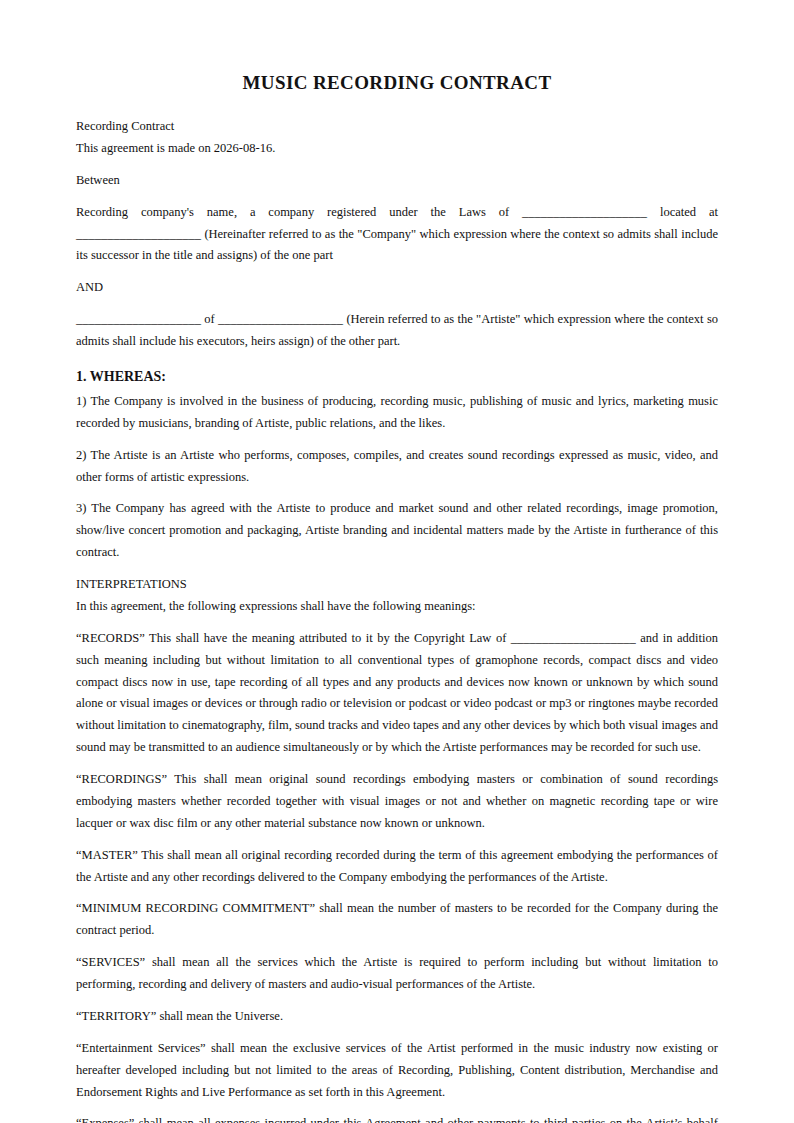
What a music recording contract is
A recording contract is the agreement between an artiste and a label under which the label funds, records and releases the artiste's music and shares in what it earns.
The label brings money and infrastructure: studio time, production, distribution, marketing and the relationships that get a record played. The artiste brings the music and, in most arrangements, a commitment to deliver a stated number of releases over a period.
The economics are worth understanding before signing anything. Royalty percentages sound generous and are usually calculated after the label has recouped its costs, which means an artiste can have a successful record and receive very little until recording, video and marketing spend has been recovered.
And the question this form does not ask is the most important one in the industry: who owns the master recordings. That single point has ended more artiste and label relationships than every other term combined, and it must be addressed even though the form does not prompt for it.
Who needs one
Independent labels signing artistes.
Artistes being offered a deal who want to understand what they are agreeing to before signing.
Producers and management companies structuring artiste arrangements.
Anybody in a recording relationship that has run on trust and now involves real money.
Where an artiste simply wants distribution without giving up rights, a distribution agreement or a licensing arrangement is a very different and often better deal than a full recording contract.
Before you start
Settle these, and an artiste should take independent advice before signing any of them.
Who owns the master recordings, and whether ownership ever reverts to the artiste.
Whether royalties are calculated before or after the label recoups its costs.
What counts as a recoupable cost.
How many releases the artiste must deliver and over what period.
Whether the label takes a share of income beyond recordings, such as performances, endorsements and publishing.
And how the artiste can leave.
The walkthrough
Filling in the form, step by step
Every question you will be asked, what it means, and an example of a good answer.
Step 1 of 3
Music Recording Contract
The label
The contract opens by naming the recording company.
Use the registered company name. An artiste signing with a label should check that entity exists and has some substance behind it, because a recording contract commits them for years, and a label that disappears while holding rights to their recordings leaves the artiste unable to release their own work.
The country matters for a practical reason beyond the governing law. Music rights are territorial and collection societies operate nationally, so where the label is based affects how royalties are collected and accounted for. In Nigeria collective management of musical works involves a licensed collecting society, and an artiste should understand how their income flows through it.
The date is when the term starts running, which matters because these agreements are measured in years and releases.
- Agreement date
- When the contract takes effect. The term below runs from here, and where the artiste has already been recording with the label informally, that earlier work should be addressed expressly rather than absorbed silently.
- Name of the Company
- The registered name of the label. An artiste should verify the entity actually exists and has substance, since a label that folds while holding rights to their recordings leaves them unable to release their own work.
- Address of the Company
- The label's business address, for notices and royalty statements.
- Country
- Where the label operates. It affects how royalties are collected, since music rights are territorial and collecting societies work nationally. In Nigeria that means a licensed collective management organisation, and an artiste should understand how their income flows through it.
Step 2 of 3
Music Recording Contract
The artiste, the term and the releases
This step commits the artiste, and both numbers deserve scrutiny.
The duration and the release commitment work together, and the combination is what an artiste is actually agreeing to. A five year term requiring three albums is a very different commitment from a two year term requiring one, and artistes routinely focus on the money while accepting a term that constrains them for years.
Be aware of how the two interact in practice. A contract requiring a stated number of releases within a period does not end simply because the period expires: many are drafted so the term continues until the releases are delivered. An artiste who does not record is not free, they are in default.
Think about what an LP and an EP mean here, and define them. How many tracks constitutes each, and what standard the label must accept. Without a definition, an artiste can deliver work the label rejects, and the obligation continues.
This is the point at which independent legal advice earns its cost. The numbers look simple and they carry years of commitment.
- Artiste's name
- The artiste's full legal name, not their stage name. Record the performing name separately, since the agreement binds the person and the audience knows the other one.
- Artiste's address
- The artiste's address for notices, statements and payments.
- Duration of Contract
- How long the contract runs, in years. Consider carefully how it interacts with the release commitment below, since many contracts continue beyond the stated term until the required releases are delivered.
- Number of LP
- How many full length albums the artiste must deliver. Define what constitutes an album, in track numbers, and what standard the label must accept, otherwise the artiste can deliver work that is rejected while the obligation continues.
- Number of EP
- How many extended plays are required. The same applies: define what counts as an EP and the standard for acceptance, since a delivery obligation with no definition is one the artiste cannot be sure of discharging.
Step 3 of 3
Music Recording Contract
Royalties, endorsements and leaving
The final step is the money, and it is where an artiste most needs to look past the headline number.
The royalty split is the percentage each side takes. The percentage matters much less than what it is calculated on and when it starts being paid. Most recording contracts are recoupable: the label recovers its recording, video and marketing costs from the artiste's share before the artiste sees anything. A generous sounding split on a recouped basis can produce nothing for years, and artistes are regularly surprised by this. The agreement should state plainly what costs are recoupable and how they are accounted for, and the artiste should have a right to see the statements and to audit them.
The endorsement split is a separate and increasingly significant question. A label taking a share of endorsement income is claiming part of money the artiste earns from their personal fame, sometimes from work the label had nothing to do with. That is a negotiable point and an artiste should understand what they are giving away. Arrangements extending to touring, merchandise and publishing as well are broader still.
The termination fee is what it costs the artiste to leave. A high fee can lock somebody into a relationship that is not working, and it is worth understanding the number before rather than after.
And again, because it is not on this form: agree who owns the masters.
- Royalty Percentage for Artiste
- The artiste's share of recording income. The percentage matters far less than what it is calculated on and when it starts: most contracts are recoupable, meaning the label recovers recording, video and marketing costs from the artiste's share first. State what is recoupable and give the artiste a right to see and audit the statements.
- Royalty Percentage for the Company
- The label's share. Together with the artiste's share it should account for the whole, and any deductions taken before the split, such as distribution fees, should be stated rather than assumed.
- Endorsement Percentage for the Artiste
- The artiste's share of endorsement income. This is money earned from personal fame, sometimes from work the label had no part in, so an artiste should think hard before conceding much of it.
- Endorsement Percentage for the Company
- The label's share of endorsements. A label claiming a share here is reaching beyond recordings into the artiste's wider career, which is negotiable and should be a deliberate concession rather than an unnoticed one.
- Termination fee to be paid by Artiste
- What it costs the artiste to end the contract early. A high figure can lock somebody into a relationship that has stopped working, so understand the number now rather than when you want to leave.
Ready to make yours?
Answer those questions in the builder and download a finished music recording contract in Word and PDF.
Start now, ₦10,000After you download it
Settle master ownership in writing
The form does not ask and it is the most important term in the industry. Who owns the recordings, and whether ownership reverts to the artiste after a period.
Artistes should take independent advice
Not the label's lawyer. A recording contract commits years of work and income, and the terms that matter most are the ones that look technical.
Register with a collecting society
Collective management is how performance and broadcast income reaches artistes in Nigeria. Recording income is only part of what music earns.
Insist on statements and audit rights
Royalties you cannot verify are royalties you cannot enforce. Regular accounting and a right to inspect the records are basic protections.
Questions people ask
Who owns the master recordings?
Whoever the contract says, and this form does not ask, which is why it must be dealt with expressly. It is the single most disputed term in the music industry and should never be left implied.
What does recoupable mean?
That the label recovers its recording, video and marketing costs from the artiste's royalty share before the artiste receives anything. A successful record can therefore pay an artiste nothing for years.
Is a high royalty percentage a good deal?
Not on its own. What it is calculated on, what is deducted first, and what costs are recoupable matter far more than the headline number.
Should a label share in endorsement income?
It is negotiable, and an artiste should think hard before conceding it. Endorsements are earned from personal fame, sometimes from work the label had nothing to do with.
What happens if I do not deliver the required albums?
Many contracts continue beyond the stated term until the releases are delivered, so an artiste who stops recording is in default rather than free. Define what counts as delivery and the standard for acceptance.
Can I leave a recording contract early?
Usually only by paying the termination fee the contract specifies. Understand that figure before signing, since a high one can lock you into a relationship that has stopped working.
Documents that go with this
Terms used on this page
Copyright
Copyright is the automatic right you get over original work you create, such as writing, music, film, photographs and software. It protects the expression, not the underlying idea.
Royalty
A royalty is a payment for using something somebody else owns, usually calculated as a share of the revenue it generates. Musicians, authors, franchisors and patent holders all earn this way.
Intellectual Property
Intellectual property is the legal ownership of things you create rather than things you can touch, including trademarks, copyright, patents and designs. In Nigeria each type has its own registry and its own rules.
Licensing
Licensing is permission to use something you own without giving it away. The owner keeps the asset, the licensee gets defined rights for a defined period, and money usually flows as a royalty or a fee.
Work for Hire
Work for hire is the question of who owns something created by somebody you paid. For employees the answer usually favours the employer. For freelancers it usually does not.
Moral Rights
Moral rights are an author's personal rights in their work: to be credited as its creator, and to object to it being treated in a way that damages their reputation. They stay with the author even after the copyright is sold.
Infringement
Infringement is using somebody's intellectual property without permission. What you have to prove, and what you can recover, depends on which right was infringed.
Termination
Termination is the ending of a contract on its terms. In employment it means the relationship ends, normally with notice or payment in lieu, and it does not imply that anybody did anything wrong.
Read more on this
How to Trademark a Catchphrase or Slogan
How to Trademark a Catchphrase or Slogan A catchphrase or slogan is often the most memorable part of a brand. Short, distinctive phrases such as advertising taglines, campaign slogans, or promotional expressions help con…
10 Legal Documents Every Startup in Nigeria Needs
10 Legal Documents Every Startup in Nigeria Needs Starting a business in Nigeria is exciting. Entrepreneurs launch new ventures every day—technology startups, creative agencies, e-commerce platforms, consulting firms, an…
The Unpopular but Essential Document Called a Consulting Agreement in Nigeria
The Unpopular but Essential Document Called a Consulting Agreement Most business relationships don’t fall apart at the beginning—they unravel somewhere in the middle. At the start, everything feels clear. The consultant…
Step by step guides for every document on LegalDoc
Browse all guides