
How to Write a Nominee Shareholder Agreement
A nominee holds shares in their name for somebody else. CAMA now requires beneficial ownership to be disclosed, so this arrangement is not what it once was.
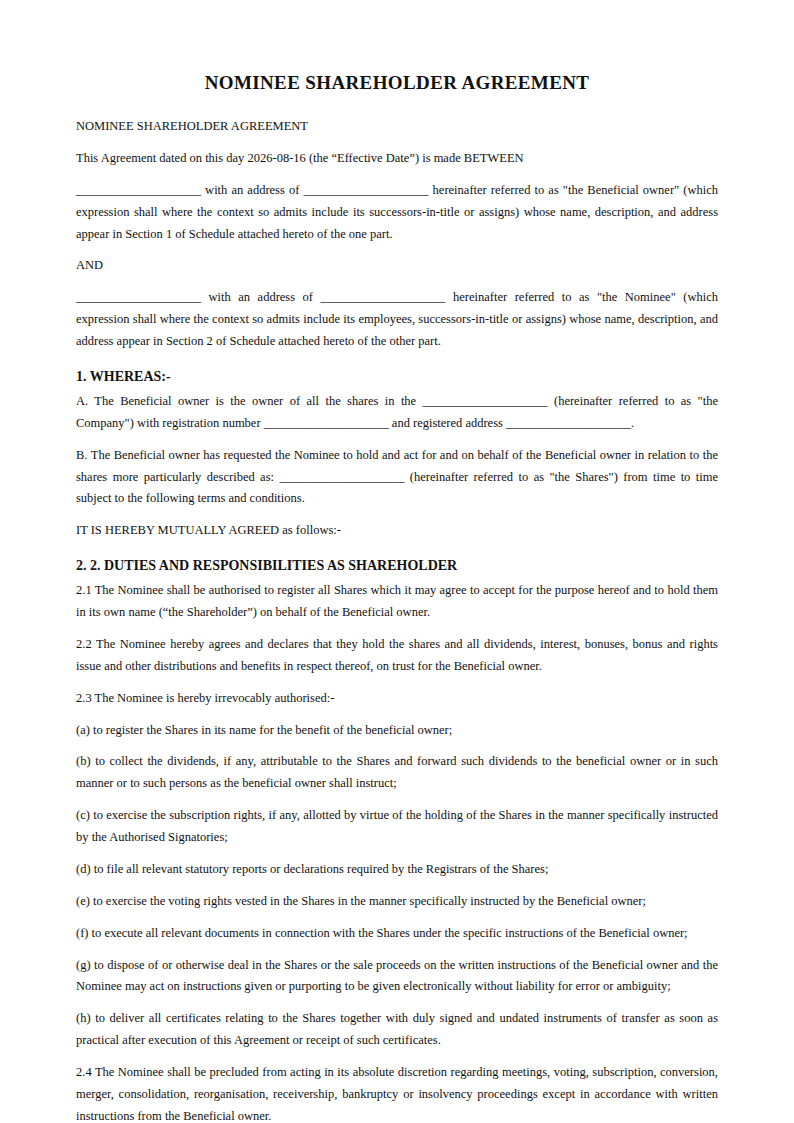
What a nominee shareholder agreement is
A nominee shareholder agreement records that shares registered in one person's name are actually held for somebody else.
The nominee appears on the company's register of members and looks, to the outside world, like the owner. The beneficial owner is the person genuinely entitled to the shares, the dividends and the proceeds of any sale.
The agreement is what makes that relationship enforceable. Without it, the beneficial owner is relying entirely on the nominee's honesty, and the register says the nominee owns the shares outright.
The legal landscape here has changed. CAMA 2020 introduced disclosure obligations for persons with significant control, and the Corporate Affairs Commission maintains a beneficial ownership register. Nominee arrangements remain lawful, but the assumption that they keep ownership private no longer holds, and using one to conceal ownership from a regulator is a different matter entirely.
Who needs one
Investors with legitimate reasons for not appearing personally on a register, such as holding through a professional nominee for administrative convenience.
Companies meeting a minimum shareholder requirement where one owner does not want a second person to have real economic rights.
Family arrangements where shares are held for a minor or on behalf of a wider family interest.
Before using one, be clear about why. If the reason is to hide ownership from a regulator, a creditor or a spouse in matrimonial proceedings, this is the wrong instrument and the arrangement is unlikely to survive scrutiny.
Before you start
Settle these points.
Who the beneficial owner genuinely is, since that is what must be disclosed under the persons with significant control rules.
What the nominee may and may not do without instruction, particularly voting and any transfer.
What the nominee is paid.
How the shares are transferred back when the arrangement ends.
And what happens if the nominee dies, since shares registered in their name may otherwise be treated as part of their estate.
The walkthrough
Filling in the form, step by step
Every question you will be asked, what it means, and an example of a good answer.
Step 1 of 2
Nominee Shareholder Agreement
The beneficial owner and the nominee
The agreement names the two people whose relationship it governs.
The beneficial owner is the person the shares really belong to. Name them fully and accurately, because this document is the evidence of their entitlement. If a dispute arises, or if the nominee dies, this agreement is what distinguishes the beneficial owner from a person making an unsupported claim over somebody else's registered shares.
The nominee is the registered holder. Choose one carefully: they will appear as the owner, and the arrangement depends on their cooperation for voting, dividends and any eventual transfer. Professional nominees exist for this reason, and a friend who agrees informally is a weaker choice than people assume.
Both addresses matter, because notices and instructions pass between them throughout the arrangement.
- Date of the Agreement
- The date the arrangement is made. Where the shares were already registered in the nominee's name before this agreement, note the earlier history rather than implying the arrangement began today.
- Beneficial Owner's name
- The person the shares genuinely belong to, named in full. This document is the evidence of their entitlement, and it is what separates them from somebody making an unsupported claim over shares registered to another person.
- Beneficial Onwer's Address
- The beneficial owner's address, where dividends, notices and instructions are directed. Keep it current, since the arrangement depends on communication between the two parties.
- Nominee's name
- The person or firm who will appear on the register of members as holder. Choose carefully: the arrangement depends on their cooperation for voting, dividends and the eventual transfer back.
- Nominee's Address
- The nominee's address. This is often what appears on company records, so it should be somewhere that reliably receives corporate correspondence.
Step 2 of 2
Nominee Shareholder Agreement
The company, the shares and the fee
This step identifies exactly what is being held and on what terms.
Give the company's registration number as well as its name. Names can be similar and change; the registration number is the identifier that cannot be confused, and it is what a registry search runs on.
Describe the shares precisely: how many, what class, and what proportion of the issued capital. The nominee holds these specific shares and no others, and a vague description creates room for argument about what was covered, particularly if the nominee holds shares in the same company for more than one person.
The fee is the nominee's compensation. Professional nominees charge an annual fee; a friend acting informally may charge nothing, and it is worth stating that expressly rather than leaving the arrangement to be characterised later.
What the form does not ask, and what the agreement genuinely needs, is the instruction mechanism: that the nominee votes only as directed, accounts for dividends received, and transfers the shares back on demand. Those obligations are the substance of the arrangement.
- Name of the Company
- The company whose shares are held, using the registered name from the certificate of incorporation.
- Registration Number of the Company
- The CAC registration number. Company names can be similar or change over time, and the registration number is the identifier that cannot be confused, which is what a registry search actually uses.
- Company's registered office address
- The company's registered office as recorded at the CAC, which identifies the entity beyond doubt.
- Description of the shares
- The specific shares held: how many, what class, and what proportion of the issued capital. Precision matters, particularly where the nominee holds shares in the same company for more than one beneficial owner.
- Fees to be paid to the nominee
- What the nominee is paid, and how often. Professional nominees charge an annual fee. Where the nominee acts without charge, say so expressly rather than leaving the basis of the arrangement to be worked out later.
Ready to make yours?
Answer those questions in the builder and download a finished nominee shareholder agreement in Word and PDF.
Start now, ₦10,000After you download it
Disclose beneficial ownership
CAMA 2020 requires disclosure of persons with significant control, and the CAC maintains a beneficial ownership register. A nominee arrangement does not remove that obligation.
Add the instruction and transfer terms
The form does not ask, so add them: the nominee votes only as directed, accounts for dividends, and transfers the shares back on demand. Those obligations are the point of the agreement.
Take a signed blank transfer form
A pre-signed share transfer form held by the beneficial owner makes recovery possible if the nominee becomes uncooperative or unavailable.
Plan for the nominee dying
Shares registered in their name may be treated as part of their estate. The agreement, and evidence of it held safely, is what protects the beneficial owner against that.
Questions people ask
What is a nominee shareholder?
Somebody who appears on a company's register of members as the holder of shares that actually belong to another person, the beneficial owner.
Are nominee shareholders legal in Nigeria?
Yes, but CAMA 2020 requires disclosure of persons with significant control and the CAC maintains a beneficial ownership register, so the arrangement no longer keeps ownership private.
What does the agreement need to say?
Beyond identifying the parties and shares, it should require the nominee to vote only as directed, to account for dividends received, and to transfer the shares back on demand.
What happens if the nominee dies?
Shares registered in their name may be treated as part of their estate. A properly executed agreement, held safely, is the beneficial owner's protection against that outcome.
Can a nominee arrangement hide ownership?
Not from the CAC, given the beneficial ownership disclosure requirements. Using a nominee to conceal ownership from a regulator or a creditor is a different matter and unlikely to survive scrutiny.
How does the beneficial owner recover the shares?
Through the transfer mechanism in the agreement. Holding a pre-signed blank transfer form makes recovery practical if the nominee becomes uncooperative.
Documents that go with this
Terms used on this page
Nominee Shareholder
A nominee shareholder holds shares in their own name on behalf of somebody else. It is lawful, it is common in Nigeria, and it is only as safe as the written agreement behind it.
Beneficial Owner
A beneficial owner is the real person behind a shareholding or an asset, as opposed to whoever appears on the register. CAMA 2020 requires Nigerian companies to disclose them.
Share Transfer
A share transfer is the sale or gift of shares from an existing shareholder to somebody else. It is not complete when the money is paid. It is complete when the company enters the new owner in its register of members.
Statutory Registers
Statutory registers are the records CAMA requires a company to keep: members, directors, charges and significant control. They are the first thing anybody buying or investing asks to see.
Share Capital
Share capital is the value of shares a company has issued or is permitted to issue. It is not cash in the bank, and the figure you declare at the CAC drives your registration cost.
Corporate Affairs Commission (CAC)
The Corporate Affairs Commission is the federal agency that registers and regulates companies, business names and incorporated trustees in Nigeria. If a business is legally registered here, the CAC is where that happened.
Trustee
A trustee holds and manages property for the benefit of somebody else. They control the asset but never own it for themselves, and the law holds them to a high standard.
Company
A company is a business registered at the CAC as its own legal person, separate from the people who own it. It signs contracts, owns property and owes debts in its own name, which is what keeps those debts away from your personal bank account.
Read more on this
Founders Vs. Shareholders
When building a company, it’s important to understand the distinct roles of founders and shareholders and the legal documents that formalize their relationships. Founders: Globally, roughly 40 million startup companies a…
Business Name vs Limited Liability Company (Ltd) vs Public Company (Plc)
Business Name vs Limited Liability Company (Ltd) vs Public Company (Plc) — A Practical Guide In Nigeria the Corporate Affairs Commission (CAC) and the Companies and Allied Matters Act (CAMA) provide the legal framework f…
11 Essential and Protective Documents Needed by a Startup Company
Business Plan Certificate of Incorporation, Memart, Art. of association, Status Report Founders’ Agreement Service Level Agreements Non-Disclosure Agreement Employee Contracts Intellectual Property Agreements Shareholder…
Step by step guides for every document on LegalDoc
Browse all guides