
How to Write a Travel Consent Letter for a Child
Immigration officers stop children travelling without both parents. This letter is what gets them through, and the detail on it is what makes it credible.
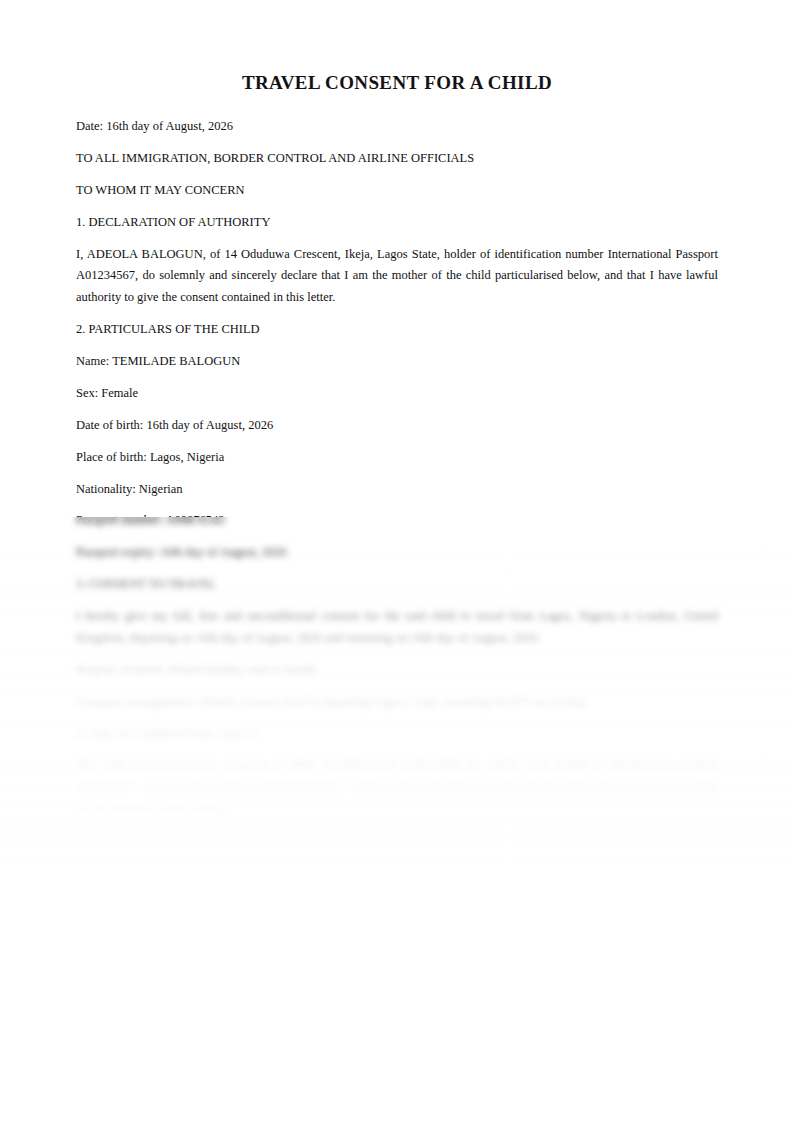
What a travel consent for a child is
A travel consent letter is a written statement from a parent or guardian confirming that a child has permission to travel.
It exists because of child trafficking and parental abduction. Immigration and airline staff are trained to question a child travelling without both parents, and they are right to. The letter answers those questions before they are asked: who the child is, who is travelling with them, who consented, and how the absent parent can be reached.
It is not a Nigerian formality. Immigration authorities in destination countries frequently ask for it, airlines ask for it at check in, and a family arriving without one can find a child refused boarding.
The letter carries more weight when it is notarised or sworn as an affidavit, and many destinations effectively expect that. Given what it is for, the extra step is worth taking.
Who needs one
Parents sending a child abroad with one parent, a relative, a family friend or a school group.
Children travelling unaccompanied, where the airline runs its own unaccompanied minor process alongside this letter.
Separated or divorced parents, where a child travelling with one parent should carry the consent of the other parent.
Guardians travelling with a child who is not legally theirs, which attracts more scrutiny than any other arrangement.
Even where both parents travel together, a copy of the birth certificate is worth carrying, since surnames do not always match.
Before you start
Have these to hand.
The child's passport, for the number and expiry date.
The full travel itinerary, including flight numbers and dates.
The details of whoever is accompanying the child, or receiving them at the other end.
The address where the child will stay.
And the other parent's details, since a letter that does not account for the second parent is the one most likely to be questioned.
The walkthrough
Filling in the form, step by step
Every question you will be asked, what it means, and an example of a good answer.
Step 1 of 4
Travel Consent for a Child
The child and the trip
The letter opens with the journey itself.
Name the child exactly as their passport does. Officials compare the letter against the passport, and a difference in spelling or in the order of names raises precisely the question the letter exists to close.
Give the destination and origin properly, with the city and country, and both dates. A one way journey with no return date attracts more scrutiny than any other feature of a child's travel, so if the return is genuinely open, be ready to explain it.
The dates should match the tickets. Officials cross reference, and a letter consenting to travel on dates that do not correspond to the booking is worse than no letter at all.
- The child's full name
- The child's full name exactly as it appears in their passport, in the same order. Officials compare the two, and any difference raises the question this letter exists to answer.
- Travelling to
- Where the child is travelling to, with the city and country, for example London, United Kingdom. It should match the itinerary and any visa.
- Travelling from
- Where the journey begins, with city and country. For a multi leg trip, note the full route rather than only the first flight.
- Date of departure
- The date of departure, matching the ticket. Officials cross reference this against the booking, so a mismatch undermines the letter.
- Date of return
- The date of return. A trip with no return date attracts more scrutiny than anything else, so where the return is genuinely open, be prepared to explain why.
Step 2 of 4
Travel Consent for a Child
The child's identity documents
This step establishes who the child is, and the passport details are what officials actually check.
Copy the passport number and expiry date exactly from the document. An error here is the fastest way to have the letter set aside as unreliable.
Check the expiry date while you are looking at it. Many countries require a passport to remain valid for six months beyond the date of entry, and a child refused boarding for a passport expiring in four months is a common and entirely avoidable problem.
The date and place of birth, nationality and sex are all cross referenced against the passport and any visa. Fill them in from the document rather than from memory.
Carry the birth certificate alongside this letter. It is the document that proves the relationship between the child and the consenting parent, which the letter asserts but does not itself establish.
- Sex of the child
- As recorded in the passport. It is one of the details officials cross reference, so take it from the document.
- The child's date of birth
- The child's date of birth, matching the passport and birth certificate exactly.
- Place of birth
- The place of birth as shown in the passport, with city and country.
- The child's nationality
- The child's nationality as stated in the passport. Where the child holds more than one, name the passport being used for this journey.
- The child's passport number
- The passport number, copied exactly from the document. An error here is the quickest way to have the whole letter treated as unreliable.
- The child's passport expiry date
- The expiry date. Check it now: many countries require six months validity beyond entry, and a child turned away for a passport expiring sooner is an avoidable disappointment.
Step 3 of 4
Travel Consent for a Child
You, and the other parent
This step is the consent itself, and the second parent question is the one that matters most.
Name yourself as you appear on the child's birth certificate and on your own identification, and give your passport or identity card number so officials can verify you are who the letter says.
The second parent question is where letters most often fall down. A letter signed by one parent, where a second parent exists and is unaccounted for, is exactly what immigration officers are trained to question, because parental abduction usually looks like a well organised trip with one parent's consent.
Where both parents are alive and share responsibility, the strongest position is a letter signed by both. Where that is impractical, giving the other parent's name, address and phone number lets an official verify the arrangement rather than refuse it.
Where the other parent is deceased, or where a court has granted sole custody, say so and carry the death certificate or court order. Where you genuinely cannot locate them, be ready to explain that, since silence invites the worst interpretation.
- Your full name (parent or guardian giving consent)
- Your full name as it appears on the child's birth certificate and your own identification. Consistency between the documents is what makes the consent verifiable.
- Your relationship to the child
- Whether you are the mother, father or legal guardian. A guardian should carry the court order or documentation establishing that status, since it attracts more questions than a parent does.
- Your home address
- Your home address, which should match your identification where possible.
- Your passport or ID number
- Your passport or national identity card number, so an official can verify that the person consenting is who the letter says they are.
- Your phone number
- A number reachable while the child is travelling, including international dialling code. Officials do call, and an unreachable consenting parent is a serious problem at a border.
- Your email address
- An email address you monitor during the trip, as a second route to reach you.
- Date of this letter
- The date you sign. Officials look at how recent it is, so a letter written months earlier for a different trip is worth replacing with a current one.
- Does the child have a second parent or guardian?
- Whether a second parent or guardian exists. This is the question officials care most about, because a letter from one parent that ignores the other is what parental abduction looks like.
- The other parent or guardian's full name
- The other parent or guardian's full name. Where both parents can sign, that is stronger still. Where the other parent is deceased or you hold sole custody by court order, say so and carry the document.
- The other parent or guardian's address
- Their address, so the arrangement can be verified rather than doubted.
- The other parent or guardian's phone number
- Their phone number with international code. Being able to reach the absent parent is often what resolves a border question in minutes rather than hours.
Step 4 of 4
Travel Consent for a Child
Who travels with the child, and the practical details
The final step covers the arrangements at both ends and the information somebody would need in an emergency.
If an adult is accompanying the child, name them with their identification and their relationship. Officials verify the adult against this letter, so their passport number should be exact. An aunt travelling with a child whose surname differs from hers is entirely normal and entirely questionable at a border unless the paperwork explains it.
If the child is travelling alone, the person receiving them at the other end is the important detail, with a full name, address and reachable phone number. Airlines running an unaccompanied minor service will require this separately as well.
The accommodation address and purpose of travel answer the two questions immigration officers ask most often about any traveller, and answering them in advance shortens the conversation considerably.
The medical section is the part parents skim and should not. Blood group, allergies and conditions are what a hospital abroad would need before treating a child whose parents are in another country. This letter may be the only document with that information on it.
- Will the child travel with an adult?
- Whether an adult is accompanying the child. Travelling alone triggers the airline's unaccompanied minor process, which runs alongside this letter rather than replacing it.
- Accompanying adult — full name
- If accompanied, the full name of the adult travelling with the child, exactly as on their passport, since officials verify the person against this letter.
- That adult's relationship to the child
- That adult's relationship to the child, for example aunt or family friend. Where surnames differ, this is what explains a difference officials would otherwise query.
- That adult's passport or ID number
- Their passport or identity number, copied exactly. It is checked against the document they present at the border.
- That adult's phone number
- Their phone number with international code, so they can be reached during the journey.
- Who will receive the child on arrival?
- If the child travels alone, who receives them on arrival, with full name, address and a reachable phone number. Airlines require this separately for their unaccompanied minor service.
- Flight or transport details
- Flight numbers and dates for each leg, for example the outbound and return services. Officials cross reference these against the booking.
- Purpose of the trip
- Why the child is travelling, for example a school holiday visit to family. It answers one of the two questions immigration officers ask most often.
- Where will the child stay?
- The full address where the child will stay, which is the other question immigration asks. A complete address shortens the conversation considerably.
- Any medical conditions or allergies?
- Any conditions, allergies or medication, for example mild asthma with an inhaler. A hospital abroad may have nothing else to go on while the parents are in another country.
- The child's blood group
- The child's blood group. It seems excessive until it is the only medical information available in an emergency thousands of kilometres from home.
- Emergency contact — name
- Somebody reachable who is not travelling, ideally in Nigeria, who can be contacted if neither parent can be.
- Emergency contact — phone number
- Their phone number with international dialling code, so it can be dialled from the destination country.
Ready to make yours?
Answer those questions in the builder and download a finished travel consent for a child in Word and PDF.
Start now, ₦5,000After you download it
Have it notarised or sworn
A notarised letter or affidavit carries considerably more weight at a border than an unwitnessed one, and some destinations effectively expect it.
Carry the supporting documents
The child's birth certificate, copies of both parents' identification, and any custody order. The letter asserts the relationship; those documents prove it.
Get both parents to sign where possible
A letter signed by both parents answers the question officials are actually asking. One signature with the second parent unaccounted for is what triggers scrutiny.
Give the travelling adult a copy
They need it at check in and at immigration. A letter sitting in a parent's file at home protects nobody.
Questions people ask
Does a child need a consent letter to travel from Nigeria?
It is not a universal legal requirement, but immigration and airline staff routinely question children travelling without both parents, and a letter is what resolves those questions quickly.
Should both parents sign?
Where both are alive and share responsibility, yes. A letter from one parent that does not account for the other is precisely what officials are trained to scrutinise.
Does the letter need to be notarised?
It carries much more weight notarised or sworn as an affidavit, and some destinations effectively expect it. Given what the document is for, the extra step is worth taking.
What if the other parent is deceased or absent?
Say so in the letter and carry the evidence: a death certificate, or a court order granting sole custody. Silence about a second parent invites the worst interpretation.
What documents should travel with the letter?
The child's birth certificate, copies of both parents' identification, any custody order, and the child's passport. The letter asserts the relationship and those documents prove it.
What if the child is travelling alone?
Name the person receiving them with a full address and reachable phone number. The airline's unaccompanied minor service is a separate process that runs alongside this letter.
Documents that go with this
Terms used on this page
Guardianship
Guardianship is legal responsibility for a child who is not your own, or for an adult who cannot manage their own affairs. For parents, the point of it is naming in advance who takes care of your children if you are not there.
Child Custody
Child custody is the court decision about who a child lives with and who makes decisions for them after a separation. In Nigeria the only test that matters is the welfare of the child.
Affidavit
An affidavit is a written statement of facts that you swear is true, signed in front of someone authorised to take oaths. Once sworn, it becomes evidence a court or government office can rely on.
Notary Public
A notary public is a legal practitioner authorised to witness signatures, administer oaths and certify documents, particularly for use abroad. Their seal is what makes a Nigerian document acceptable overseas.
Next of Kin
Next of kin is the person you name on a form as your closest relative and first point of contact. In Nigeria it is widely believed to decide who inherits your property. It does not.
Maintenance
Maintenance is financial support for a child or a spouse. Both parents owe it to their children regardless of whether they were married, and it is the child's entitlement rather than the other parent's.
CERPAC
CERPAC is the residence and work card a foreign national needs to live and work in Nigeria. It sits on top of the employer's expatriate quota, not on its own.
Marriage
Marriage in Nigeria comes in three forms: statutory, customary and Islamic. They are governed by different laws, dissolved by different courts, and they produce different rights over property and inheritance.
Read more on this
Travel Consent for a Child in Nigeria: What Parents Must Know
Travel Consent for a Child in Nigeria: What Parents Must Know Before Any Domestic or International Trip Taking a child on a trip sounds routine until the paperwork comes into play. The moment a child is traveling alone,…
Travel Consent for a Child in Nigeria: Template and A-Z Guide
Travel Consent for a Child Traveling with Grandparents, Relatives, or a School: Compliance Guide
Travel Consent for a Child Traveling with Grandparents, Relatives, or a School: Compliance Guide When a child is traveling without both parents, the paper trail matters almost as much as the ticket. That is true whether…
Step by step guides for every document on LegalDoc
Browse all guides