
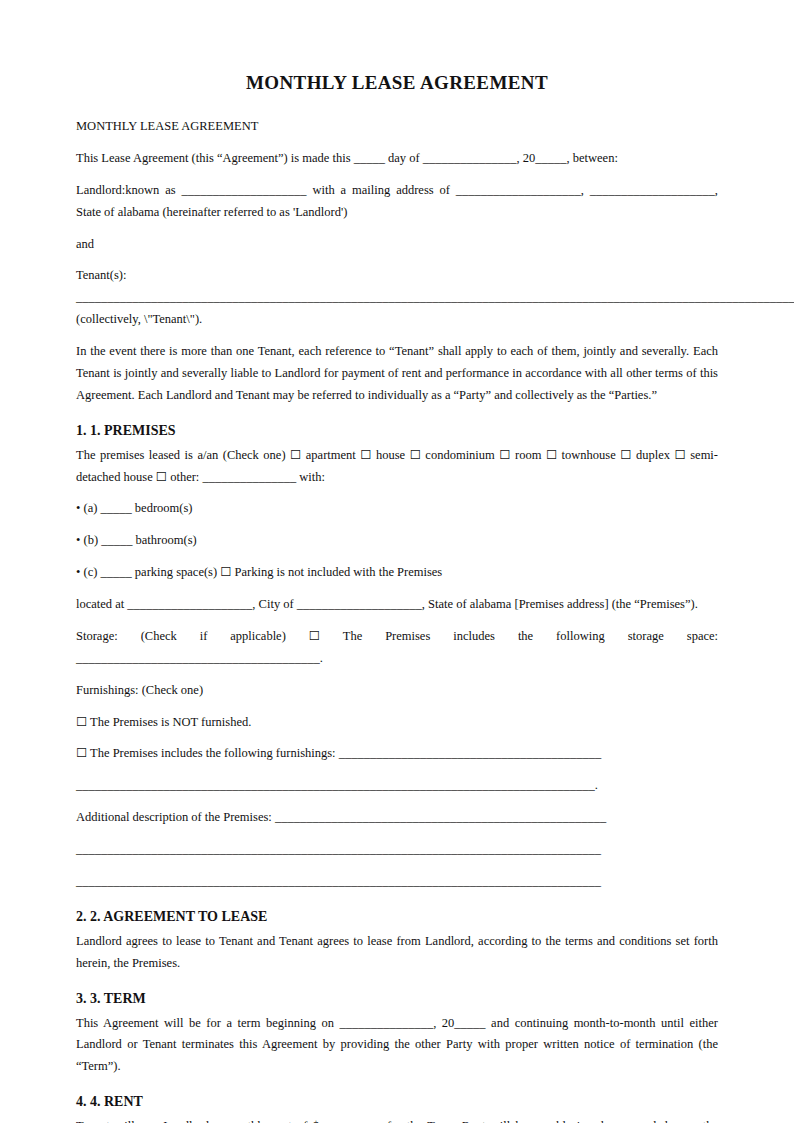
Month-to-Month Lease Agreement: How It Works
This is a United States form, with a state dropdown covering the fifty states. A month-to-month lease creates a tenancy that renews automatically every month until either the landlord or the tenant gives notice to end it.
If the property is in Nigeria, you want a Nigerian document instead. Use our tenancy agreement for residential lettings or the standard lease agreement for longer terms, and read the essential clauses in a Nigerian tenancy agreement before you sign anything. The section near the end of this guide explains how a Nigerian monthly tenancy differs, because the differences are substantial.
Month-to-Month Against a Fixed Term
A fixed term lease runs for a set period, commonly a year. Neither side can end it early without a break clause or a breach, and at the end it either renews or the tenant leaves.
A month-to-month tenancy has no end date. It continues until somebody gives notice, which makes it flexible for both sides and uncertain for both sides.
It suits a tenant who may need to move, a landlord planning to sell or renovate, a trial period with a new tenant, and the gap after a fixed term expires while both parties decide what to do. The trade off is that a tenant can be asked to leave on a month's notice, and a landlord can lose a tenant just as quickly.
Notice to End It
This is the clause that defines the arrangement, and the period is set by state law rather than by the parties.
Thirty days is the common requirement, but it is not universal. Some states require sixty days, and some require longer from a landlord than from a tenant, or longer where the tenant has been in occupation beyond a certain period. City ordinances can add further requirements, particularly in rent regulated markets.
So check the rule for the state and the city, and put the correct figure in the agreement. Notice should be in writing, should state the date the tenancy ends, and should be delivered in the way the state prescribes.
The same applies to rent increases. A landlord generally cannot raise the rent mid month, and must give the statutory notice period, which in some places is longer for a larger increase.
Rent, Deposits and Late Fees
State the rent, the day it is due, the method of payment and where it is paid. Say what happens with a partial payment, because accepting one can have consequences for an eviction already under way.
Security deposits are regulated in most states. There are commonly caps on the amount, frequently one or two months' rent, rules on whether it must be held in a separate account, and a deadline after the tenancy ends for returning it with an itemised statement of any deductions. Missing that deadline can cost a landlord penalties well beyond the deposit.
Late fees are also often capped or required to be reasonable, and a grace period may be mandatory. A fee set arbitrarily high is the kind a court will not enforce.
Entry, Repairs and Required Disclosures
A landlord generally needs to give notice before entering, commonly twenty four hours, except in a genuine emergency. Say the notice period and the permitted reasons in the agreement.
Split the repair obligations. The landlord is responsible for keeping the property habitable, which is an implied obligation in most states and cannot be signed away. The tenant is responsible for damage they cause and usually for minor upkeep.
Two federal points apply regardless of state. For housing built before 1978, the landlord must give the tenant the lead based paint disclosure and pamphlet. And the Fair Housing Act prohibits discrimination on protected grounds in advertising, screening and terms, which means the same criteria applied to every applicant.
States add their own disclosures, on matters such as mould, flooding, bed bugs, smoking policy and utilities, so check the list for the state before finalising.
Ending It, and Eviction
When notice is properly given, the tenancy ends on the stated date and the tenant leaves. Deal in the agreement with the move out inspection, the condition required, and the return of keys.
If a tenant does not leave, the landlord's only lawful route is the court eviction process for that state. Changing the locks, removing belongings or cutting off utilities is unlawful self help everywhere in the United States and exposes the landlord to damages, often statutory and often more than the rent owed.
How a Nigerian Monthly Tenancy Differs
If your property is in Nigeria, the framework is state tenancy legislation rather than US state law, and three differences matter.
Notice. Under the Lagos State Tenancy Law 2011, for example, a monthly tenancy requires one month's notice to quit, while a yearly tenancy requires six months. Other states have their own periods, and getting the period wrong invalidates the notice.
Rent in advance. The Lagos law makes it unlawful for a landlord to demand or receive more than six months' rent in advance from a monthly tenant, or more than one year from a yearly tenant. That is the opposite problem from the US one, where the concern is deposit caps rather than advance rent.
Recovery of premises. A Nigerian landlord must serve the correct statutory notices and obtain a court order. Locking a tenant out or removing the roof is unlawful, and our guide on how much notice a Nigerian landlord must give by tenancy type sets out the periods.
Frequently Asked Questions About Month-to-Month Leases
How much notice is needed to end a month-to-month tenancy? Thirty days in many US states, but some require sixty, and some require more from the landlord than from the tenant. The period is set by state and sometimes city law, so check it rather than assuming thirty.
Can the landlord raise the rent at any time? No. A rent increase needs the statutory notice period, cannot take effect mid month, and may be limited where rent regulation applies.
Is this form suitable for a property in Nigeria? No. It is built on US state law. For a Nigerian letting use the tenancy agreement, which reflects Nigerian notice periods and the limits on rent in advance.
Can a landlord keep the security deposit? Only for unpaid rent and damage beyond normal wear, and most states require the deposit to be returned within a set period with an itemised statement. Missing that deadline can make the landlord liable for penalties.
Can a landlord change the locks if the tenant will not leave? No. Self help eviction is unlawful in every US state, and in Nigeria as well. The only lawful route is the court process.
Getting Your Month-to-Month Lease Right
The provisions that decide disputes are the notice period, the deposit handling, the entry rules and the required disclosures for the state.
Answer a few questions and you will have a month-to-month lease prepared, ready to download in Word and PDF. Renting in Nigeria? Use the Nigerian tenancy agreement instead.