
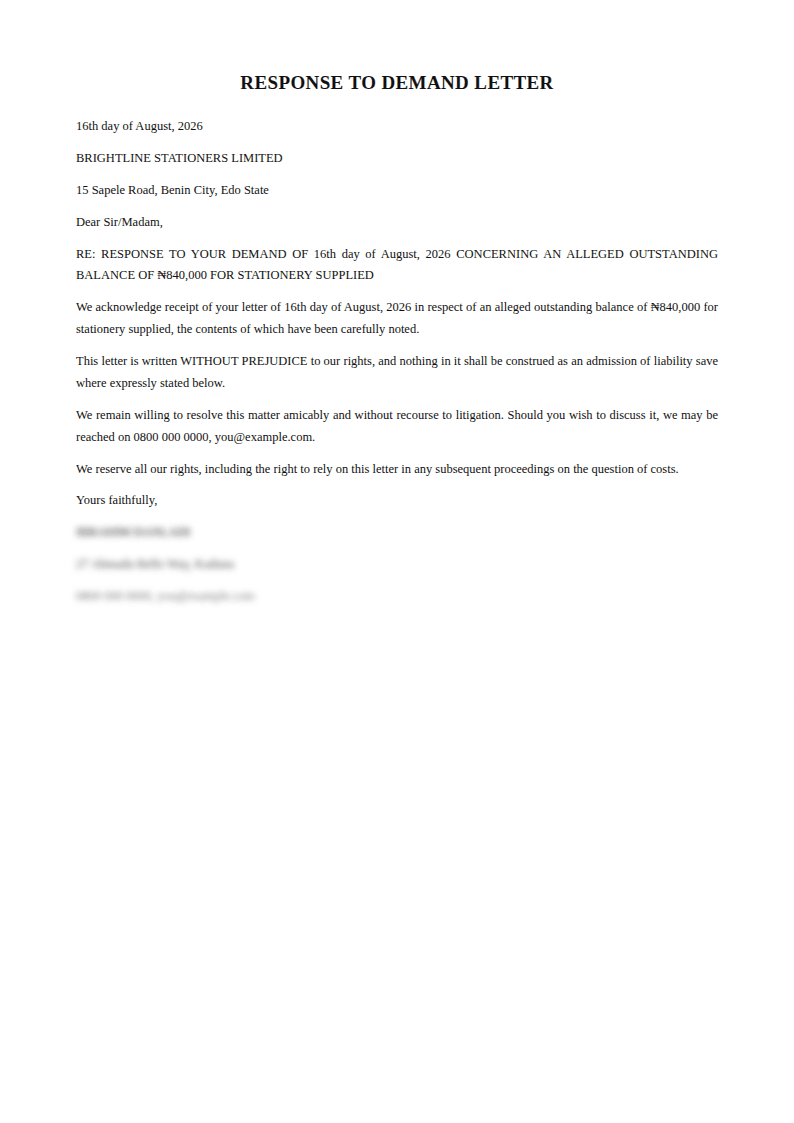
Replying to a Demand Letter in Nigeria
A demand letter has arrived. Somebody says you owe them money and has given you a deadline. What you write back, and whether you write back at all, shapes everything that follows.
The instinct is either to ignore it or to fire off something angry. Both are expensive. A measured written reply protects your position, and in a great many cases ends the matter without anybody going to court.
Why You Should Always Reply
Silence is read as acceptance. If this ends up before a judge, the first thing the other side will produce is their letter and the fact that you never answered it. An unanswered demand looks like a debt nobody disputed.
Replying also forces the other side to be specific. Many demand letters are vague about what is owed and why. Asking for the invoices, the dates and the calculation often reveals that the figure is wrong, or that part of it was already paid.
And it buys you time. A reply that raises a genuine query legitimately pauses the escalation while they answer it.
Before You Write Anything
Check the facts. Pull the contract, the invoices, your bank records. Work out what you actually owe, if anything.
Check the limitation period. Under the Limitation Law of most Nigerian states, a simple contract debt cannot be sued on after six years from when it fell due. If the debt is older than that, say so.
Check who is demanding. Is the letter from the party you actually contracted with? Debts get assigned, and an assignee who cannot show the assignment has a problem.
Decide your position. Broadly there are four: you agree and will pay, you agree but need time, you dispute part of it, or you dispute all of it. Everything in your letter follows from which one is true.
The Four Replies
You accept and will pay. Say so, state the date you will pay, and pay on that date. Do not promise a date you will miss. A broken written promise is worse evidence against you than the original debt.
You accept but need time. Propose a specific schedule with dates and amounts. Ask them to confirm in writing that they accept it and will take no action while you keep to it. Without that confirmation you are paying instalments and still being sued.
You dispute part of it. Set out exactly which part and why. Offer to pay the part you accept. This is often the strongest position, because it shows good faith and narrows the argument to something small.
You dispute all of it. Say so clearly, give your reasons, and invite them to produce the documents they are relying on. Do not simply deny without explanation.
What Not to Put in Writing
Do not admit anything you have not verified. A sentence like "I know I still owe something" will be quoted back at you.
Do not insult them. Every line of abuse is a line their lawyer will enjoy reading to a judge.
Do not make threats. Particularly not threats to report them to the police. A commercial dispute is civil, and threatening criminal process to gain an advantage in it can itself be an offence.
Do not ignore a deadline without asking for an extension. If you need more time to investigate, ask for it in writing and give a date by which you will respond substantively.
Making an Offer Without Handing Over a Weapon
Often the sensible outcome is a settlement for less than the full amount. The difficulty is that an offer can look like an admission.
The usual protection is to mark settlement correspondence "without prejudice". Correspondence that is a genuine attempt to settle a dispute, and is marked that way, is generally not admissible to prove liability. The words are not magic on their own, the letter has to be a real settlement attempt, but used properly they let you negotiate without conceding the case.
Keep the without prejudice offer in a separate letter from your substantive reply. Mixing them muddies both.
How to Send It
In writing, with proof. Email gives you a timestamp. A courier receipt gives you delivery. Keep a copy of everything, including the original demand and the envelope it came in.
Reply to the address on their letter, and to their registered office if they are a company registered at the Corporate Affairs Commission. Reply within their deadline, or write inside it asking for more time.
When to Get a Lawyer Involved
Get advice if the sum is large relative to your means, if the letter is from a law firm and alleges more than a simple unpaid invoice, if there is a threat to wind up your company, or if the claim touches land or a guarantee you signed.
For a disputed invoice or a debt you can evidence was paid, a clear letter from you does the job.
Frequently Asked Questions About Responding to a Demand Letter
What happens if I just ignore it? They can file a claim, and your silence becomes part of their evidence. Judges notice when a demand went unanswered. Replying costs you nothing and removes that point.
Does replying mean I am admitting the debt? Not if the letter is written carefully. Dispute what you dispute, accept only what you have verified, and keep any settlement offer in a separate letter marked without prejudice.
What does without prejudice actually do? Correspondence that is a genuine attempt to settle a dispute and is marked without prejudice is generally not admissible to prove liability. It lets you make an offer without it being used as an admission. The label alone is not enough; the letter must really be a settlement attempt.
How long do I have to respond? Whatever their letter says, usually seven to fourteen days. If you need longer to check records, write inside the deadline and ask for an extension with a date you will reply by.
Can they have me arrested over a debt? A simple commercial debt is a civil matter, not a crime. Threatening criminal process to force payment of a civil debt is improper, and you should say so plainly in your reply if it happens.
Getting Your Reply Right
Read next: how a demand letter is meant to be written, which tells you a good deal about the one you have received. If you need to send your own, use the demand letter.
The replies that work are short, factual, and specific about what is accepted and what is not. The ones that cause damage are the emotional ones and the vague ones.
Answer a few questions and you will have a response written for Nigerian use, setting out your position clearly without conceding anything you have not checked, ready to download in Word and PDF.