
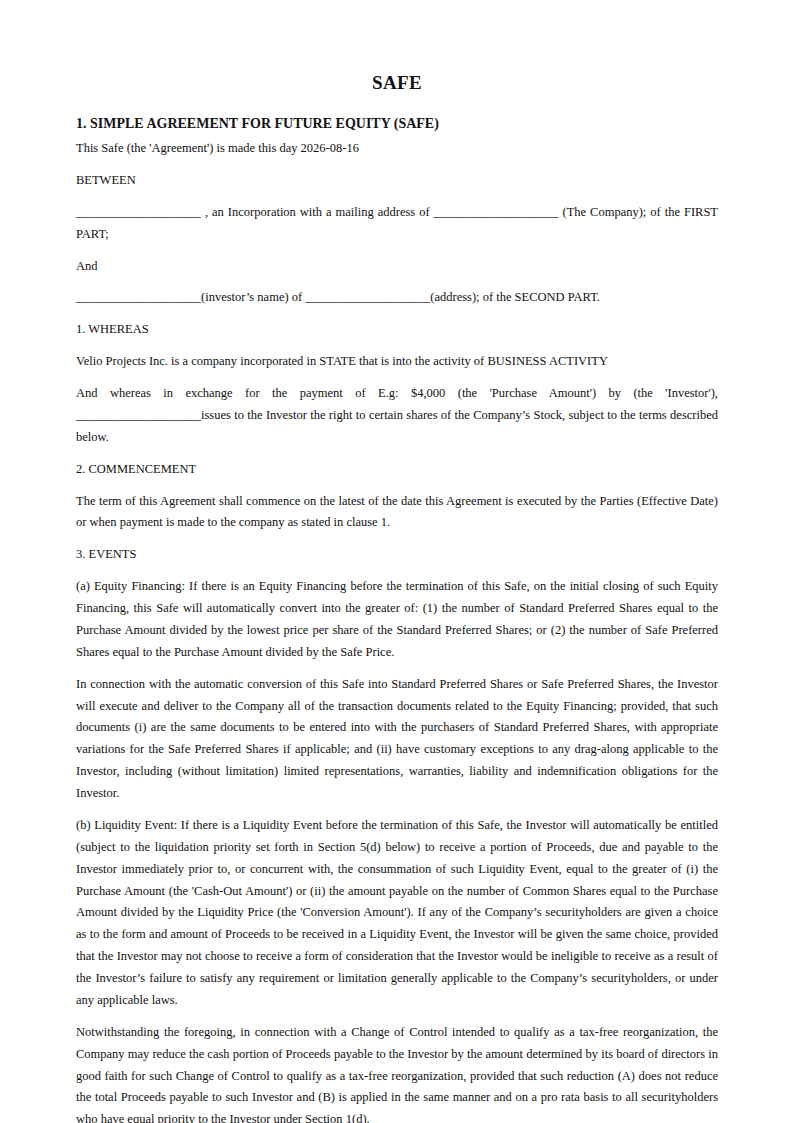
SAFE: Simple Agreement for Future Equity
This is a United States instrument. A SAFE lets an investor put money into a startup now in exchange for shares later, when the company raises a priced round. It was created by Y Combinator in 2013 and became the standard way early stage US startups take money before anybody has agreed a valuation.
A Nigerian company cannot simply use a US SAFE form. The Nigerian equivalents are a convertible loan note or a subscription agreement with conditions, governed by Nigerian law, with the allotment on conversion filed at the Corporate Affairs Commission under CAMA 2020. If you are at this stage, our guide to the legal documents every Nigerian startup needs and the founders agreement are the practical starting points.
Why It Exists
Valuing a company with no revenue is guesswork, and arguing about it burns weeks that a startup does not have. A priced equity round also means lawyers on both sides, term sheets and a closing, which is disproportionate for a small cheque.
A SAFE postpones the valuation. The investor gives money now and gets shares at the next priced round, on terms that reward them for having taken the earlier risk. It is short, standardised, and can be signed without a negotiation, which is the whole point.
It Is Not a Loan
This is the distinction that matters most and it is routinely missed.
A convertible note is debt. It carries interest, it has a maturity date, and if it has not converted by then the investor can demand repayment, which for a startup with no cash is an existential problem.
A SAFE is not debt. No interest, no maturity date, no repayment obligation. If the company never raises a priced round, the SAFE simply does not convert, and the investor's money is gone. That is a considerably friendlier instrument for a founder and a riskier one for an investor, which is why investors ask for a lower valuation cap in exchange.
The Valuation Cap and the Discount
These are the two terms that determine what the investor's money buys.
The valuation cap sets the maximum valuation at which their money converts. Invest a hundred thousand dollars with a five million cap, and if the next round prices the company at twenty million, the investor still converts as though it were five million. The lower the cap, the more shares the investor gets.
The discount gives the investor shares at a percentage below the price paid in the priced round, commonly ten to twenty five per cent.
Many SAFEs have a cap only. Some have both, in which case the investor gets whichever is better for them. A most favoured nation clause is a third variant, letting the investor take the best terms given to any later SAFE holder, which is used where neither side wants to fix a number at all.
Pre-Money and Post-Money, and Why It Changed
The 2018 revision replaced the original pre-money SAFE with a post-money version, and the difference is not cosmetic.
Under the original pre-money SAFE, working out how much of the company each SAFE holder would end up with required solving for several unknowns at once, and the answer depended on how many other SAFEs existed. Founders who had issued five or six of them at different caps regularly discovered at their Series A that they had sold much more of the company than they believed.
The post-money SAFE fixes the investor's percentage of the company as measured after all SAFEs convert but before the new round's money comes in. The investor knows what they are getting. The dilution from later SAFEs falls on the founders rather than on earlier investors.
That is clearer, and it means founders must model the cap table before signing each one. Stacking SAFEs without doing the arithmetic is the single most common and most expensive mistake at this stage.
Conversion, and the Other Two Exits
A SAFE converts on one of three events.
An equity financing. The main route. The SAFE converts into shares at the cap or the discounted round price, usually into the same class of preferred stock the new investors receive.
A liquidity event. If the company is sold or goes public before a priced round, the SAFE holder chooses between getting their money back and converting into common stock at the cap, taking whichever is worth more.
Dissolution. If the company winds up, the SAFE holder ranks ahead of common shareholders for the return of their money, and behind creditors. In an insolvent wind up that usually means nothing.
Pro rata rights, meaning the investor's right to participate in the next round to maintain their percentage, sit in a side letter in the post-money version rather than in the SAFE itself.
What a Nigerian Startup Should Do Instead
If the company taking the investment is registered in Nigeria, three things follow.
Use a Nigerian law instrument. A convertible loan note or a conditional subscription agreement, drafted so that conversion results in a valid allotment of shares. The allotment is then filed with the Corporate Affairs Commission and the register of members updated, because in Nigeria that register is what makes somebody a member.
Get a Certificate of Capital Importation where the money comes from abroad. The receiving Nigerian bank issues it, and it is what allows the investor to repatriate dividends and capital later through the official market. Money that arrives without one is very difficult to take out again, and investors who know the market will ask about it before wiring anything.
Understand the holding company question. Many Nigerian startups raising from foreign funds end up incorporating a US holding company above the Nigerian operating company, precisely so they can issue standard instruments like SAFEs. That has real tax and regulatory consequences in both countries and is a decision to take with advice, not a formality.
Frequently Asked Questions About SAFEs
Can a Nigerian company issue a SAFE? Not a standard US SAFE form. A Nigerian company should use a convertible loan note or a conditional subscription agreement under Nigerian law, with the resulting allotment filed at the Corporate Affairs Commission.
Is a SAFE debt? No. It has no interest, no maturity date and no repayment obligation. A convertible note does have all three, and that is the main practical difference between the two.
What happens if the company never raises a priced round? The SAFE does not convert and the investor generally gets nothing, unless there is a sale or a wind up with assets left. That risk is why investors negotiate the valuation cap.
What is the difference between a cap and a discount? The cap limits the valuation at which the money converts. The discount gives shares below the new round's price. Where a SAFE has both, the investor takes whichever gives them more shares.
Why does a Certificate of Capital Importation matter? For foreign money coming into a Nigerian company, it is the document that supports later repatriation of dividends and capital through official channels. Without it, getting money out again is a serious problem.
Getting Your SAFE Right
The terms that decide how much of your company you have sold are the valuation cap, whether the SAFE is post-money, and how many of them you have signed.
Answer a few questions and you will have a SAFE prepared, ready to download in Word and PDF. If the company is Nigerian, start with the founders agreement and take advice on a Nigerian law convertible instrument.