
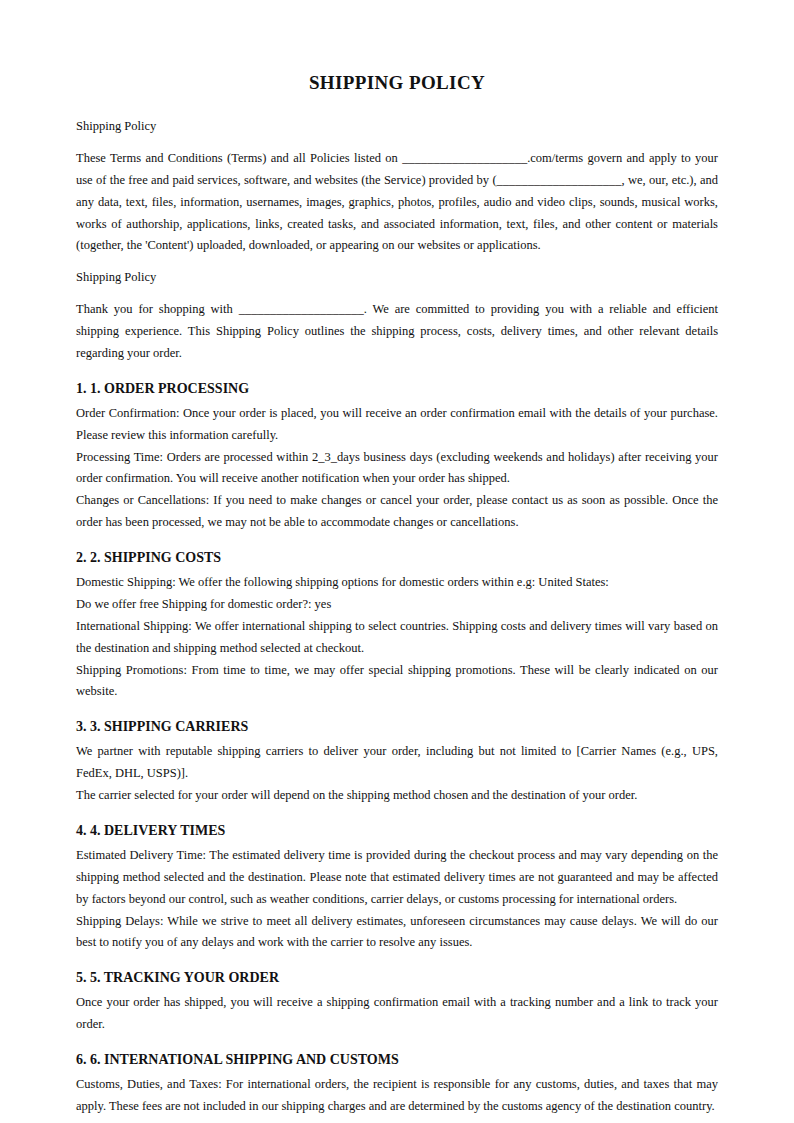
Shipping and Delivery Policy for a Nigerian Business
A shipping policy tells a customer where you deliver, how much it costs, how long it takes, and what happens when a package goes missing. In Nigerian ecommerce that last part is not a detail. It is most of your customer support.
The businesses with the fewest delivery arguments are not the ones with the fastest couriers. They are the ones whose policy said in advance exactly what would happen.
Delivery Zones and Honest Timelines
Nigeria is not one delivery market. Lagos island and mainland behave differently. Abuja, Port Harcourt, Kano and Ibadan are each their own thing. Delivery to a smaller town may depend on a park service or a courier's local agent.
So set out zones, and give each one a realistic range in working days. Same day or next day within Lagos. Two to four working days to other major cities. Three to seven working days elsewhere. Then say plainly that these are estimates and not guarantees, and that they run from dispatch rather than from order.
Resist the temptation to quote the best case. A policy promising forty eight hours nationwide generates a complaint on every order that takes four days, and most of them will.
Costs, and Saying Them Before Checkout
State how delivery is priced: a flat rate, by zone, by weight, or free above a threshold. If your courier quotes at pickup and the cost varies, say so and say how the customer is told the figure before you charge it.
The one thing not to do is surprise somebody after payment. A delivery fee appearing in a WhatsApp message after the order was paid for is the most common source of Nigerian ecommerce disputes, and it is entirely avoidable.
Processing Time Is Separate From Delivery Time
Customers hear one number and assume it is the total. Split them explicitly.
Processing is the time between payment and handing the package to the courier: often one to two working days, longer for made to order items. Delivery is the courier's part. A customer told "one to two working days to dispatch, then two to four in transit" understands a package arriving on day five. A customer told "three days" does not.
Say when your cut off is, and that orders after it are processed the next working day. Say what happens over public holidays, which in Nigeria matter more than most policies allow for.
Who Carries the Risk in Transit
This is the clause worth the most money and the one most often missing.
Say at what point risk passes to the customer: on delivery, or on handing to the courier. Delivery is the customer friendly position and the one most retailers should take, because the customer did not choose the courier and cannot chase them.
Then say what you do if a package is lost or damaged in transit: that you will raise a claim with the courier, and that you will replace or refund within a stated period rather than making the customer wait for the courier's process to finish. Whether you also offer insured delivery as a paid option belongs here too.
Failed Deliveries and Wrong Addresses
Packages fail to arrive for ordinary reasons. Nobody home, phone off, address incomplete, customer travelling, or an address that a courier simply cannot find, which in parts of Nigeria is common.
Say how many attempts the courier makes, what happens after that, whether a redelivery is charged, and how long you hold an undelivered package before returning it to stock. Say that the customer is responsible for giving a correct address and a reachable phone number, and that a redelivery caused by a wrong address may be charged.
Also say how a customer tracks their order and who they contact. A tracking number and one clear channel removes most of the chasing.
Frequently Asked Questions About Shipping Policies in Nigeria
Do I need a shipping policy if I only deliver in Lagos? Yes, and it is easier to write. State your zones within Lagos, the timelines, the cost and what happens when a delivery fails. Most disputes are about those four things, not about distance.
Who is responsible if the courier loses my customer's package? Whoever your policy says, and the fair and usual answer is you, until delivery. You chose the courier and you can pursue them. Making the customer carry a loss they could not prevent damages you more than the package cost.
Can I charge for delivery after the customer has paid? Avoid it. Delivery costs should be stated before payment, or the policy should explain clearly how a variable cost is quoted and agreed before you charge it. Surprise fees after payment are the leading cause of Nigerian ecommerce complaints.
What should I promise on delivery times? Ranges in working days, measured from dispatch, described as estimates. Be conservative. Meeting a four day estimate consistently earns better reviews than missing a two day promise.
What if the customer gives the wrong address? Say in the policy that the customer is responsible for the address and phone number they provide, and that a redelivery arising from an incorrect address may be charged. Then apply that consistently rather than case by case.
Getting Your Shipping Policy Right
Read next: the full shipping policy guide. Pair this with a return and refund policy, because customers read both before they buy.
A shipping policy earns its place by answering the questions before they are asked: where, how much, how long, and what happens when it goes wrong.
Answer a few questions about your zones, couriers and timelines and you will have a shipping and delivery policy written for Nigerian ecommerce, ready to download in Word and PDF.