

Get the document right, then sign it any way you like
Over seventy Nigerian legal documents in Word and PDF, ready to sign on paper or electronically.
Browse the documentsThe client is in Abuja, you are in Lagos, and the contract needs signing today. So they open the PDF on their phone, draw a signature with a finger, and send it back on WhatsApp. Ten minutes, no courier, no printing. Deal done.
But is it? If that client later says they never agreed, will a Nigerian court accept a signature drawn on a screen? For most contracts the answer is reassuring: an electronic signature is valid in Nigeria. The more useful questions are which documents still need ink, and how to make sure you can prove who signed.
The short answer
Yes. Nigerian law recognises electronic signatures. The Evidence Act accepts an electronic signature as proof that a document was signed, and since 2023 expressly covers digital signatures too. The Cybercrimes Act 2015 makes electronic signatures binding for transactions generally. There are exceptions: wills and codicils, family-law matters such as marriage and divorce, court documents, and birth and death certificates. In practice, documents for registration at a lands registry are still signed in ink. For everything else, the real issue is proof, so use a method that records who signed and when.
What the law says
Two statutes do the work.
The Evidence Act 2011 provides that where a rule of evidence requires a signature, an electronic signature satisfies it, provided it can be shown that a procedure was followed to verify it. The Evidence (Amendment) Act 2023 went further, recognising digital signatures and electronic records expressly and setting out how electronic records are authenticated.
The Cybercrimes (Prohibition, Prevention, etc.) Act 2015, in section 17, makes electronic signatures binding in respect of purchases of goods and other transactions, and makes it an offence to forge somebody else's electronic signature. The same section lists the documents the rule does not apply to.
What counts as an electronic signature
An electronic signature is not one thing. It is any electronic method of showing that a person intends to be bound by a document, and some methods are far easier to prove than others.
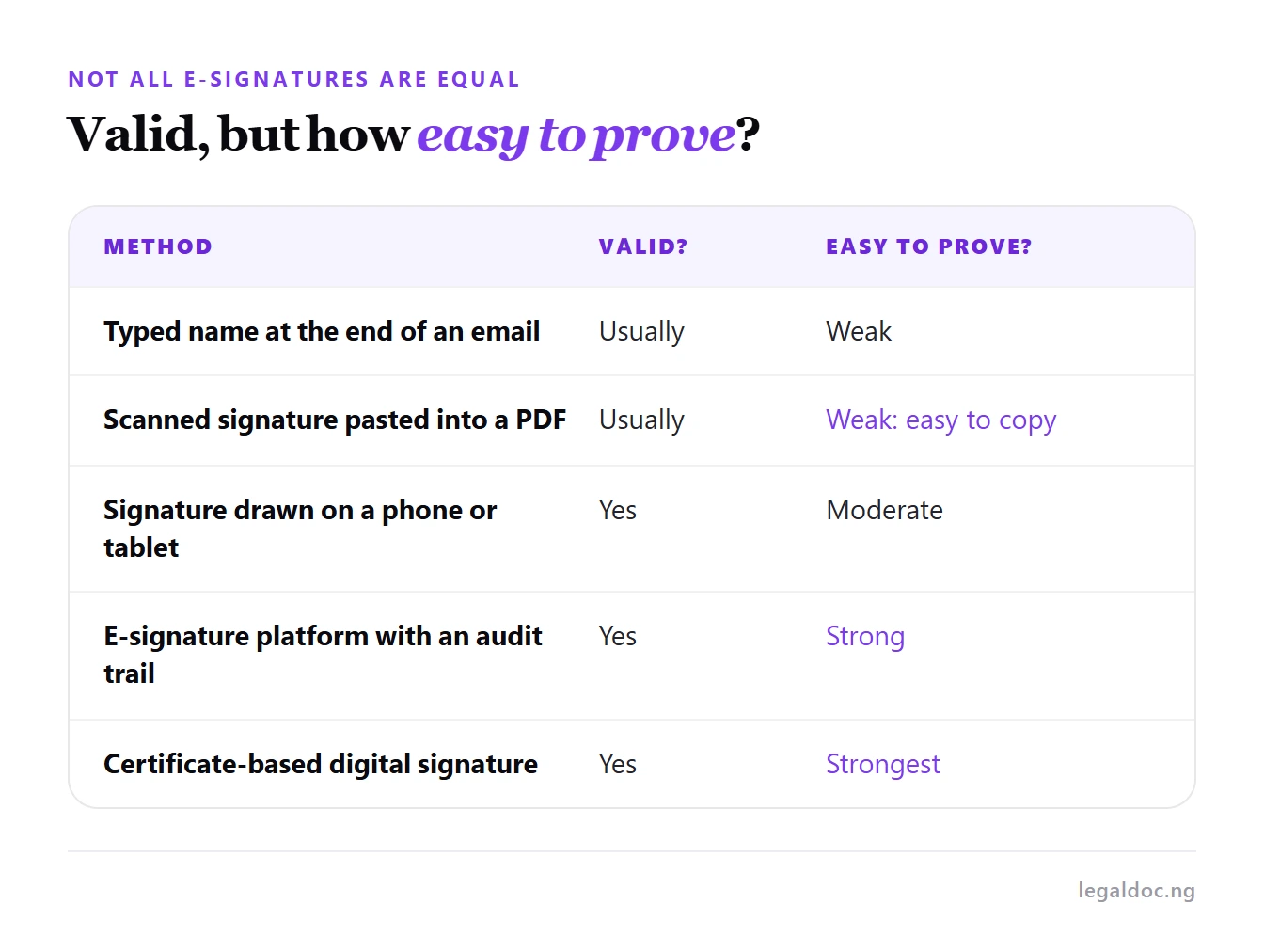
All five can be valid. They are not equally easy to prove.
A typed name at the end of an email, a scanned signature pasted into a PDF, a signature drawn on a phone, a signature through an e-signature platform, and a certificate-based digital signature can all be electronic signatures. The difference is what you can show afterwards. A pasted image of a signature proves very little, because anybody with a copy of it can paste it. A platform that records the signer's email, the time, the device and every view of the document produces evidence that is hard to argue with.
The documents that still need ink
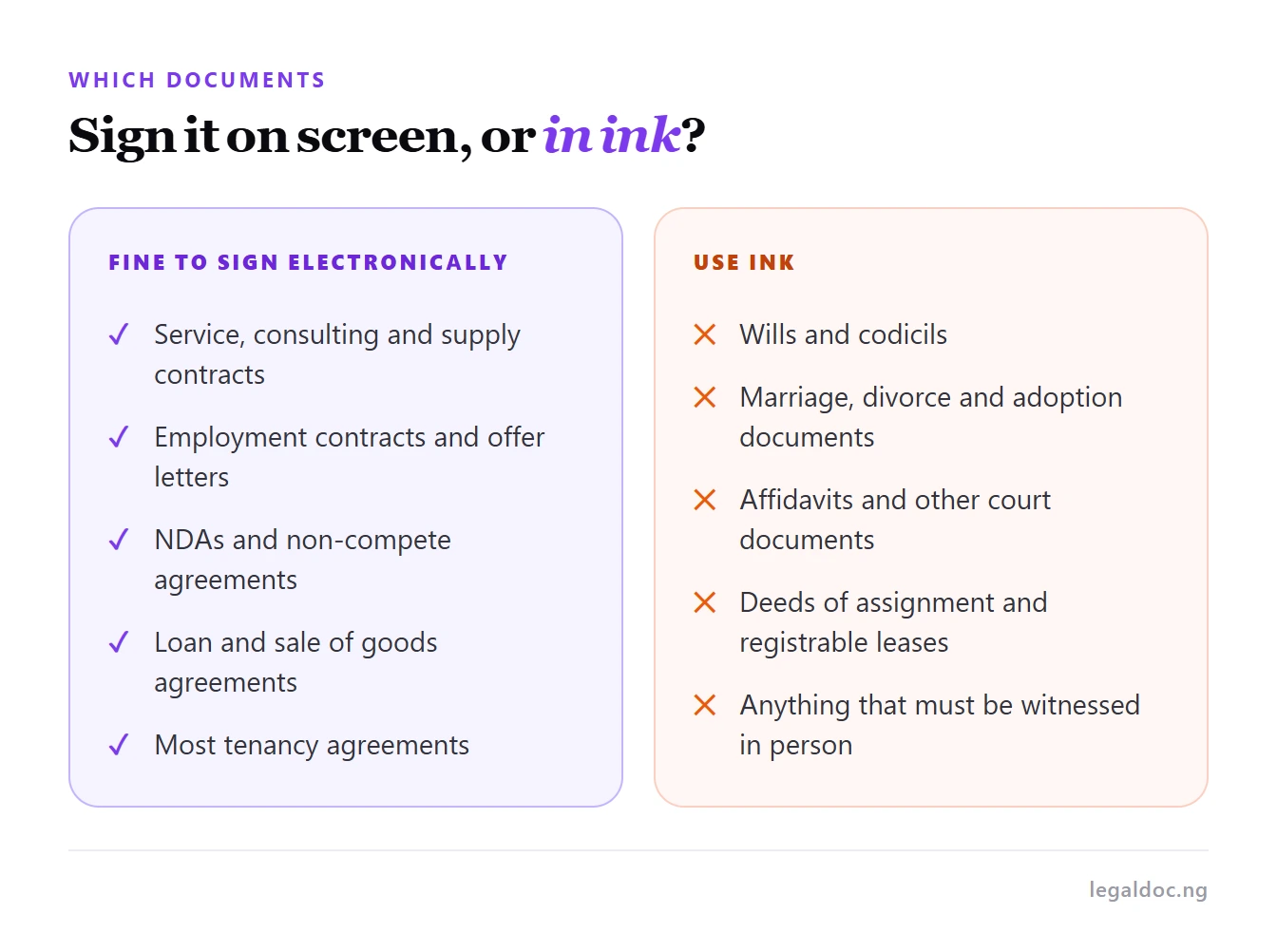
When in doubt about a document that has to be witnessed or registered, use ink.
Wills and codicils. The Cybercrimes Act excludes wills and other testamentary documents from the rule, and the law on wills separately requires the testator to sign in the presence of two witnesses who also sign. Sign a will in ink, with both witnesses in the room. We explain the formalities in how to write a will in Nigeria.
Family-law documents. Matters such as marriage, divorce and adoption are excluded.
Court documents. Affidavits, pleadings, motions and court orders are excluded from the general rule; they follow the court's own rules on filing and signing.
Signed electronically? Ask whether it will hold up
Describe how the document was signed and LegalDoc+ tells you how strong it is under the Evidence Act and what to keep.
Ask LegalDoc+Land documents. A deed of assignment or a registrable lease goes through Governor's consent and the lands registry, which in practice still expect ink signatures and witnesses. Do not take a chance on the document that proves you own land.
Signing for a company
Since the Companies and Allied Matters Act 2020, a company is no longer required to have a common seal. A company can sign through its authorised directors, and for ordinary commercial contracts that signature can be electronic. What matters is that the person signing has authority. If you are dealing with a company, check that the signer is a director or has been authorised, and ask for a board resolution for anything significant.
The real question is proof
Disputes about electronic signatures are rarely about whether e-signing is legal. They are about whether this particular person signed this particular document. Under the Evidence Act, electronic evidence has to be properly authenticated before a court will rely on it, and anybody tendering a computer-generated document will usually need to show how it was produced.
So the practical aim is to create evidence as you sign, not afterwards.
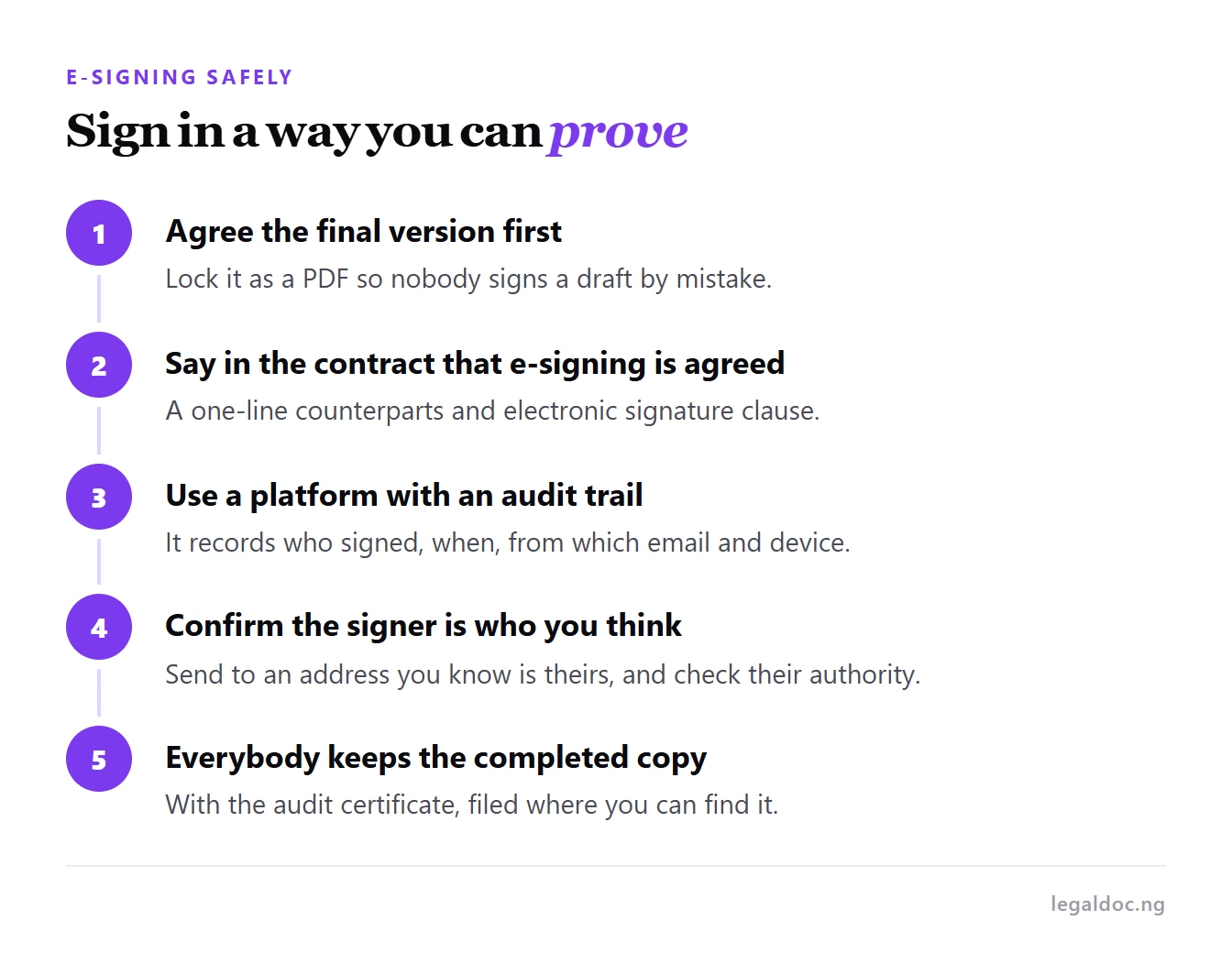
An audit trail made at the time is worth more than any argument made later.
It also helps to say in the contract itself that electronic signing is agreed. A short clause does it: "This Agreement may be signed electronically and in counterparts, each of which is an original and which together form one agreement." It removes any later argument that the parties meant to sign in ink.
What about WhatsApp?
A contract signed on a phone and sent on WhatsApp can be perfectly valid. The weakness is evidential. A screenshot of a signature can be denied, a chat can be deleted, and a photographed page does not show which version was signed.
If WhatsApp is how your business works, strengthen it: send the final PDF, ask the other party to confirm in the chat that they have signed that document and agree to it, export and keep the chat, and keep the signed file. For anything significant, use an e-signature platform instead.
Getting the document right first
An electronic signature only proves that somebody agreed to a document. It cannot fix a document that was wrong to begin with. Every LegalDoc document downloads as Word and PDF, ready to sign in ink or through any e-signature tool, from an employment contract to a non-disclosure agreement.
And if somebody sends you a contract to e-sign, upload it to LegalDoc+ before you click. It reads the whole document in minutes, flags the clauses worth questioning, and tells you if what you have been sent is a document that should not be signed electronically at all.
Frequently Asked Questions About Electronic Signatures in Nigeria
Are electronic signatures legal in Nigeria? Yes. The Evidence Act recognises electronic and digital signatures, and the Cybercrimes Act 2015 makes electronic signatures binding for transactions, subject to listed exceptions.
Is a contract signed on WhatsApp valid? It can be. The harder question is proving who signed which version, so keep the final PDF, a confirmation from the other party in the chat, and an export of the conversation.
Can a will be signed electronically in Nigeria? No. Wills and codicils are excluded from the rule on electronic signatures, and a will must be signed in the presence of two witnesses who also sign. Use ink.
Can a tenancy agreement be signed electronically? A tenancy agreement is a contract and can generally be signed electronically. For a long lease or anything you intend to register at the lands registry, sign in ink with witnesses.
How do you prove an electronic signature in court? By showing it belongs to the person who is said to have signed, which an e-signature platform's audit trail does well, and by meeting the Evidence Act's requirements for electronic evidence.
Does a Nigerian company still need a seal to sign contracts? No. Under CAMA 2020 the common seal is optional, and a company can sign through its authorised directors.
Where this leaves you
For the everyday contracts that keep a business running, an electronic signature is valid in Nigeria and saves days. Keep ink for wills, family documents, court papers and land, and for everything else, sign in a way that leaves a trail: the final version, a reliable platform, and a copy for everybody.